• Privacy Policy
  • Terms & Condition
  • Archive

ARK Foundation

  • Home
  • About
    • About Organization
    • Our Partners
    • Global Networks & Leadership
  • Our Team
    • Advisor
    • Executive Director
    • Research and Development
    • Research Uptake & Communications
    • Programme and Training
    • Finance and Administration
    • Data and Field Management
  • Our Work
    • Communicable Disease
    • Non-communicable Disease
    • Multimorbidity
    • Antimicrobial Resistance
    • Maternal, Newborn, Child and Reproductive Health
    • Nutrition
    • Health Systems
    • Climate Change and Environment
    • Gender, Equity and Social Inclusion
  • News & Media
    • Event
    • News
    • Blog
    • Video
    • Newsletter
  • Resources
    • Journal Article
    • Report
    • Working Paper
    • Project Brief
    • Policy Brief
    • Conference Proceedings
    • Infographics
    • Posters
  • Career
  • Contact
/ Published in News, News and Media

Experts urge policy reforms to strengthen urban health systems in Bangladesh


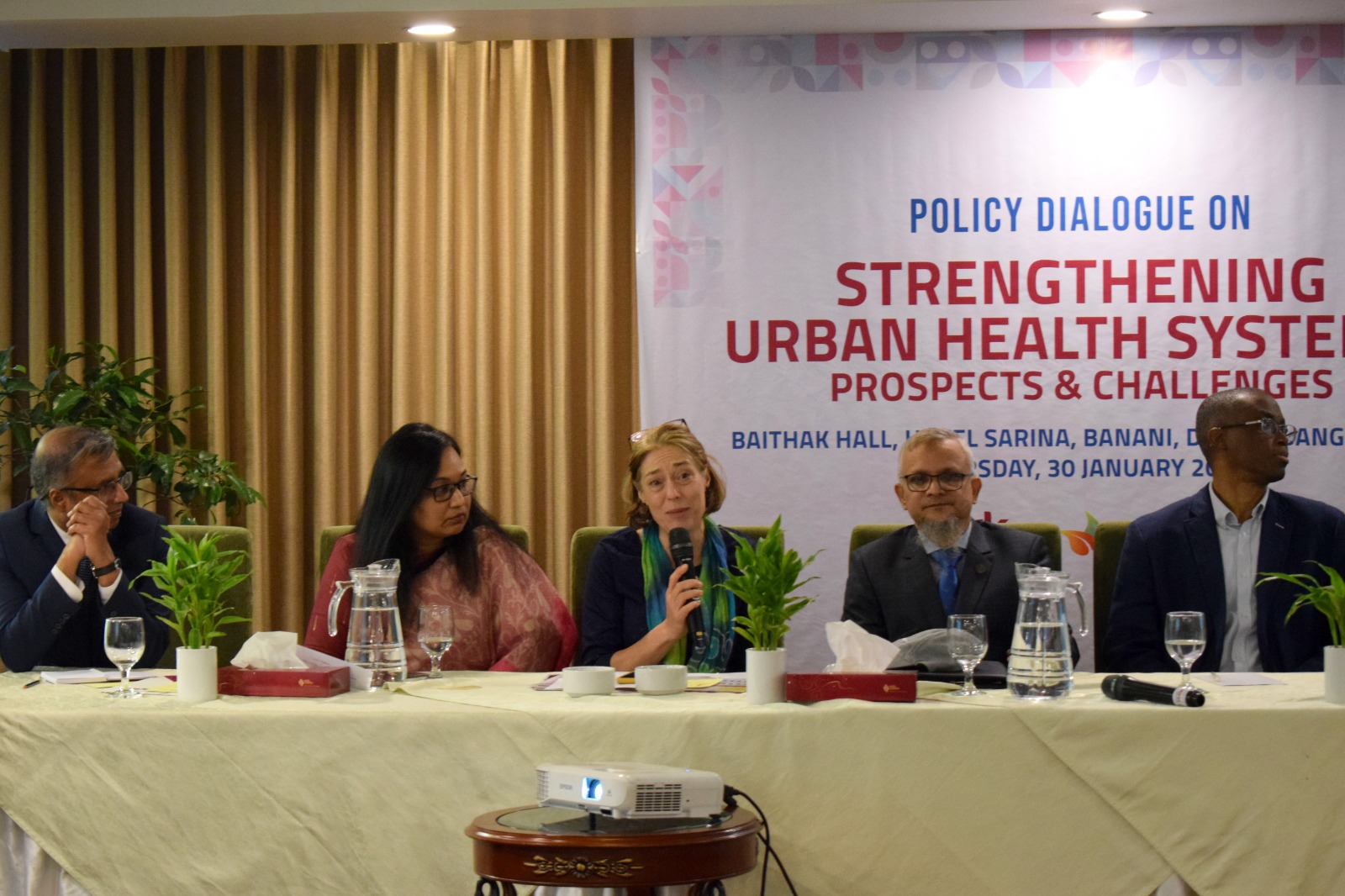
Health policymakers, researchers, and development partners gathered in Dhaka to discuss challenges and prospects for urban health in low- and middle-income countries (LMICs). The policy dialogue, titled Strengthening Urban Health Systems: Prospects & Challenges, was organized by ARK Foundation Bangladesh and BRAC James P. Grant School of Public Health on Thursday (30 January 2025). Experts highlighted the urgent need for evidence-based policy reforms and program interventions to address health inequities in cities.

According to the World Health Organization, a significant portion of the 4.2 billion people living in cities face inadequate housing, poor transport, insufficient sanitation, weak waste management, and poor air quality—posing severe health risks. The urban poor, in particular, have limited access to quality healthcare.

Md Enamul Haque, director general of the Health Economics Unit at the Ministry of Health and Family Welfare (MoHFW), noted that despite existing health financing strategies and urban health policies, weak implementation has hindered primary healthcare in cities. “We require strong coordination among the agencies working in urban areas, including health. Let’s work together to build a healthy society,” he said.

Prof Rumana Huque, executive director of ARK Foundation, emphasized that non-communicable diseases (NCDs) account for most deaths in Bangladesh. She stressed the need to strengthen urban primary healthcare to improve NCD services and reduce out-of-pocket healthcare expenditures.

Experts called for better coordination among government agencies, clearer delineation of roles in urban health management, and the expansion of national protocols on diabetes and hypertension in primary healthcare centers. They also urged improved data linkages between private healthcare providers and the public health system to strengthen service delivery.

“As urban populations grow and diabetes and hypertension become more prevalent, a wide range of private-for-profit, NGO, and informal providers have emerged to meet healthcare demand. Our research highlights the strong need for linkage between public and private providers,” said Prof Helen Elsey, CHORUS co-director.

The event brought together officials from Dhaka South City Corporation and Dhaka North City Corporation, directors from MoHFW, representatives of the Foreign, Commonwealth & Development Office (FCDO), and researchers from Bangladesh, Nepal, Ghana, Nigeria, and the UK.

The dialogue was part of the Community-led Responsive and Effective Urban Health Systems (CHORUS), a research consortium working in Bangladesh, Ghana, Nigeria, and Nepal. CHORUS research indicates that poor urban residents often turn to private and informal providers due to the public sector’s lack of readiness, inadequate resources, and inconvenient service hours.

Originally published in The Business Standard on 01 February, 2025. Read the report here
What you can read next

TB & Tobacco project findings shared in the 50th Union World Conference on Lung Health
স্বাস্থ্য খাতে সমতা নিশ্চিত করা জরুরি
Why does it matter? Childhood obesity among school going children in Urban Bangladesh: Potential Way Forward

Recent Posts

  • The Karlson-Holm-Breen (KHB) Method: Why Logistic Mediation Results Might Be Misleading?

    Read pdf here Written by Ibrahim Hasan and S M ...
  • South Asian Coalition of Policy and Evidence for Equitable food systems (SCOPE)

    The South Asian Coalition of Policy and Evidenc...
  • Fragmentation in urban health service provision? A plurality of providers is the answer

    Read it here or download PDF  Abdullah Rafi, fr...
  • International Women’s Day 2026

      When women give knowledge, care, and lea...
  • In-country public-private partnerships hold the key to promoting inclusiveness in Dutch trade and international cooperation agenda

    Read the PDF here...
  • COVID-19 and Tobacco

    Read the PDF here  ...
  • Taxation on Sugar-Sweetened Beverages (SSBs) in Bangladesh: What should we do?

    Read the PDF here...
  • Public Private Partnership in Improving Access and Utilization of Health Care Services: Scopes, Opportunities and Challenges

    Find the PDF here  ...
  • Influencing TB policy and practice in Bangladesh using a Public-Private Mix approach

    Read the PDF here Policy messages: TB case noti...
  • How can public-private partnerships enhance the use of long acting contraceptive methods in Bangladesh?

    Read the PDF here Using a public-private partne...
  • Improving the quality of care at community clinics in rural Bangladesh through new approaches

    Read the PDF here Key messages The training was...
  • Integrating tobacco cessation within the TB programme: Findings from the ‘TB & Tobacco’ study

    Find the PDF here Integrating tobacco cessation...
  • The Complicated Cigarette Tax Structure in Bangladesh is Causing Expansion of the Low-Tier Cigarette Market and Lower Tax Revenue

    Find the PDF here Implementing a uniform ad val...
  • Digital Health in Dhaka | Simple App | Transforming Urban Healthcare | Channel 24 | ARK Foundation

      Digital health is reshaping urban health...
  • বাংলাদেশে স্বাস্থ্যবিমা: বাস্তবসম্মত সমাধান নাকি শুধু আলোচনা? | Channel 24 | ARK Foundation

    স্বাস্থ্যসেবার ব্যয় কি নাগালের বাইরে চলে যাচ্ছ...
  • Course: Project Management in Public Health

    Download the prospectus from here Introduction ...
  • Precision at Scale: Managing 3,559 Survey Clusters in the World’s Largest Refugee Settlement

    Find the pdf version here or read it here By  Z...
  • The Areca Nut Paradox in Bangladesh: A Rapid Review of Cultural Embeddedness, Public Health Risks, Livelihood Dependence, and Policy Gaps

    Read it here or download the PDF version By Nab...
  • Why does it matter? Childhood obesity among school going children in Urban Bangladesh: Potential Way Forward

    Read the PDF here Written by Badruddin Saify Fo...
  • বৈষম্য কমাতে চাই কার্যকর প্রাথমিক স্বাস্থ্যসেবা | Prof. Dr. Liaquat Ali | ARK Foundation | Channel24

    স্বাস্থ্যসেবা কি শুধু প্রতিশ্রুতির মধ্যেই আটকে ...

Empower Your Career with ARK Foundation

Discover opportunities to make a difference in health, education, gender equality, and environmental sustainability.

JOIN US

ARK Foundation is a non-government, non-political and not-for-profit organization dedicated to the socio-economic development of Bangladesh. Through evidence-based research, training and communications it provides sustainable solutions for health, education and social development.

ADDRESS

Suite A-1, C-3 & C-4, House # 06, Road # 109,
Gulshan-2, Dhaka, Bangladesh, 1212

Phone: +88 02 55069866

Email: info@arkfoundationbd.org

LOCATION

  • GET SOCIAL

© 2025. All rights reserved. ARK Foundation.

TOP