Written by: Kazi Fatin Sami (Research Assistant)
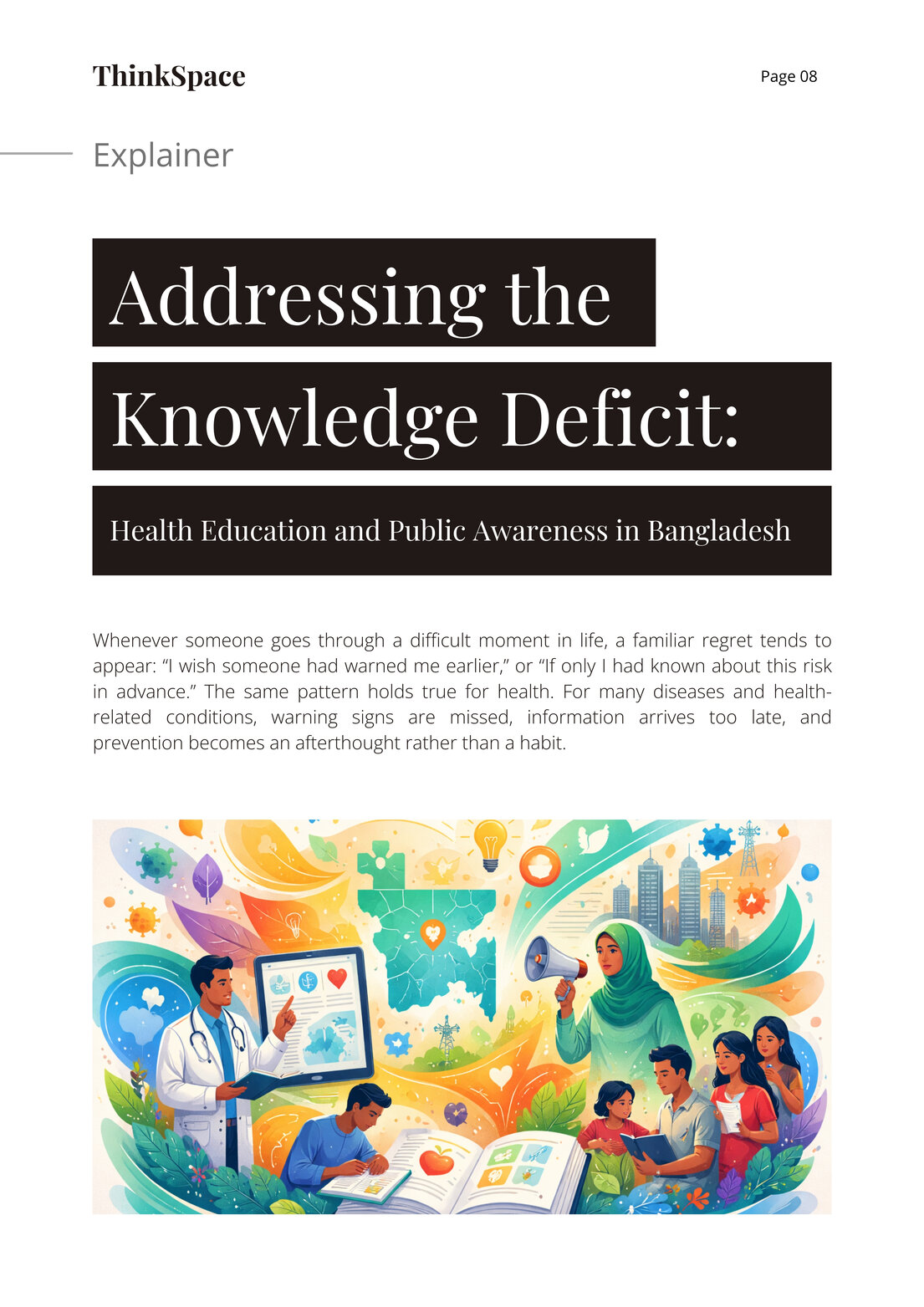
Whenever someone goes through a difficult moment in life, a familiar regret tends to appear: “I wish someone had warned me earlier,” or “If only I had known about this risk in advance.” The same pattern holds true for health. For many diseases and health-related conditions, warning signs are missed, information arrives too late, and prevention becomes an afterthought rather than a habit.
In Bangladesh, the health information gap is hard to ignore. Unlicensed practitioners, fraudulent “supernatural” healers, and medical misinformation still attract people in both rural and urban areas. Self-medication is common, including for medicines that are meant to be taken only under medical advice. Distrust in formal healthcare institutions is also widely observed. All of this raises a difficult question: why does this gap exist, and who is responsible when warning signs are missed or risks are not understood?
The education system is often the first to be blamed. And it is a fair question. If education is meant to prepare people for real life, shouldn’t it also equip them with basic health knowledge that can shape decisions, reduce harm, and save lives?
A quick reality check for readers
Before we go further, consider these questions:
- Do you know how to recognize signs of a heart attack, and what steps to take immediately?
- Do you know that dengue can become more dangerous when the fever begins to subside, and how it differs from a common cold?
- Are you aware that tuberculosis (TB) remains a persistent disease in Bangladesh, and can you recognize key symptoms and prevention measures?
- Do you know how to clean and dress a wound safely?
- Do you understand the EPI (Expanded Programme on Immunization) vaccines, where to get them, and what to do if you’re unsure about schedules?
- Are you familiar with recommended maternal health practices and danger signs during pregnancy and childbirth?
- Do you understand why antibiotic misuse is harmful, and how it links to antimicrobial resistance?
Many of these topics connect directly to major drivers of illness and death. Yet in many communities, especially outside major cities, practical knowledge about prevention and early warning signs remains uneven.
Is the education system ignoring health education?
Not entirely. It would be inaccurate to say schools teach nothing about hygiene, disease prevention, or health-related topics. If you look through primary and secondary textbooks available through NCTB’s online listings, you will find health-related chapters across different subjects. Health content exists.
The problem is not absence. The problem is that health learning often fails to become usable knowledge.
Where do people actually learn health knowledge?
Teaching in Bangladesh is still heavily exam-focused. There is far less attention to real-life application, critical thinking, or changing everyday habits. Outside the classroom, public awareness campaigns on maternal health, immunization, TB, or HIV often have a stronger influence on what people remember and act on. This dependence on media campaigns points to a gap: school lessons do not consistently turn into practical health knowledge that people can apply in daily life.
If you were able to answer the earlier questions, where did your knowledge come from? For many, it traces back to childhood TV programmes (like Meena), public campaigns, newspaper messaging, or billboards, not school chapters. Textbooks are less likely to be the first source that comes to mind and even when they are, it is worth asking how much practical understanding they delivered.
Why isn’t existing health education proving effective?
Health education in the national curriculum doesn’t fail because it’s absent. It fails because it doesn’t land. Health lessons appear here and there across different textbooks, but they don’t build in a clear way from grade to grade. In primary school, students get basic messages on hygiene and nutrition, yet much of it stays general and easy to forget. As they grow older, health content becomes more detailed, but it also becomes more unequal. Students in the science stream are exposed to far more than those who are not, even though health literacy is something everyone needs. Even when the topics are covered, they are often taught as explanations rather than guidance. Students may learn what causes dengue or TB, but not what warning signs should trigger urgent action or what prevention looks like in everyday life. And some of the most common realities of Bangladesh, from infectious disease risks in certain seasons to the growing burden of non-communicable diseases, are not always taught in a practical, memorable way. So students learn enough to answer questions in exams, but not always enough to respond confidently when health decisions matter most.
What can be done?
Bangladesh’s literacy levels are widely reported in the mid-to-high 70% range, with BBS reporting 77.9% functional literacy (age 7+) in 2023(BANBEIS, 2024). This matters because schools remain one of the few platforms that can reach people early, before harmful habits and misinformation become “normal.”
Public health campaigns should continue, since they have played a major role in shaping awareness. But campaigns cannot carry the full burden of health learning for an entire population. The formal education system still has a role that no billboard can replace.
A realistic way forward is to treat health learning as a life skill that grows with age, not scattered facts that students memorise and forget. In early grades, the focus can be everyday habits and safety: hygiene, safe water, diarrhoea prevention, basic nutrition, and simple first aid. In middle grades, learning can reflect what students begin to face more directly: dengue prevention and warning signs, puberty and menstrual health, injury prevention, and how to spot common health misinformation. By secondary school, students can learn the basics that shape adult health: NCD risks (diet, tobacco, inactivity), safe medicine use, and why antibiotic misuse fuels antimicrobial resistance.
The method matters as much as the content. Short role-plays, case scenarios, and “what would you do?” discussions help students build practical judgment, not just exam answers.
Health regrets often begin with the same sentence: “I didn’t know.” If prevention is meant to become normal, health education needs to be taught in ways that stick, travel home, and show up when it matters.
Originally published in ThinkSpace Vol:1 (February, 2026)
References:
- Bangladesh Bureau of Educational Information and Statistics (BANBEIS). (2023). Bangladesh Education Statistics 2023. Ministry of Education, Government of the People’s Republic of Bangladesh.