Written by: Marhouba Khan Asfi (Research Assistant)
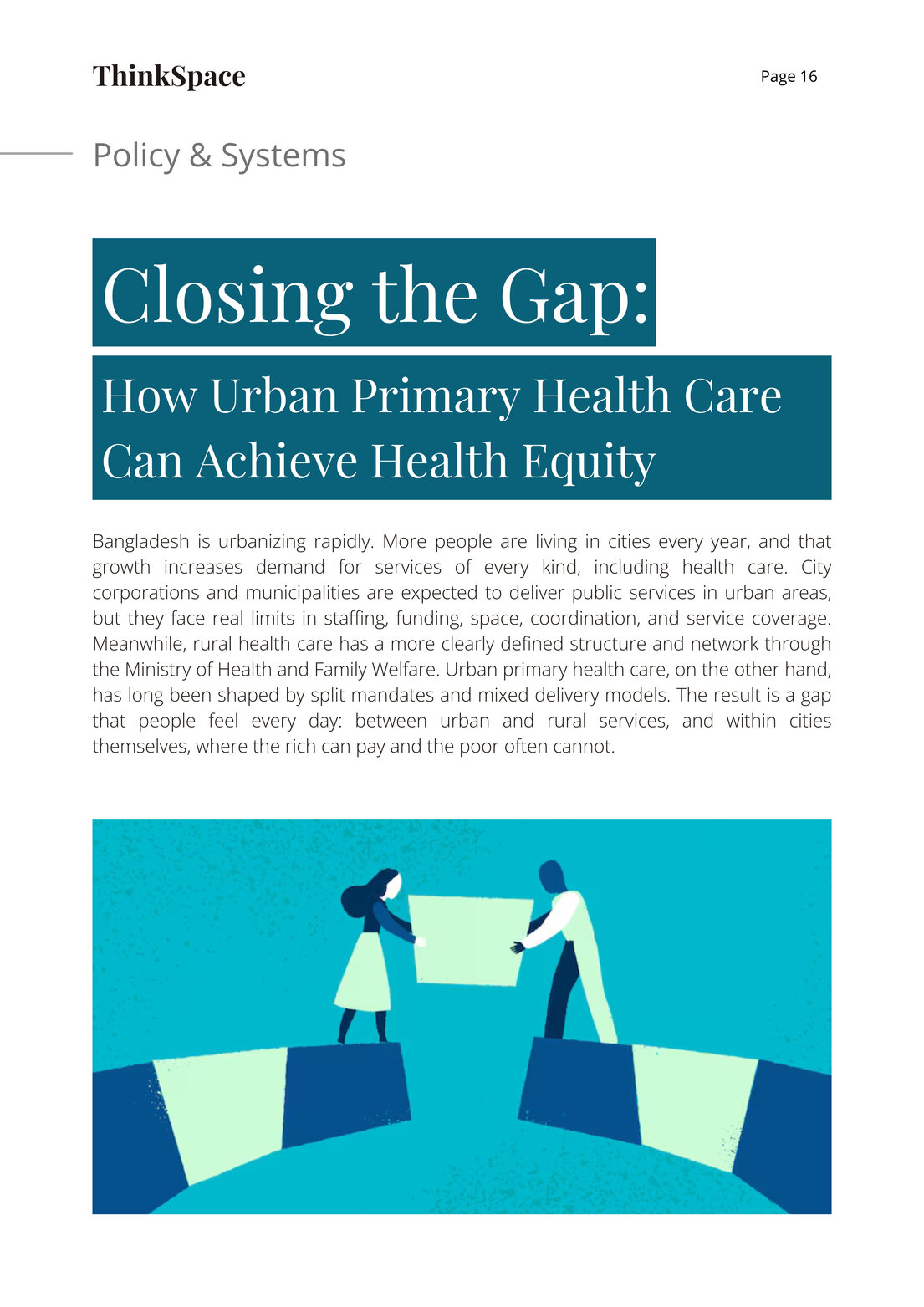
Bangladesh is urbanizing rapidly. More people are living in cities every year, and that growth increases demand for services of every kind, including health care. City corporations and municipalities are expected to deliver public services in urban areas, but they face real limits in staffing, funding, space, coordination, and service coverage. Meanwhile, rural health care has a more clearly defined structure and network through the Ministry of Health and Family Welfare. Urban primary health care, on the other hand, has long been shaped by split mandates and mixed delivery models. The result is a gap that people feel every day: between urban and rural services, and within cities themselves, where the rich can pay and the poor often cannot.
This is what health inequity looks like in practice. The urban poor are more exposed to risk and have fewer safe options when illness hits. Crowded living conditions, weak sanitation and drainage, limited access to clean water, and unsafe working environments can increase vulnerability to disease. At the same time, non-communicable diseases (NCDs) are rising across all income groups, including low-income urban households. NCDs do not behave like a short fever or a one-time infection. They demand screening, counselling, regular follow-up, and referral when complications appear. Yet many urban facilities and affordable clinics are still not set up to deliver that kind of steady, long-term care at scale.
Health equity means everyone has a fair chance to stay healthy and access care without being pushed into financial trouble. In urban areas, inequity often hides in plain sight. Resources are unevenly distributed. People face long waiting times, travel farther than they should for basic services, and struggle with out-of-pocket costs. Skilled providers may be limited where need is highest. Private facilities may be nearby, but they are priced out of reach for many households. When the only “available” care is unaffordable, access becomes a word on paper, not a reality.
Primary health care is the foundation of a functioning health system. When primary care is strong, it reaches people early, helps prevent illness, treats common conditions, manages chronic diseases, and connects patients to higher-level services when needed. Urban primary health care can narrow the equity gap, but only if it is designed around how people actually live and work in cities.
What strengthening urban primary health care should focus on
1) Make primary care reachable in daily life: Equity starts with access that fits real schedules. Urban primary health care centres need to be placed where underserved communities can reach them without spending half a day on transport and waiting. Location matters, but so do operating hours. Many urban residents work long shifts or depend on daily wages. If services are open only during standard office hours, people are forced to choose between income and care. Extending hours into early mornings, evenings, or select weekends can make care possible for those who cannot afford to miss work.
Reachability is not only about a building. Outreach matters, too. Community-based health workers, local partnerships, and clear information on where to go and what services are available can reduce confusion and delay. For families living in informal settlements, the “right” clinic can be hard to identify, and navigating the system can be exhausting. A simple, reliable pathway to care is part of equity.
2) Make urban primary care capable of managing NCDs and long-term needs: Cities are dealing with rising NCD risk, and primary care is where prevention and early management should live. Urban primary health care centres can offer practical services that reduce suffering and lower long-term costs: basic screening, early detection, counselling that matches people’s living conditions, routine follow-up, and referral pathways that actually work.
This is also where continuity becomes a make-or-break issue. A one-time visit does not manage hypertension or diabetes. Patients need follow-up, reminders, and a record of what happened last time. Technology does not have to be complicated for this to work. Even simple digital registers or basic apps can help track visits, document test results, support referral, and follow up with patients. A small improvement in record-keeping can prevent missed follow-ups and repeated “starting over” at every visit. That is a real equity gain, since the people least able to return again and again are often the ones who need continuity the most.
3) Make services reliable and affordable by fixing the basics behind the counter: Many urban primary care facilities struggle with shortages: staff, equipment, diagnostics, medicines, and supplies. When basics are missing, patients are pushed into private markets or informal options, which increases out-of-pocket spending and deepens inequity.
This is where strategic purchasing matters, but it needs plain language. It means buying the right medicines and supplies, from reliable sources, based on what communities actually need, so stock-outs drop and patients are not forced to pay extra outside the facility. It also means planning procurement and service delivery so limited funds are spent on what protects people most, rather than on ad hoc fixes.
Affordability is not only about drug prices. It is about preventing the chain reaction that happens when services fail: repeated travel, repeated tests, time away from work, and partial treatment because money ran out. When a primary care centre is reliable, the “hidden costs” of seeking care shrink.
Urban health equity also depends on what sits outside the clinic. Clean water, safe housing, drainage, waste management, transport, and green space shape exposure and well-being. Health cannot be separated from urban development. Better coordination between local government and health providers can reduce the conditions that keep people sick and make clinics overflow.
Finally, urban Bangladesh needs more equity-focused research that reflects the lived reality of city communities, especially those in informal settlements. Without evidence on who is being left out and why, planning will keep missing the same groups. Equity-focused research can identify gaps, explain the drivers behind them, and support targeted policy recommendations that match local contexts.
A goal that is within reach
Health equity in urban Bangladesh is achievable, but it requires treating urban primary health care as the core of urban health systems, not an afterthought. Stronger access, stronger NCD-focused primary care, and more reliable and affordable services can shift what people experience when they seek help.
A city can build high-end hospitals and still leave millions without basic care. Urban health equity will not be won in the most expensive facilities. It will be won when primary care becomes reachable, trustworthy, and continuous for the people who keep the city running.
Originally published in ThinkSpace Vol:1 (February, 2026)