• Privacy Policy
  • Terms & Condition
  • Archive

ARK Foundation

  • Home
  • About
    • About Organization
    • Our Partners
    • Global Networks & Leadership
  • Our Team
    • Advisor
    • Executive Director
    • Research and Development
    • Research Uptake & Communications
    • Programme and Training
    • Finance and Administration
    • Data and Field Management
  • Our Work
    • Communicable Disease
    • Non-communicable Disease
    • Multimorbidity
    • Antimicrobial Resistance
    • Maternal, Newborn, Child and Reproductive Health
    • Nutrition
    • Health Systems
    • Climate Change and Environment
    • Gender, Equity and Social Inclusion
  • News & Media
    • Event
    • News
    • Blog
    • Video
    • Newsletter
  • Resources
    • Journal Article
    • Report
    • Working Paper
    • Project Brief
    • Policy Brief
    • Conference Proceedings
    • Infographics
    • Posters
  • Career
  • Contact

Midwifery education in Bangladesh is improving women’s access to safe childbirth

by
In association with the British High Commission in Bangladesh, the Directorate General of Nursing and Midwifery (DGNM) and the United Nations Population Fund (UNFPA) organised a dissemination seminar on Wednesday 1 June 2022, at the auditorium of DGNM in Dhaka, to share findings of two studies on midwifery in Bangladesh. ARK Foundation conducted one of
Read more
  • Published in Event, News and Media
No Comments

Stakeholder Workshop on the physical health of people living with severe mental illness including effect of COVID-19 pandemic and its responses in Bangladesh: What has been done so far and way forward

by
Policy Brief  prepared by: Prof. Rumana Huque, Asiful Haidar Chowdhury, Fariha Islam Munia on behalf of IMPASS study Research Team in Bangladesh   ARK Foundation in partnership with National Institute of Mental Health (NIMH) and with the technical support of Department of Health Science, University of York is implementing IMPACT SMI and IMPASS research study
Read more
  • Published in Policy Brief, Resources
No Comments

The Role of the Private Sector in the COVID-19 Pandemic: Experiences From Four Health Systems

by
As societies urbanize, their populations have become increasingly dependent on the private sector for essential services. The way the private sector responds to health emergencies such as the COVID-19 pandemic can determine the health and economic wellbeing of urban populations, an effect amplified for poorer communities. Here we present a qualitative document analysis of media
Read more
  • Published in Journal Article, Resources
No Comments

Health Economics Research Network-HERN launched in Bangladesh

by
ARK Foundation Bangladesh, with the support from Centre from Health Economics, University of York, UK has launched Health Economics Research Network (HERN) in Bangladesh. A number of students complete undergraduate degrees in economics and health economics each year from different public and private universities of Bangladesh. However, they still require the practical experience of applying
Read more
  • Published in Event, News and Media
No Comments

Implementation Status of Non-Communicable Disease Control Program at Primary Health Care Level in Bangladesh: Findings from A Qualitative Research

by
Objective: Bangladesh has 67% of estimated deaths caused by non-communicable  diseases (NCDs). The country aimed to reduce NCD-related premature deaths by one-third by 2030. This study aimed to explore the overall implementation status of the NCD control program at the primary health care (PHC) level in Bangladesh, explore the challenges, and identify the way forward
Health systems strengtheningNon-communicable diseasesPrimary health care
Read more
  • Published in Journal Article, Resources
No Comments

Public Private Partnership in Improving Access and Utilization of Health Care Services: Scopes, Opportunities and Challenges

by
Improved quality and access to healthcare services are essential for a country’s development. Private sectors like NGOs, for-profit and non-profit organizations have significantly contributed to health by financing and managing healthcare services in different ways. Private sector, similar to other countries, brings technology, innovation, financing, and most importantly, additional health workforce – areas that public
Read more
  • Published in Blog, News and Media
No Comments

Men’s Health in Urban Bangladesh: Is the Urban Primary Healthcare System Leaving Men Behind?

by
Abdur Rahim (67) lazily passes his days at his shabby little home in Duwaripara slum. Being a retired day-laborer, he is now financially dependent on his wife’s and daughter’s income, both of whom work as part-time maids for several families in Pallabi, Dhaka. Rahim, sitting at a teastall with a bunch of his contemporaries, expresses
Read more
  • Published in Blog, News and Media
No Comments

CHORUS Blog: Important Yet Ignored: Non-Communicable Diseases in Urban Bangladesh

by
By Tahmid Hasan In Bangladesh, NCDs are estimated to account for 67% of all deaths. In low and middle-income countries, urbanization has been identified as one of the crucial underlying reasons for the increasing trends of NCDs. Bangladesh has also been experiencing rapid urbanization for the past two decades. The urban population of Bangladesh has increased
Read more
  • Published in Blog, News and Media
No Comments

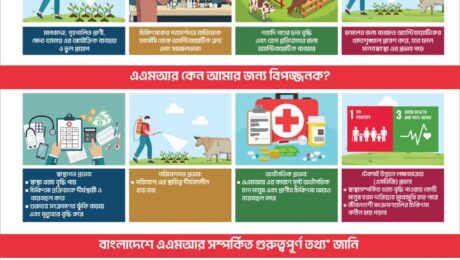
Tackling the Overlooked Pandemic of Antimicrobial Resistance: Community Solutions To Antimicrobial Resistance (COSTAR)

by
By Badruddin Saify, Research Assistant, ARK Foundation   Antibiotic resistance (ABR) arises when bacteria develop resistance to antibiotics. In other words, antibiotics are ineffective against them. It is a common myth that people or animals develop resistance to antibiotics, whereas, in reality, it is germs that become resistant antibiotics.   Vector illustration of superbugs. No
Read more
  • Published in Antimicrobial Resistance, Event, News and Media
No Comments

10 percent increase in the price of cigarettes would reduce overall cigarette smoking among people by 7.1 percent

by
Cigarette price increases are more effective in reducing cigarette demand among poorer people.  A recently conducted research study finds that the demand for cigarettes responds less than proportionately to changes in cigarette price. Moreover, the study finds that an increase in cigarette price by 10 percent results in a 9 percent decrease of cigarette demand
Read more
  • Published in News and Media, Workshop
No Comments
  • 11
  • 12
  • 13
  • 14
  • 15

Recent Posts

  • Why does it matter? Childhood obesity among school going children in Urban Bangladesh: Potential Way Forward

    Read the PDF here Written by Badruddin Saify Fo...
  • How SCIMITAR-SA turns barriers into better support to quit tobacco

    Find the HTML version  SCIMITAR-SA is built aro...
  • Strengthening Tobacco Cessation Through Local Adaptation

    Find the HTML version here  WP1 focuses on adap...
  • 𝐒𝐂𝐈𝐌𝐈𝐓𝐀𝐑-𝐒𝐀 | 𝐒𝐞𝐯𝐞𝐧 𝐒𝐞𝐬𝐬𝐢𝐨𝐧𝐬 𝐭𝐨 𝐐𝐮𝐢𝐭 𝐓𝐨𝐛𝐚𝐜𝐜𝐨

    Find it here A tobacco cessation intervention d...
  • Factors associated with knowledge, attitude, practice and training interest of drug sellers in shaping antimicrobial resistance: A cross-sectional study in urban Bangladesh

    Find the PDF here  or HTML version here  ...
  • Country Case Studies on Implementation of Drowning Prevention Activities

    This study will consist of ten in-depth country...
  • Where antibiotics enter the city: what we are learning with drug sellers in Mirpur

    Written by: Asiful Haidar Chowdhury (Senior Res...
  • Closing the Gap: How Urban Primary Health Care Can Achieve Health Equity

    Written by: Marhouba Khan Asfi (Research Assist...
  • Field Reflections from CHORUS Project 1 and 2: Listening Between Appointments, Streets, and Silence

    Written by: Nabila Binth Jahan (Junior Research...
  • When Public Spaces Aren’t Truly Public: Making Physical Activity Safer for Women and Girls in Urban Bangladesh

    Written by: Umme Salma Anee (Senior Research As...
  • Addressing the Knowledge Deficit: Health Education and Public Awareness in Bangladesh

    Written by: Kazi Fatin Sami (Research Assistant...
  • Behind the Numbers: Verifying Immunization Coverage in the Rohingya Camps

    Written by: Ibrahim Hasan (Research Assistant) ...
  • Field Reality: What We Learned While Assessing Smoke-Free Public Places

    Written by: Lenik Chakma (Research Assistant) I...
  • The Hidden Tax on Health: Why Diabetes is Bankrupting Bangladesh’s Families

    Written by: Sirat-E-Rowshan Islam (Research Upt...
  • Social determinants of health (SDOH) and its relationship with clinical and economic outcomes in people with type 2 diabetes in Bangladesh

    Social determinants of health and its relations...
  • Universal Health Coverage needs more than a bigger budget. It needs institutions and skills

    As the nation is heading towards its 13th natio...
  • Developing and evaluating an adapted behavioral activation intervention for people with depression and diabetes (DiaDeM)

    DiaDeM stands for “Developing and evaluating an...
  • ThinkSpace: Quarterly Research Digest

    ARK Foundation is pleased to launch ThinkSpace,...
  • CHORUS Annual Partners’ Meeting

    The CHORUS Partners’ Meeting officially commenc...
  • আসন্ন নির্বাচনে রাজনৈতিক দলগুলোর কাছে স্বাস্থ্যখাতে প্রত্যাশা

    আগামী ত্রয়োদশ জাতীয় সংসদ নির্বাচনকে সামনে রেখে ...

Empower Your Career with ARK Foundation

Discover opportunities to make a difference in health, education, gender equality, and environmental sustainability.

JOIN US

ARK Foundation is a non-government, non-political and not-for-profit organization dedicated to the socio-economic development of Bangladesh. Through evidence-based research, training and communications it provides sustainable solutions for health, education and social development.

ADDRESS

Suite A-1, C-3 & C-4, House # 06, Road # 109,
Gulshan-2, Dhaka, Bangladesh, 1212

Phone: +88 02 55069866

Email: info@arkfoundationbd.org

LOCATION

  • GET SOCIAL

© 2025. All rights reserved. ARK Foundation.

TOP