Find the PDF here
Written by Riona Khan and S M Abdullah
Imagine a young garment worker in Dhaka. S/he wakes up early, boards a crowded bus, sits for long hours at a sewing machine, returns home exhausted, and spends the evening indoors. The day is full for them, but physically, they have barely moved. Conversely, imagine their cousin in a rural village. S/he walks to the fields, works outdoors, cycles to the market, and socialises in open spaces. Their day, too, is full, but movement is woven into it. These two lives reflect a profound transformation underway in Bangladesh: as the country urbanises, the way people move, or don’t move, is changing.
Physical inactivity is not a minor lifestyle issue. Public health research has consistently highlighted the crucial role of physical activity in enhancing health and well-being, from reducing daily stress to preventing chronic diseases. Globally, around 74% of all deaths worldwide are due to non-communicable diseases (NCDs), and every year approximately 3.2 million deaths are linked to insufficient physical activity.1 Despite this, approximately a quarter of the world population remains physically inactive, according to the recommended World Health Organization (WHO) guidelines.2 This is even worse for low- and middle-income countries (LMICs) where the vast majority (73%)3 of deaths from NCDs take place. Bangladesh is no exception. At first glance, the solution seems simple: move more. But physical activity is not just about personal motivation; it is shaped by where and how we live.
Regardless of where in the world, many find it challenging to commit to exercise. The reasons are diverse, including psychological, physical, socioeconomic, and environmental factors. These barriers vary based on population, culture, and socioeconomic conditions. In developing countries like Bangladesh, obstacles such as poor traffic systems, lack of recreational facilities, fears of crime and harassment, and time constraints are prominent. Conversely, higher-income countries often cite mental health issues and time constraints as common barriers, with environmental factors playing a lesser role.3 Across all nations, modern living has intensified these barriers to physical activity.
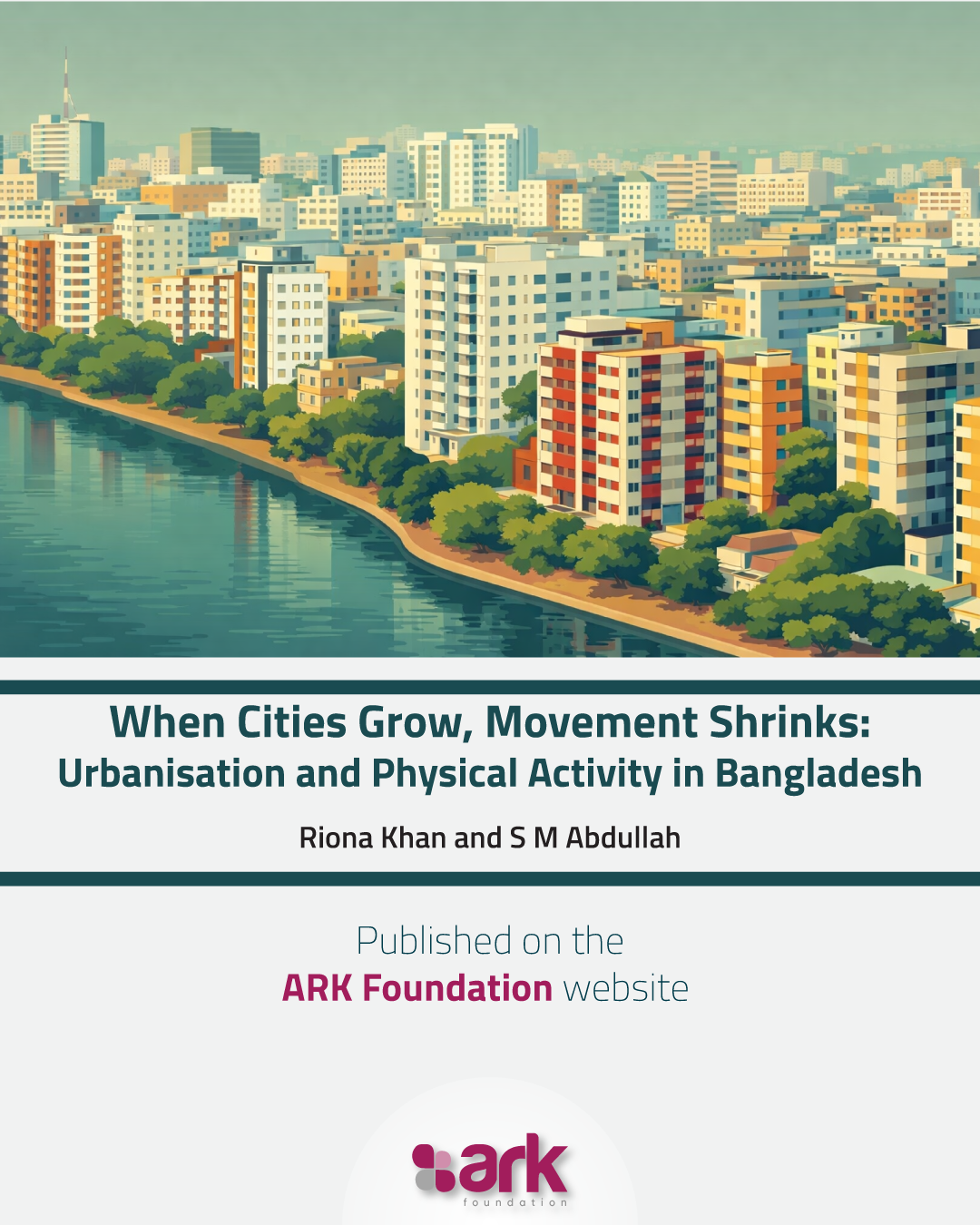
To understand why modern living is especially threatening to physical activity, it would be useful to pan out and observe the evolution of physical activity throughout human history. For most of human history, movement was non-negotiable. Hunting, farming, carrying water, building shelter and survival required physical effort. Industrialisation and technological progress gradually reduced that necessity. Today, screens replace fields, vehicles replace walking, and machines replace manual labour. Physical activity has shifted from being necessary to being optional. Physical activity has now reached an all-time low, exemplified by the negligible change in physical activity globally in the last two decades.3 This reflects a time of exponential economic growth, globalisation and urbanisation with ever increasing access to movement-saving technology. The evolutionary perspective allows us to see where Bangladesh is in the timeline. Bangladesh is currently undergoing this transition at a remarkable speed. Over the past three decades, accelerated economic growth has been accompanied by rapid urbanisation. As of 2022, about 40% of the population live in urban areas, and this is projected to rise to over half by 2050.4,5 Urbanisation brings opportunity, jobs, education, and services, but it also reshapes daily life in ways that quietly reduce movement.
Although the definition of urbanisation is complex and debated, it can be seen as the process by which sparsely populated areas become permanently concentrated with people through migration, leading to structural changes in the environment, living and working conditions, and lifestyles.6 These changes directly and indirectly influence physical activity levels. A study on environmental factors affecting physical activity in LMICs demonstrated this.7 It found that most environmental features, such as recreational facilities or walking infrastructure, had weak or inconsistent links to physical activity when considered alone. However, it consistently showed that more urbanised areas had populations that were less physically active and more sedentary. This underscores that urbanisation creates a complex interplay of factors across all aspects of life, fundamentally impacting movement and exercise capacity.
In Bangladeshi urban areas, key factors reducing physical activity include increased motorisation, higher crime rates, poor traffic safety, and limited access to recreational spaces, greenery, and walkable infrastructure. Urban areas in Bangladesh exhibit higher rates of physical inactivity (38-60%) than rural regions (32-42%).8 Additionally, population density in cities such as Dhaka, Khulna, and Chittagong is exceptionally high, with Dhaka ranking among the most densely populated mega cities globally. This density exacerbates resource shortages and amplifies the challenges to physical activity.
Urbanisation effects are intensified by socio-cultural norms and perceptions in Bangladeshi society. Although enrolment and retention rates in schools have steadily increased with urbanisation, Bangladeshi parents typically prioritise academic achievement over physical activity and other recreational activities, so school children often do not get the physical activity they need.9 Another example is ingrained gender roles and fear of harassment as barriers for women, despite the increase of women participating in the labour force. An overarching cultural norm is that physical activity is simply not a high priority. Occupation-based activities are the primary source of physical activity among Bangladeshis nationwide, followed by travel-related activities, with minimal involvement in recreational activities.8 Making active choices to exercise is not a common practice in the culture.
From an evolutionary perspective, necessity-driven physical activity, such as occupational work, is expected to decline further as Bangladesh becomes more urbanised and economically developed. Although this shift has drawbacks, it may also present benefits. Research indicates that occupational physical activity often does not enhance health and may even increase the risk of adverse health conditions, a phenomenon known as the ‘physical activity paradox’.2 This issue is intensified in Bangladesh, where workers’ rights and working conditions are generally poorer. Additionally, for many labour-intensive workers, working to survive offers little fulfilment. As necessity diminishes, individuals may have more choice in their activities. Whether this is beneficial depends largely on how well these choices are planned and implemented.
Given the current state of urban Bangladesh, what can be done? To increase health-promoting physical activity in Bangladesh, a society-wide effort involving families, community groups, government, organisations, and individuals is essential. The family environment, including shared values, habits and daily routines are highly influential for an individual and can be used to promote healthier habits.1 Incorporating spaces which induce social interaction can also promote more community-driven healthy behaviours, which can be done in social circles and religious communities. Another useful recommendation would be to examine one’s own conceptions and biases about physical activity, gain awareness on its benefits and evaluate possibilities to add more movement into daily routines.
Insufficient physical activity reflects broader socioeconomic issues. For many urban residents in Bangladesh, more urgent concerns include poverty, safe housing, and sanitation.5 Therefore, the government and non-profit organisations must persist in addressing these issues to meet the demands of urbanisation and enhance living standards. Removing objective barriers for exercise by ensuring safe and adequate spaces for movement and infrastructural security must also be a mission. This would include making the conditions for occupational physical activity safer too, since labour-intensive work is still the reality for many urban dwellers in Bangladesh. The government may also implement targeted interventions towards groups that have consistently low physical activity or are at greater risk of developing NCDs.
Bangladesh is at a crucial juncture. As the country rapidly urbanises and develops economically, physical activity driven by necessity is expected to decline. However, widespread inactivity is not inevitable. Urbanisation can either entrench sedentary lifestyles or foster vibrant, active cities that promote health and wellbeing. The outcome depends on whether physical activity is prioritised as a fundamental aspect of development. Urban growth does not have to reduce movement, but achieving this requires deliberate, collective efforts from policymakers, planners, communities, and individuals.
Authors: Riona Khan1 and S M Abdullah1,2
1 ARK Foundation, Dhaka, Bangladesh
2 University of Dhaka, Dhaka, Bangladesh
Correspondence: Riona Khan, Research Intern, ARK Foundation, Dhaka, Bangladesh.
References
- Hasan, A. B. M. Nahid, et al. “Perceived Barriers to Maintain Physical Activity and Its Association to Mental Health Status of Bangladeshi Adults: A Quantile Regression Approach.” Nature: Scientific Reports, vol. 13, no. 1, 2 June 2023, pp. 1–10, https://doi.org/10.1038/s41598-023-36299-7
- Salvo, Deborah, et al. “When Moving Is the Only Option: The Role of Necessity versus Choice for Understanding and Promoting Physical Activity in Low- and Middle-Income Countries.” Annual Review of Public Health, vol. 44, no. 1, 16 Dec. 2022, pp. 151–165, https://doi.org/10.1146/annurev-publhealth-071321-042211
- World Health Organization. “Noncommunicable Diseases.” World Health Organization, 23 Dec. 2024, www.who.int/news-room/fact-sheets/detail/noncommunicable-diseases
- Ritchie, Hannah. “Bangladesh Has Been Urbanizing Much Faster than Its Neighbors.” Our World in Data, 28 Feb. 2025, ourworldindata.org/data-insights/bangladesh-has-been-urbanizing-much-faster-than-its-neighbors
- Roy, Shilpi. “Urbanisation in Bangladesh: Challenges and Way Forward” Asia-Europe Foundation, Oct. 2021
- Boakye, Kwadwo, et al. “Urbanization and Physical Activity in the Global Prospective Urban and Rural Epidemiology Study.” Scientific Reports, vol. 13, no. 1, 6 Jan. 2023, https://doi.org/10.1038/s41598-022-26406-5
- Elshahat, Sarah, et al. “Built Environment Correlates of Physical Activity in Low- and Middle-Income Countries: A Systematic Review.” PLOS ONE, vol. 15, no. 3, 17 Mar. 2020, https://doi.org/10.1371/journal.pone.0230454
- Uddin, R., et al. “Physical Activity and Sedentary Behaviour in Bangladesh: A Systematic Scoping Review.” Public Health, vol. 179, Feb. 2020, pp. 147–159, https://doi.org/10.1016/j.puhe.2019.10.006
- Hasan, A. M. Rumayan, et al. “Challenges of Promoting Physical Activity among School Children in Urban Bangladesh: A Qualitative Inquiry.” PLOS ONE, vol. 15, no. 3, 16 Mar. 2020, https://doi.org/10.1371/journal.pone.0230321