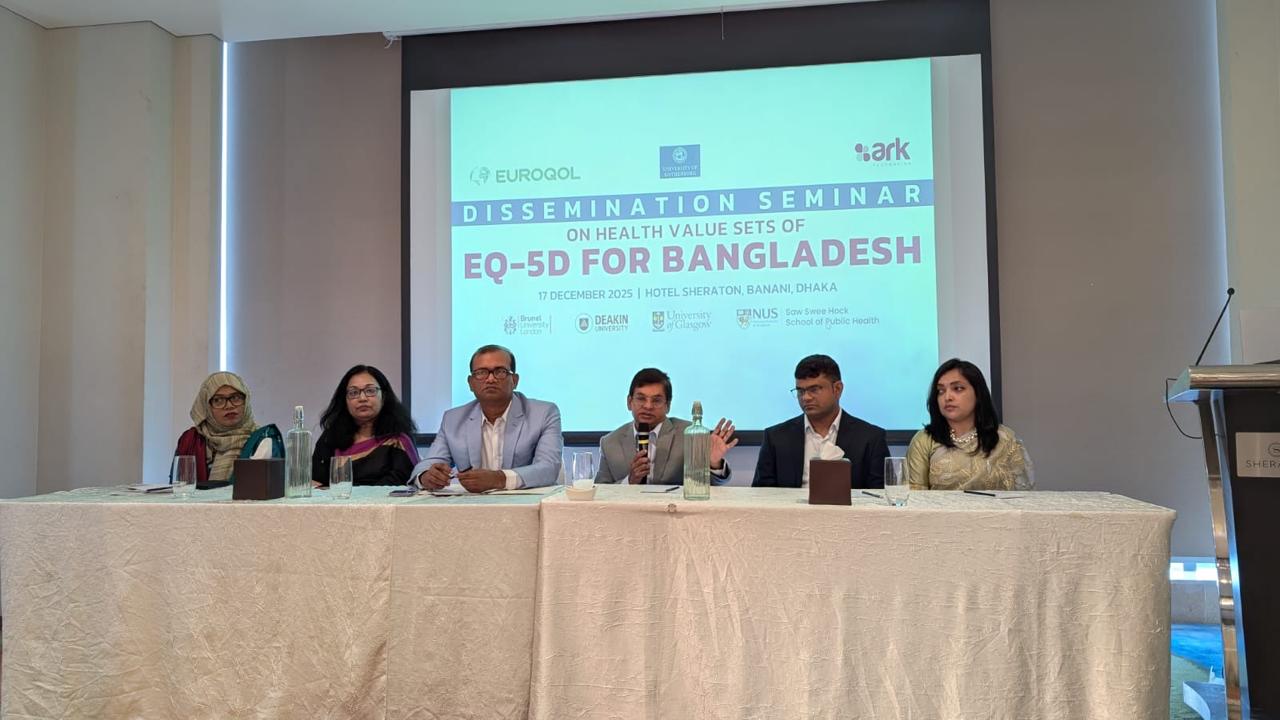
ARK Foundation organized a dissemination event on 17 December 2025 in Dhaka titled ‘EQ-5D Valuation Study for Bangladesh,’ bringing together health economists, policymakers, researchers, and development partners. EQ-5D (EuroQol 5-Dimension) is a tool that measures people’s health-related quality of life, capturing how health problems affect people’s daily activities and overall well-being.
The event presented findings from Bangladesh’s first nationally representative EQ-5D value set study, addressing the country’s reliance on foreign benchmarks and introducing locally developed EQ-5D-3L and EQ-5D-5L value sets to support evidence-based health economic evaluation and policy decisions.
Prof. Dr. Khair Ahmed Choudhury, Additional Director General (Administration), Directorate General of Health Services (DGHS), Ministry of Health and Family Welfare (MoHFLW) attended the event as the chief guest. Dr. Mahmuda Ali, Health Officer at Dhaka North City Corporation; Dr. Nurul Islam, Program Manager at the Non-Communicable Disease Control (NCDC), DGHS; Prof. Jahangir Khan, Professor of Health Economics at the University of Gothenburg; Dr. Sayem Ahmed, Lecturer in Health Economics at Brunel University of London; Dr. Marufa Sultana, Research Fellow at Deakin University; Prof. Rumana Huque, Executive Director of ARK Foundation; and Md. Badruddin Saify, Research Associate at ARK Foundation also attended the event.
During the discussion, chief guest Prof. Dr. Khair Ahmed Choudhury expressed strong interest in the EQ-5D value set for children. He noted, “It is necessary to incorporate perspectives from hard-to-reach rural areas as well as modern urban settings, as these contexts may produce very different health outcomes. Despite societal limitations, studies like this mark an important milestone for healthcare in Bangladesh.”
Prof. Jahangir Khan emphasized the importance of developing a value set that reflects Bangladesh’s own social context and population preferences. He stated, “Previously, we used the value set of England and Thailand, which is not suitable within the Bangladeshi perspective. Having our own value set is essential. It not only supports financial assessment but also incorporates multidimensional impacts such as environmental, social, organizational, and ethical aspects.”
Dr. Sayem Ahmed presented his research on the EQ-5D value sets for Bangladeshi adults, explaining analytical approaches and its relevance to Bangladesh’s population norms. Md. Badruddin Saify shared reflections from the field and recommended that such field studies be conducted with supervision from local government authorities, with fixed data collection protocols and adequate training for data collectors.
Dr. Marufa Sultana discussed her pilot study on the EQ-5D-Y tool for youth as a health-related quality of life measure in Bangladesh. The pilot study included children aged 8-17 years rural and urban primary school students. Dr. Marufa shared the findings and said, “After participating in the survey, 54 percent of students reported that the tool captured their overall health situation. Some children also suggested adding additional dimensions such as physical activity, sleep, and nutrition to better reflect their wellbeing.
In the concluding session, Dr. Mahmuda Ali highlighted how the tool could be integrated into policymaking for heterogeneous urban communities, particularly through engagement with adolescents and young adults. Dr. Nurul Islam emphasized the importance of implementing the findings at the grassroots level to better understand why many people in Bangladesh remain dissatisfied with overall health services.
Health technology assessment can help optimize resource use and support decision-making in Bangladesh’s budget-constrained healthcare system, shaping more efficient and inclusive healthcare in Bangladesh.
Read the news here: https://www.tbsnews.net/bangladesh/health/bangladesh-sets-its-own-eq-5d-health-value-sets-1312621