
• Privacy Policy
  • Terms & Condition
  • Archive

ARK Foundation

  • Home
  • About
    • About Organization
    • Our Partners
    • Global Networks & Leadership
  • Our Team
    • Advisor
    • Executive Director
    • Research and Development
    • Research Uptake & Communications
    • Programme and Training
    • Finance and Administration
    • Data and Field Management
  • Our Work
    • Communicable Disease
    • Non-communicable Disease
    • Multimorbidity
    • Antimicrobial Resistance
    • Maternal, Newborn, Child and Reproductive Health
    • Nutrition
    • Health Systems
    • Climate Change and Environment
    • Gender, Equity and Social Inclusion
  • News & Media
    • Event
    • News
    • Blog
    • Video
    • Newsletter
  • Resources
    • Journal Article
    • Report
    • Working Paper
    • Project Brief
    • Policy Brief
    • Conference Proceedings
    • Infographics
    • Posters
  • Career
  • Contact
/ Published in Policy Brief, Resources

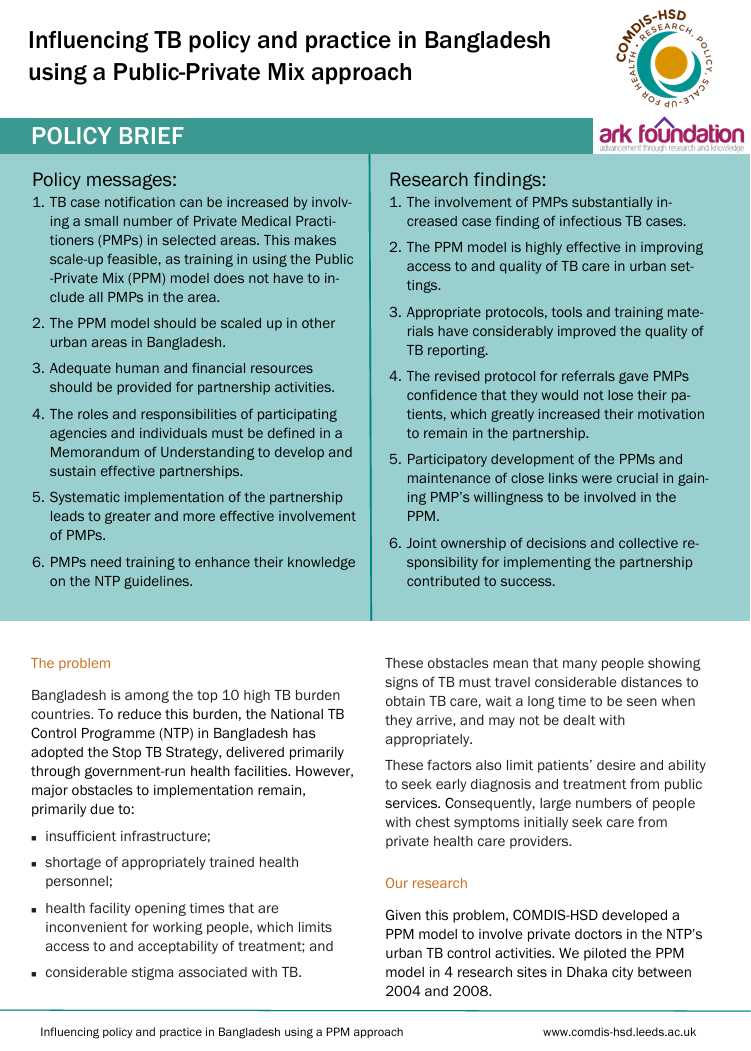
Influencing TB policy and practice in Bangladesh using a Public-Private Mix approach

Read the PDF here

Policy messages:

  1. TB case notification can be increased by involving a small number of Private Medical Practitioners (PMPs) in selected areas. This makes scale-up feasible, as training in using the Public-Private Mix (PPM) model does not have to in-clude all PMPs in the area.
  2. The PPM model should be scaled up in other urban areas in Bangladesh.
  3. Adequate human and financial resources should be provided for partnership activities.
  4. The roles and responsibilities of participating agencies and individuals must be defined in a Memorandum of Understanding to develop and sustain effective partnerships.
  5. Systematic implementation of the partnership leads to greater and more effective involvement of PMPs.
  6. PMPs need training to enhance their knowledge on the NTP guidelines.
Research findings:
  1. The involvement of PMPs substantially increased case finding of infectious TB cases.
  2. The PPM model is highly effective in improving access to and quality of TB care in urban settings.
  3. Appropriate protocols, tools and training materials have considerably improved the quality of TB reporting.
  4. The revised protocol for referrals gave PMPs confidence that they would not lose their patients, which greatly increased their motivation to remain in the partnership.
  5. Participatory development of the PPMs and maintenance of close links were crucial in gaining PMP’s willingness to be involved in the PPM.
  6. Joint ownership of decisions and collective responsibility for implementing the partnership contributed to success.
The problem
Bangladesh is among the top 10 high TB burden countries. To reduce this burden, the National TB Control Programme (NTP) in Bangladesh has adopted the Stop TB Strategy, delivered primarily through government-run health facilities. However, major obstacles to implementation remain, primarily due to:
  • insufficient infrastructure;
  • shortage of appropriately trained health personnel;
  • health facility opening times that are inconvenient for working people, which limits access to and acceptability of treatment; and
  • considerable stigma associated with TB.
These obstacles mean that many people showing signs of TB must travel considerable distances to obtain TB care, wait a long time to be seen when they arrive, and may not be dealt with appropriately. These factors also limit patients’ desire and ability to seek early diagnosis and treatment from public services. Consequently, large numbers of people with chest symptoms initially seek care from private health care providers.
Our research
Given this problem, COMDIS-HSD developed a PPM model to involve private doctors in the NTP’s urban TB control activities. We piloted the PPM model in 4 research sites in Dhaka city between 2004 and 2008.
What is the PPM model?
The model asks private doctors to refer patients to designated TB diagnosis Centres for sputum testing. If a patient tests positive for TB, s/he can get a prescription from their private doctor for free TB drugs, also available from the TB diagnosis centres. The model not only allows private doctors to make use of the free testing service and drugs
offered by the NTP, but also allows the TB Centres and private doctors to trace patients and monitor whether treatment was completed.
Pilot results over 4 years:
  • The case notification rate for new SS+ TB cases in the study areas increased steadily and was consistently higher than the national average (see Figure 1)
  • 703 PMPs were trained in technical and operational aspects of TB care, and PPM/TB record-keeping
  • 3,585 sputum smear positive (SS+) TB patients were registered across 5 TB centres;
  • 647 of the 3,585 patients were referred by PMPs
Our methods
We used a systematic, participatory and phased approach to develop the PPM model. We involved stakeholders in developing and revising the:
  • tools and guidelines needed to diagnose patients;
  • national recording and reporting forms;
  • registers to maintain records of the referrals from PMPs; and
  • NTP’s TB treatment algorithm to incorporate a flexible referral mechanism.
Scaling up
After the pilot was found to be effective in 4 research sites in Dhaka City, the NTP started implementing the PPM model in Chittagong, Sylhet, and other areas of Dhaka, covering more than 15 million people. From the inception of the PPM until 2010:
  • 703 participating PMPs referred almost 19,000 TB suspects and 3,959 SS+ TB cases to the designated TB diagnostic centres; and
  • almost 36% of all SS+ TB cases were attributable to involvement of the private sector providers.
This model is now being used to train PMPs to refer clients to NGO, private and government clinics for family planning advice.
This brief is informed by:

Zafar Ullah AN, Huque R, Husain A, et al. (2012)Effectiveness of involving the private medical sector in the National TB Control Programme in Bangladesh: evidence from mixed methods. BMJ Open. 2(6). doi:10.1136/bmjopen-2012-001534

For more information email Dr Rumana Huque at rumanah14@yahoo.com

With thanks to the patients, PMPs and NGOs involved in this study, and the Bangladesh NTP for permission to carry out the study.
This project was funded with UK aid from UK government.


What you can read next

Policy priorities for strengthening smokeless tobacco control in Bangladesh: A mixed-methods analysis
Preparedness of Urban Primary Healthcare Centres of Bangladesh in Managing Diabetes Mellitus and Hypertension
Using public-private partnerships to influence healthcare policy and practice in Bangladesh

Recent Posts

  • Experts urge action as misinformation threatens vaccination efforts

    Read the report here As measles cases resurface...
  • Webinar on 𝐒𝐭𝐚𝐧𝐝𝐢𝐧𝐠 𝐰𝐢𝐭𝐡 𝐒𝐜𝐢𝐞𝐧𝐜𝐞 𝐢𝐧 𝐭𝐡𝐞 𝐀𝐠𝐞 𝐨𝐟 𝐌𝐢𝐬𝐢𝐧𝐟𝐨𝐫𝐦𝐚𝐭𝐢𝐨𝐧: 𝐏𝐫𝐨𝐭𝐞𝐜𝐭𝐢𝐧𝐠 𝐏𝐮𝐛𝐥𝐢𝐜 𝐇𝐞𝐚𝐥𝐭𝐡

     Join us for an insightful discussion: “𝐒𝐭𝐚𝐧𝐝𝐢𝐧...
  • Air Pollution is Changing: The Hidden Climate Risks We are Not Talking About

    Read the blog here or download the PDF version ...
  • mHealth intervention (mTB-Tobacco) for smoking cessation in people with drug-sensitive pulmonary tuberculosis in Bangladesh and Pakistan: protocol for an adaptive design, cluster randomised controlled trial (Quit4TB)

    Read the article here or download the PDF versi...
  • Gender differences in mental health help-seeking behaviour in Bangladesh: findings from a cross-sectional online survey

    Read the article here or download PDF version A...
  • Designing a strategic purchasing framework for urban primary healthcare services in Bangladesh: a protocol for a mixed-method study with a discrete choice experiment

    Find the article here or download PDF version A...
  • Expansion of low-price cigarette market and its implications for cigarette tax revenue: Evidence from Bangladesh

    Read the article here or download the PDF versi...
  • Engaging rural communities in Bangladesh to address antimicrobial resistance via the community dialogue approach: a protocol for a cluster-randomized controlled trial

    Read the article here or download the PDF versi...
  • Associations between sociodemographic characteristics and knowledge about antibiotics and antibiotic resistance and usage of antibiotics from a One Health perspective in rural Bangladesh: a descriptive cross-sectional study

    Find the article here or download the PDF versi...
  • Perceived barriers and the price inflating effects of informal payments in fresh food retailing in urban Bangladesh

    Find it here or download the PDF version  ...
  • Facilitators and challenges to access fresh fruits and vegetables in a low to middle income group in Bangladesh: Consumers’ perception

    Find it here or download the PDF version Abstra...
  • How prepared are urban primary care facilities to manage hypertension and type 2 diabetes in Dhaka, Bangladesh? A cross-sectional descriptive study of government urban dispensaries and NGO clinics

    Find the article here or download the PDF versi...
  • Tobacco cessation intervention for individuals with severe mental illness in Bangladesh, India, and Pakistan: protocol for a multi-country feasibility randomised controlled trial (SCIMITAR-SA)

    Read the article here or download the PDF versi...
  • When Cities Grow, Movement Shrinks: Urbanisation and Physical Activity in Bangladesh

    Find the PDF here Written by Riona Khan and S M...
  • Patient and provider perspectives of pluralistic primary care services in urban Bangladesh: a qualitative study

    Read it here or find PDF here Abstract Backgrou...
  • The Karlson-Holm-Breen (KHB) Method: Why Logistic Mediation Results Might Be Misleading?

    Read pdf here Written by Ibrahim Hasan and S M ...
  • South Asian Coalition of Policy and Evidence for Equitable food systems (SCOPE)

    The South Asian Coalition of Policy and Evidenc...
  • Fragmentation in urban health service provision? A plurality of providers is the answer

    Read it here or download PDF  Abdullah Rafi, fr...
  • International Women’s Day 2026

      When women give knowledge, care, and lea...
  • In-country public-private partnerships hold the key to promoting inclusiveness in Dutch trade and international cooperation agenda

    Read the PDF here...

Empower Your Career with ARK Foundation

Discover opportunities to make a difference in health, education, gender equality, and environmental sustainability.

JOIN US

ARK Foundation is a non-government, non-political and not-for-profit organization dedicated to the socio-economic development of Bangladesh. Through evidence-based research, training and communications it provides sustainable solutions for health, education and social development.

ADDRESS

Suite A-1, C-3 & C-4, House # 06, Road # 109,
Gulshan-2, Dhaka, Bangladesh, 1212

Phone: +88 02 55069866

Email: info@arkfoundationbd.org

LOCATION

  • GET SOCIAL

© 2025. All rights reserved. ARK Foundation.

TOP