
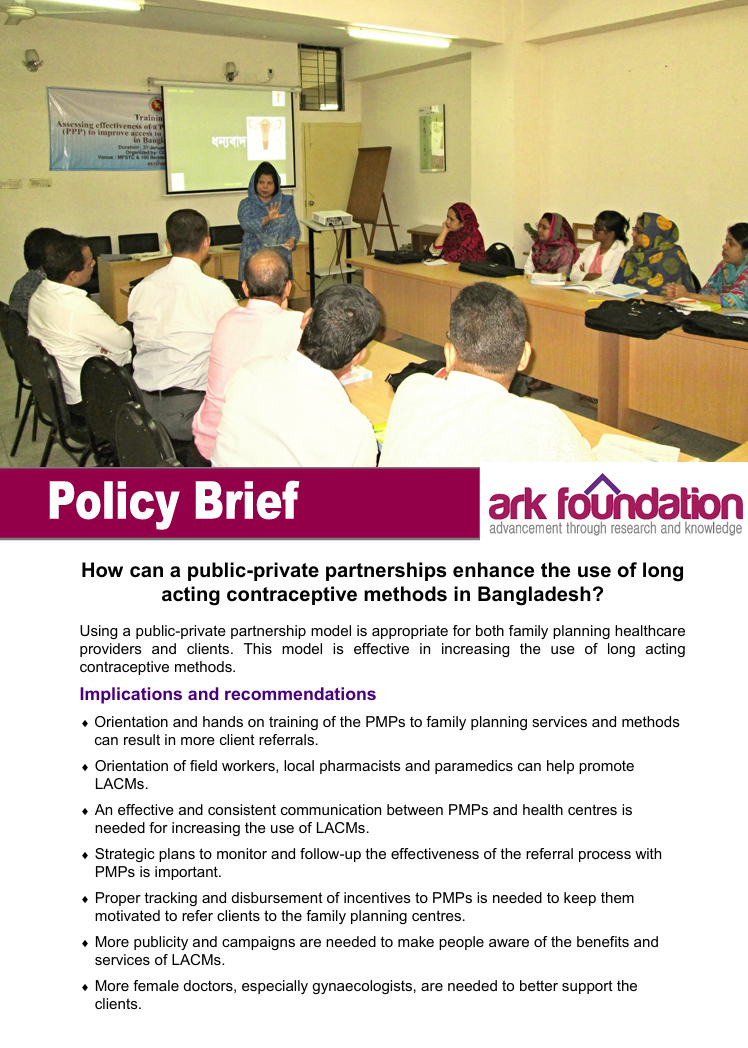
Using a public-private partnership model is appropriate for both family planning healthcare providers and clients. This model is effective in increasing the use of long acting contraceptive methods.
Implications and recommendations
- Orientation and hands on training of the private medical practitioners (PMPs) to family planning services and methods can result in more client referrals.
- Orientation of field workers, local pharmacists and paramedics can help promote long acting contraceptive methods (LACMs).
- An effective and consistent communication between PMPs and health centres is needed for increasing the use of LACMs.
- Strategic plans to monitor and follow-up the effectiveness of the referral process with PMPs is important.
- Proper tracking and disbursement of incentives to PMPs is needed to keep them motivated to refer clients to the family planning centres.
- More publicity and campaigns are needed to make people aware of the benefits and services of LACMs.
- More female doctors, especially gynaecologists, are needed to better support the clients.
Introduction
Bangladesh is the 7th most populous country in the world and the 5th largest in Asia. Annually, the population increases by around two million people, resulting in a serious demographic crisis. Such growth creates a great burden on the limited resources of Bangladesh, obstructing efforts to achieve reproductive health goals, including a reduction in maternal mortality and in fertility rates.
Long acting contraceptive methods (LACMs) are important to reduce the overall fertility rate and increase contraceptive use throughout Bangladesh, helping to overcome the challenges of overpopulation. LACMs therefore need promoting among clients and the uptake of LACMs in family planning service centres needs to be increased.
To reduce fertility rates, the government of Bangladesh has started promoting the use of LACMs. However, although the use of short-term modern contraceptive methods have increased, the relative use of LACMs has declined. The decline in the use of LACMs is largely due to a shortage of trained providers, poor quality healthcare services in the public sector, no collaboration between public and private sector healthcare providers, social norms, misconceptions of the clients and lack of promotional efforts by the private medical practitioners.
Our research
In Bangladesh, private medical practitioners (PMPs) provide family planning services, but are not involved in promoting and referring clients to family planning centres. We developed a public-private partnership (PPP) model to help PMPs implement a referral strategy between themselves and family planning centres. Our research assessed whether the PPP model was effective in increasing the use of LACMs and acceptable to both public and private healthcare providers.
Our methods
The model involved representatives from government, NGOs and the private healthcare sector. We used 3 different healthcare centres (2 run by NGOs and 1 run by the government) in Mirpur, Dhaka. We also recruited 55 PMPs onto the study.
Our findings
- The PPP model is acceptable.
- The uptake of LACMs increased with the use of a systematic referral system.
- The uptake of LACMs increased when the private practitioners were in regular contact with and/or had their clinics either in or near the health centres that provided the family planning services.
- PMPs were more likely to refer patients to family planning centres if they were sure that their incentives would be properly disbursed.
- Pharmacists and paramedics play important role for motivating patients towards particular family planning methods.
- Communication between the PMPS and family planning centres is important to ensure continuous referral of patients for family planning services.
In-depth interviews revealed:
From clients:
- Religious norms, lack of support from family members and fear of surgery are major barriers for taking LACMs.
- Discouragements from pharmacists and paramedics prevent clients from using LACMs
- Female clients expressed their preference to consult with female doctors about family planning issues.
From PMPs:
- All PMPs stated that their knowledge about family planning services increased, particularly about LACM from the orientation program.
- Absence or lack of communication between family planning centres and PMPs results in a lack of motivation by PMPs to refer clients to family planning centres.
From centre managers:
- Managers and healthcare providers at family planning centres are not in regular contact with most of their local PMPs to promote their family planning services.
- PMPs who were in regular contact with family planning centres were found to be actively promoting LACMs and referring clients more than those who were not in regular contact with family planning centres.
The intervention
All PMPs received an orientation on the family planning services, the LACM methods, its ad-vantages, its side effects and the referral process. They also received training manuals from the Directorate General of Family Planning, an address book of all the family planning centres, referral slips, leaflets and posters. The trained PMPs referred the patients to the family plan-ning centres using the referral slips.
Voice of the participants
Exit Client PMP #6 – “Yes, I think this partnership will improve the use of LARCM. People believe in doctor’s words the most. If the doctors take the time to explain their patients, advise them to take Long-term methods and refer them to the FP providers, it will definitely work.”
GoB FP Manager – “If the doctors who are practicing at the private chambers do not have idea about my centre and how we work then why would they refer clients to this centre? That’s why I think it is important to build a relationship with private practitioners who are practicing at private chambers.”
PMP #11 (female) – “But I feel it would be a good idea if the referral slips could also be provided to the pharmacist. Private practitioners usually practice in a particular period of time, whereas pharmacists receive different clients seeking solutions for health related problems throughout the day”.
How can public-private partnerships enhance the use of long acting contraceptive methods in Bangladesh?
The research paper is under peer review at present. As soon as it is published, the policy brief will be updated with the paper reference.