
• Privacy Policy
  • Terms & Condition
  • Archive

ARK Foundation

  • Home
  • About
    • About Organization
    • Our Partners
    • Global Networks & Leadership
  • Our Team
    • Advisor
    • Executive Director
    • Research and Development
    • Research Uptake & Communications
    • Programme and Training
    • Finance and Administration
    • Data and Field Management
  • Our Work
    • Communicable Disease
    • Non-communicable Disease
    • Multimorbidity
    • Antimicrobial Resistance
    • Maternal, Newborn, Child and Reproductive Health
    • Nutrition
    • Health Systems
    • Climate Change and Environment
    • Gender, Equity and Social Inclusion
  • News & Media
    • Event
    • News
    • Blog
    • Video
    • Newsletter
  • Resources
    • Journal Article
    • Report
    • Working Paper
    • Project Brief
    • Policy Brief
    • Conference Proceedings
    • Infographics
    • Posters
  • Career
  • Contact
/ Published in Journal Article, Resources

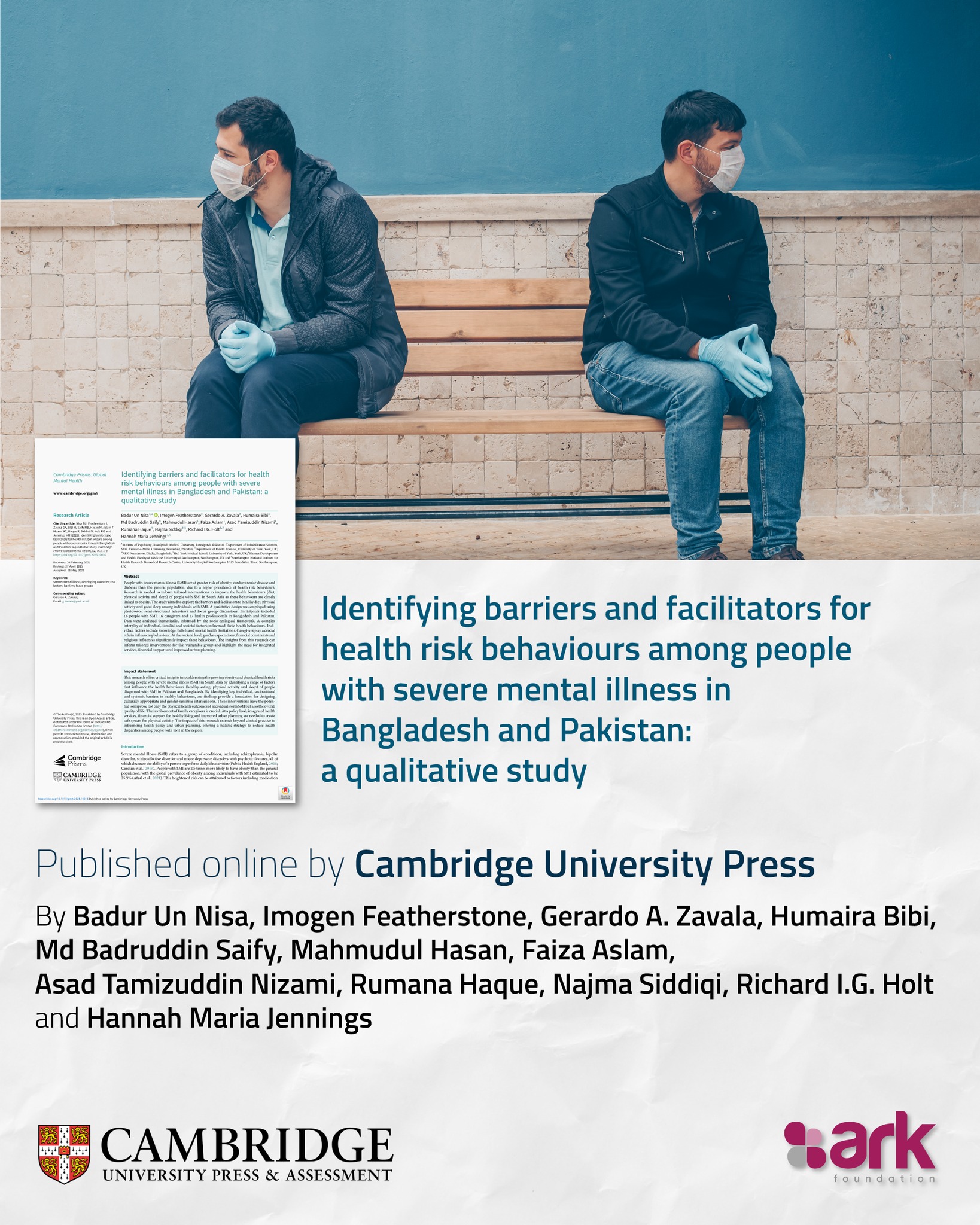
Identifying barriers and facilitators for health risk behaviours among people with severe mental illness in Bangladesh and Pakistan: a qualitative study

Read the full article here

People with severe mental illness (SMI) are at greater risk of obesity, cardiovascular disease and diabetes than the general population, due to a higher prevalence of health risk behaviours. Research is needed to inform tailored interventions to improve the health behaviours (diet, physical activity and sleep) of people with SMI in South Asia as these behaviours are closely linked to obesity. The study aimed to explore the barriers and facilitators to healthy diet, physical activity and good sleep among individuals with SMI. A qualitative design was employed using photovoice, semi-structured interviews and focus group discussions. Participants included 16 people with SMI, 16 caregivers and 17 health professionals in Bangladesh and Pakistan. Data were analysed thematically, informed by the socio-ecological framework. A complex interplay of individual, familial and societal factors influenced these health behaviours. Individual factors include knowledge, beliefs and mental health limitations. Caregivers play a crucial role in influencing behaviour. At the societal level, gender expectations, financial constraints and religious influences significantly impact these behaviours. The insights from this research can inform tailored interventions for this vulnerable group and highlight the need for integrated services, financial support and improved urban planning.

What you can read next

Core outcome sets for trials of interventions to prevent and to treat multimorbidity in adults in low and middle-income countries: the COSMOS study
Effectiveness Of Interventions to Address Obesity and Health Risk Behaviours Among People with Severe Mental Illness in Low- And Middle-Income Countries (LMICs): A Systematic Review and Meta-Analysis
From Intervention to Impact: A Qualitative Process Evaluation of a NCD Intervention to Strengthen Urban Resilience in Urban Dhaka City

Recent Posts

  • The Karlson-Holm-Breen (KHB) Method: Why Logistic Mediation Results Might Be Misleading?

    Read pdf here Written by Ibrahim Hasan and S M ...
  • South Asian Coalition of Policy and Evidence for Equitable food systems (SCOPE)

    The South Asian Coalition of Policy and Evidenc...
  • Fragmentation in urban health service provision? A plurality of providers is the answer

    Read it here or download PDF  Abdullah Rafi, fr...
  • International Women’s Day 2026

      When women give knowledge, care, and lea...
  • In-country public-private partnerships hold the key to promoting inclusiveness in Dutch trade and international cooperation agenda

    Read the PDF here...
  • COVID-19 and Tobacco

    Read the PDF here  ...
  • Taxation on Sugar-Sweetened Beverages (SSBs) in Bangladesh: What should we do?

    Read the PDF here...
  • Public Private Partnership in Improving Access and Utilization of Health Care Services: Scopes, Opportunities and Challenges

    Find the PDF here  ...
  • Influencing TB policy and practice in Bangladesh using a Public-Private Mix approach

    Read the PDF here Policy messages: TB case noti...
  • How can public-private partnerships enhance the use of long acting contraceptive methods in Bangladesh?

    Read the PDF here Using a public-private partne...
  • Improving the quality of care at community clinics in rural Bangladesh through new approaches

    Read the PDF here Key messages The training was...
  • Integrating tobacco cessation within the TB programme: Findings from the ‘TB & Tobacco’ study

    Find the PDF here Integrating tobacco cessation...
  • The Complicated Cigarette Tax Structure in Bangladesh is Causing Expansion of the Low-Tier Cigarette Market and Lower Tax Revenue

    Find the PDF here Implementing a uniform ad val...
  • Digital Health in Dhaka | Simple App | Transforming Urban Healthcare | Channel 24 | ARK Foundation

      Digital health is reshaping urban health...
  • বাংলাদেশে স্বাস্থ্যবিমা: বাস্তবসম্মত সমাধান নাকি শুধু আলোচনা? | Channel 24 | ARK Foundation

    স্বাস্থ্যসেবার ব্যয় কি নাগালের বাইরে চলে যাচ্ছ...
  • Course: Project Management in Public Health

    Download the prospectus from here Introduction ...
  • Precision at Scale: Managing 3,559 Survey Clusters in the World’s Largest Refugee Settlement

    Find the pdf version here or read it here By  Z...
  • The Areca Nut Paradox in Bangladesh: A Rapid Review of Cultural Embeddedness, Public Health Risks, Livelihood Dependence, and Policy Gaps

    Read it here or download the PDF version By Nab...
  • Why does it matter? Childhood obesity among school going children in Urban Bangladesh: Potential Way Forward

    Read the PDF here Written by Badruddin Saify Fo...
  • বৈষম্য কমাতে চাই কার্যকর প্রাথমিক স্বাস্থ্যসেবা | Prof. Dr. Liaquat Ali | ARK Foundation | Channel24

    স্বাস্থ্যসেবা কি শুধু প্রতিশ্রুতির মধ্যেই আটকে ...

Empower Your Career with ARK Foundation

Discover opportunities to make a difference in health, education, gender equality, and environmental sustainability.

JOIN US

ARK Foundation is a non-government, non-political and not-for-profit organization dedicated to the socio-economic development of Bangladesh. Through evidence-based research, training and communications it provides sustainable solutions for health, education and social development.

ADDRESS

Suite A-1, C-3 & C-4, House # 06, Road # 109,
Gulshan-2, Dhaka, Bangladesh, 1212

Phone: +88 02 55069866

Email: info@arkfoundationbd.org

LOCATION

  • GET SOCIAL

© 2025. All rights reserved. ARK Foundation.

TOP