
• Privacy Policy
  • Terms & Condition
  • Archive

ARK Foundation

  • Home
  • About
    • About Organization
    • Our Partners
    • Global Networks & Leadership
  • Our Team
    • Advisor
    • Executive Director
    • Research and Development
    • Research Uptake & Communications
    • Programme and Training
    • Finance and Administration
    • Data and Field Management
  • Our Work
    • Communicable Disease
    • Non-communicable Disease
    • Multimorbidity
    • Antimicrobial Resistance
    • Maternal, Newborn, Child and Reproductive Health
    • Nutrition
    • Health Systems
    • Climate Change and Environment
    • Gender, Equity and Social Inclusion
  • News & Media
    • Event
    • News
    • Blog
    • Video
    • Newsletter
  • Resources
    • Journal Article
    • Report
    • Working Paper
    • Project Brief
    • Policy Brief
    • Conference Proceedings
    • Infographics
    • Posters
  • Career
  • Contact
/ Published in Antimicrobial Resistance, Our Work

Piloting Antimicrobial Stewardship in Different Tiers of Hospitals in Two Districts of Bangladesh to Reduce Antimicrobial Use in Healthcare facilities

Antimicrobial resistance (AMR) is rising rapidly in Bangladesh, posing a serious threat to healthcare. To address this challenge, ARK Foundation, with support from CDC-DGHS and WHO Bangladesh, is piloting an Antimicrobial Stewardship (AMS) initiative at primary, secondary, and tertiary facilities in Cumilla and Dinajpur districts.

The project started with a national-level inception meeting, followed by district-level sensitization meetings to introduce the national AMS guideline and engage hospital leadership and key clinical departments. Following this, a baseline assessment – combining desk reviews, situation analyses, a Point Prevalence Survey (PPS), and Key Informant Interviews (KIIs) mapped antibiotic prescribing patterns, diagnostic practices, and existing AMS structures.

To build capacity, nearly 150 clinicians, nurses, pharmacists, and managers attended hands-on workshops covering the AMS framework, disease specific standard treatment guidelines (STG), and infection prevention and control (IPC). AMS committees and facility-based teams are now established at all participating sites.
A key feature is the deployment of ARK’s Project Research Physicians (PRPs), who visit each facility regularly to support to AMS committees, assist in monitoring prescribing trends using a digital tool (REDCap), and provide on-the-job training. Prescription survey forms from the national guideline are distributed across all departments. PRPs ensure these are completed, reviewed by department heads, and used to provide feedback.
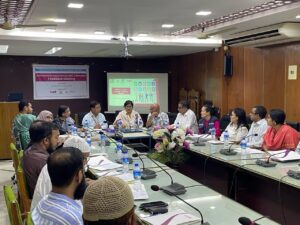

All facilities are organizing feedback meetings to review progress and guide decisions. A major outcome in one of the feedback meetings was the formal adoption of formulary restrictions and pre-authorization requirements for selected antibiotics.
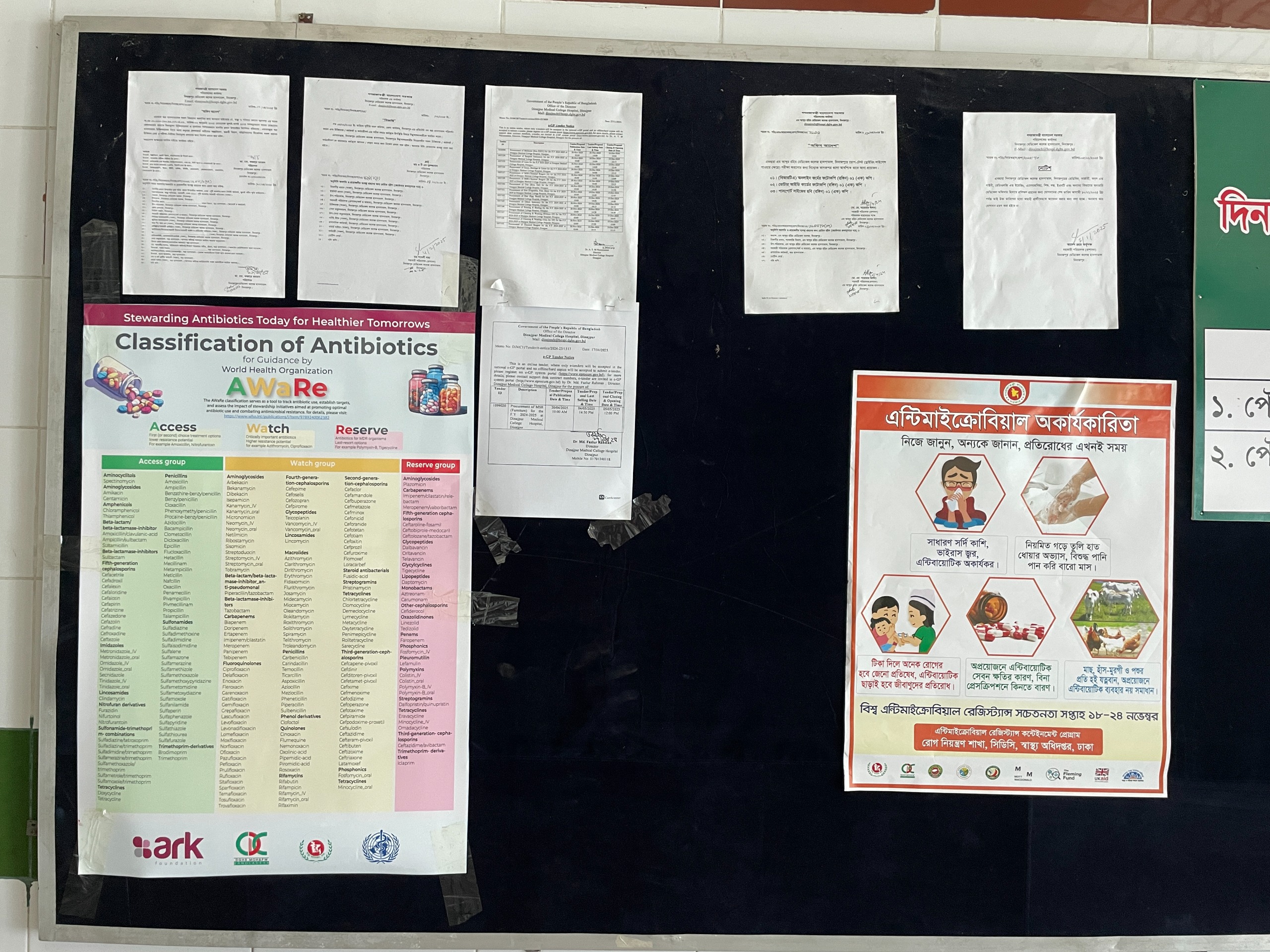
Information, Education, and Communication (IEC) materials have been displayed in key hospital areas to reinforce messages. These materials aim to remind and guide health professionals in their daily practice.
This pilot initiative is creating real-time change within hospital systems and has already led to increased awareness, structured practices, and stronger collaboration among healthcare providers. ARK Foundation is proud to contribute to Bangladesh’s national effort to combat AMR through practical, locally-led stewardship interventions.
What you can read next

Health Budget Analysis Case Study from Secondary and Primary level healthcare facilities in Kurigram District, Bangladesh
TB & Tobacco
Evaluation of Tobacco Dependence Measures of Smokeless Tobacco (ST) Users in Bangladesh

Recent Posts

  • The Karlson-Holm-Breen (KHB) Method: Why Logistic Mediation Results Might Be Misleading?

    Read pdf here Written by Ibrahim Hasan and S M ...
  • South Asian Coalition of Policy and Evidence for Equitable food systems (SCOPE)

    The South Asian Coalition of Policy and Evidenc...
  • Fragmentation in urban health service provision? A plurality of providers is the answer

    Read it here or download PDF  Abdullah Rafi, fr...
  • International Women’s Day 2026

      When women give knowledge, care, and lea...
  • In-country public-private partnerships hold the key to promoting inclusiveness in Dutch trade and international cooperation agenda

    Read the PDF here...
  • COVID-19 and Tobacco

    Read the PDF here  ...
  • Taxation on Sugar-Sweetened Beverages (SSBs) in Bangladesh: What should we do?

    Read the PDF here...
  • Public Private Partnership in Improving Access and Utilization of Health Care Services: Scopes, Opportunities and Challenges

    Find the PDF here  ...
  • Influencing TB policy and practice in Bangladesh using a Public-Private Mix approach

    Read the PDF here Policy messages: TB case noti...
  • How can public-private partnerships enhance the use of long acting contraceptive methods in Bangladesh?

    Read the PDF here Using a public-private partne...
  • Improving the quality of care at community clinics in rural Bangladesh through new approaches

    Read the PDF here Key messages The training was...
  • Integrating tobacco cessation within the TB programme: Findings from the ‘TB & Tobacco’ study

    Find the PDF here Integrating tobacco cessation...
  • The Complicated Cigarette Tax Structure in Bangladesh is Causing Expansion of the Low-Tier Cigarette Market and Lower Tax Revenue

    Find the PDF here Implementing a uniform ad val...
  • Digital Health in Dhaka | Simple App | Transforming Urban Healthcare | Channel 24 | ARK Foundation

      Digital health is reshaping urban health...
  • বাংলাদেশে স্বাস্থ্যবিমা: বাস্তবসম্মত সমাধান নাকি শুধু আলোচনা? | Channel 24 | ARK Foundation

    স্বাস্থ্যসেবার ব্যয় কি নাগালের বাইরে চলে যাচ্ছ...
  • Course: Project Management in Public Health

    Download the prospectus from here Introduction ...
  • Precision at Scale: Managing 3,559 Survey Clusters in the World’s Largest Refugee Settlement

    Find the pdf version here or read it here By  Z...
  • The Areca Nut Paradox in Bangladesh: A Rapid Review of Cultural Embeddedness, Public Health Risks, Livelihood Dependence, and Policy Gaps

    Read it here or download the PDF version By Nab...
  • Why does it matter? Childhood obesity among school going children in Urban Bangladesh: Potential Way Forward

    Read the PDF here Written by Badruddin Saify Fo...
  • বৈষম্য কমাতে চাই কার্যকর প্রাথমিক স্বাস্থ্যসেবা | Prof. Dr. Liaquat Ali | ARK Foundation | Channel24

    স্বাস্থ্যসেবা কি শুধু প্রতিশ্রুতির মধ্যেই আটকে ...

Empower Your Career with ARK Foundation

Discover opportunities to make a difference in health, education, gender equality, and environmental sustainability.

JOIN US

ARK Foundation is a non-government, non-political and not-for-profit organization dedicated to the socio-economic development of Bangladesh. Through evidence-based research, training and communications it provides sustainable solutions for health, education and social development.

ADDRESS

Suite A-1, C-3 & C-4, House # 06, Road # 109,
Gulshan-2, Dhaka, Bangladesh, 1212

Phone: +88 02 55069866

Email: info@arkfoundationbd.org

LOCATION

  • GET SOCIAL

© 2025. All rights reserved. ARK Foundation.

TOP