
Written by: Sirat-E-Rowshan Islam (Research Uptake and Communication Officer)
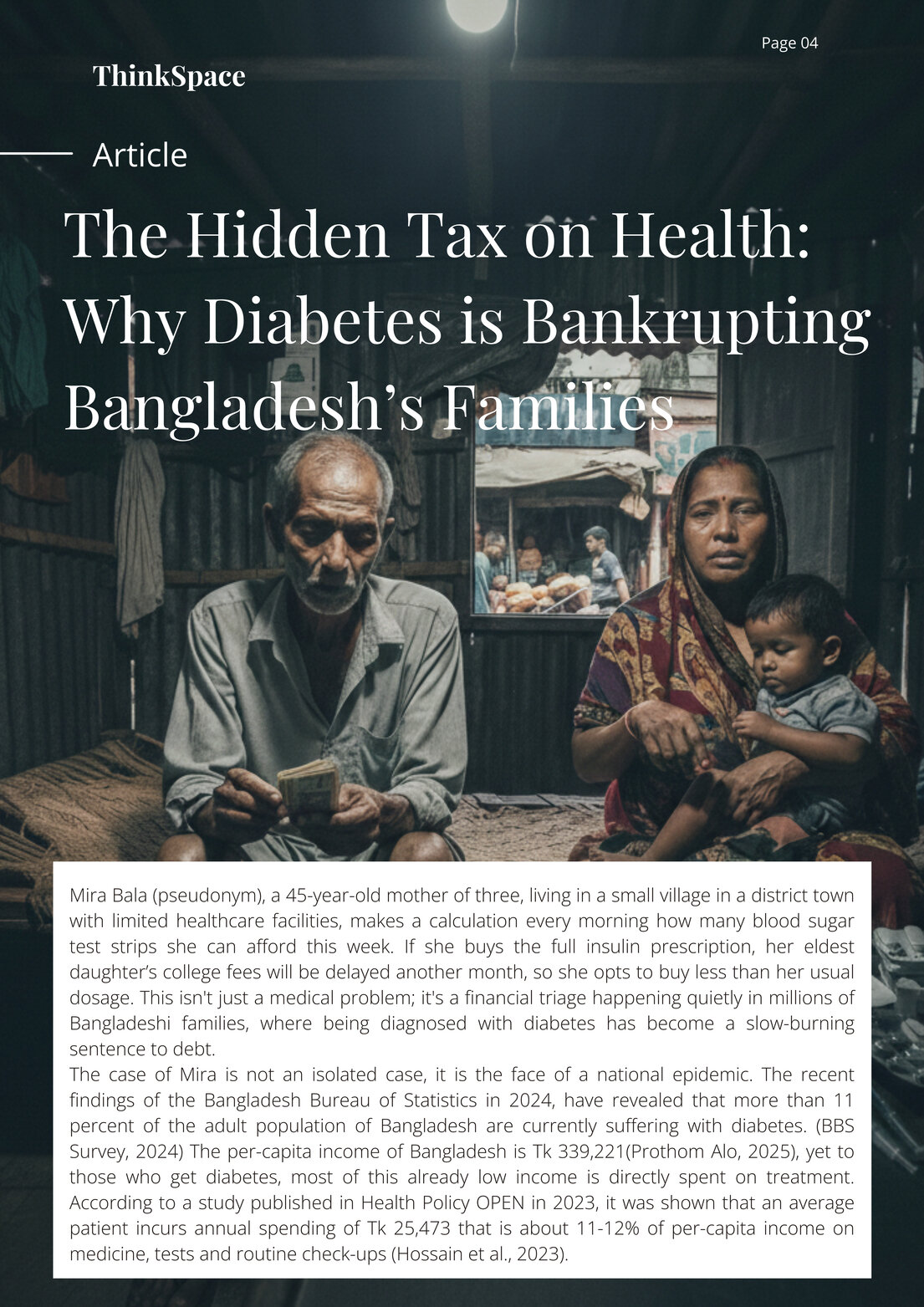
Mira Bala (pseudonym), a 45-year-old mother of three, living in a small village in a district town with limited healthcare facilities, makes a calculation every morning how many blood sugar test strips she can afford this week. If she buys the full insulin prescription, her eldest daughter’s college fees will be delayed another month, so she opts to buy less than her usual dosage. This isn’t just a medical problem; it’s a financial triage happening quietly in millions of Bangladeshi families, where being diagnosed with diabetes has become a slow-burning sentence to debt.
The case of Mira is not an isolated case, it is the face of a national epidemic. The recent findings of the Bangladesh Bureau of Statistics in 2024, have revealed that more than 11 percent of the adult population of Bangladesh are currently suffering with diabetes. (BBS Survey, 2024) The per-capita income of Bangladesh is Tk 339,221(Prothom Alo, 2025), yet to those who get diabetes, most of this already low income is directly spent on treatment. According to a study published in Health Policy OPEN in 2023, it was shown that an average patient incurs annual spending of Tk 25,473 that is about 11-12% of per-capita income on medicine, tests and routine check-ups (Hossain et al., 2023).
In the case of the complications, the annual expenses may go up to approximately 1lakh taka, nearly one-third of the income of the average Bangladeshi. Even these estimates conceal the actual burden. However, the per-capita income can only be considered an average; most of the low- and lower-middle-income families have significantly lower incomes. To them, managing diabetes does not require 10 per cent or 30 per cent- it may wipe out more than half of their annual wages. And since diabetes is a spending lifetime, the strain grows each year, and many families need to spend less on necessities, defer treatment, or become indebted.
The Anatomy of a Financial Poison
Insulin and oral anti-diabetic drugs have now taken a disproportionate portion of family income in Bangladesh; particularly of low and middle classes. A market review published in the Business Standard in 2024 indicates that the prices of major diabetes medicines have shot up in the past 5 years because of the reliance on imported raw materials and disruption of the supply chain. In the case of poorer families even the most affordable insulin will absorb 10-15 percent of monthly earnings, making diabetes one of the most costly chronic illnesses to treat (WHO, 2021). This implies that the patients will have a stipulated monthly charge which increases along with inflation, yet their income does not change.
The diabetes is crippled financially by three key forces:
To begin with, the dependency on imports increases prices. There exists a great deal of generic medicines produced in Bangladesh, but other important insulin analogs and innovative medications continue to be imported. Their price varies with the US dollar, thus, each fall of the Bangladeshi currency (Taka) increases the expenditure to the disadvantage of the patients against the institutions.
Second, healthcare is dominated by out-of-pocket expenditure. In Bangladesh, more than 67% of the health spending is spent as direct medicine expense of patients. (Bangladesh Health Watch analysis of National Health Accounts data, 2020). This creates a constant financial drain, especially in the case of a lifelong illness such as diabetes. The supply of essential insulin by the government is irregular and inadequate, and the patients have to purchase unregulated and uncontrolled prices offered in the private market.
Third, there are concealed expenses that slowly creep up. Blood glucose test strips cost 40-70 taka/unit and testing twice a day can amount to over 4,000 BDT per month which is usually more than the minimum wage of the country. When transportation, follow-ups, and the risk of complications are added to this – diabetes frequently pushes families into catastrophic health spending.
Diabetes is not merely a disease in Bangladesh. It has turned out to be an economic trap, choking the poorest families and making many able to enter into an economic crisis difficult to overcome.
Why Bangladesh’s System Fails NCD Patients
The Bangladesh health system was developed to combat outbreaks, but not the diseases that remain with an individual for life. Consequently, diabetic patients have fallen into the gaps of the system that were never meant to support them. In the majority of primary health centres, the primary care remains dominated by maternal care, fever, infections and emergency care – whereas chronic illnesses need something altogether different: constant supervision, long-term counselling, frequent follow-up and the stable access to medicine. These are the fundamental components that are lacking in the system. An individual who is diagnosed at a camp, or in a local clinic, is often left without formal advice on what to do next. Electronic health records are not common and patients have to begin afresh whenever he or she visits a different doctor. There is also imbalanced training on the management of NCDs with rural areas experiencing the greatest imbalance as the frontline providers are overworked and they are not regularly given updated clinical guidelines.
In urban areas, the challenges are amplified. Rapid population growth, unplanned settlements and high-density living increase the risk factors for NCDs, while public primary care facilities are insufficient to meet the demand. Patients often rely on private clinics or pharmacies, paying out-of-pocket for inconsistent services. Citizens with diabetes are left alone to deal with a complicated disease without effective referral pathways or chronic-care models. This structural vulnerability and not only the cost makes diabetes a day-to-day challenge, also pushing patients through various facilities in the hope of finding one that can provide them with consistent care which the system was not fully prepared to provide.
The Urgent Call for Systemic Change
In Bangladesh, diabetes has ceased to be an individual health issue, it has turned out to be a systemic crisis. The health system should focus on providing more continuous care, rather than only short-term treatment to better support patients, especially those from low-income households. Increasing the availability of affordable insulin and other vital medicines in the public institutions would decrease the reliance on high-price pharmaceutical stores. NCD management, which is included in primary healthcare, should ensure the rural and marginalized groups are not left without care, while the urban health system faces another critical challenge: uncoordinated services and a dominance of unregulated private providers, which make it extremely hard to find consistent and quality care. These need the assistance of skilled staff and frequent follow-ups in every sector. The creation of the system of referrals and digital health records can help to simplify the situation, also save time and money in the family by avoiding these issues. The poorest could be covered against disastrous health expenditure by specific financial safeguards, including subsidies or community-insurance programs. Adopting such systemic changes would ensure that care delivery of diabetes is predictable, affordable, and accessible, and households can control their health without going into debt or compromising the necessities.
Dealing with diabetes in Bangladesh will not be enough by solo effort, but it needs a multisectoral approach. Through enhancement of primary care, medicine availability, and incorporation of chronic disease management in the national health framework, the nation will be able to avoid monetary suffering and enhance the health outcomes. These reforms can be possible by bringing together healthcare providers, urban planners, education departments, transport authorities, and community organizations. Promoting healthier urban environments, regulating food systems, encouraging physical activity, and raising awareness about prevention are all essential. Coordinated policies across sectors can reduce risk factors, improve access to care, and support long-term health outcomes.
Originally published in ThinkSpace Vol:1 (February, 2026)
Reference:
- Islam, Khaleda, et al. “Implementation Status of Non-Communicable Disease Control Program at Primary Health Care Level in Bangladesh: Findings from a Qualitative Research.” Public Health in Practice, vol. 3, June 2022, p. 100271. DOI.org (Crossref), https://doi.org/10.1016/j.puhip.2022.100271.
- Hossain, Zakir, et al. “Out-of-Pocket Expenditure among Patients with Diabetes in Bangladesh: A Nation-Wide Population-Based Study.” Health Policy OPEN, vol. 5, Dec. 2023, p. 100102. DOI.org (Crossref), https://doi.org/10.1016/j.hpopen.2023.100102.
- “Bangladesh Sees Highest-Ever per Capita Income of $2,820 in FY25, BBS Provisional Data Shows.” The Business Standard, 27 May 2025, https://www.tbsnews.net/economy/bangladeshs-capita-income-rises-2820-fy25-bbs-1153056.
- “Bangladesh Sees Highest-Ever per Capita Income of $2,820 in FY25, BBS Provisional Data Shows.” The Business Standard, 27 May 2025, https://www.tbsnews.net/economy/bangladeshs-capita-income-rises-2820-fy25-bbs-1153056.
- Afroz, Afsana, et al. “Type 2 Diabetes Mellitus in Bangladesh: A Prevalence Based Cost-of-Illness Study.” BMC Health Services Research, vol. 19, no. 1, Dec. 2019, p. 601. DOI.org (Crossref), https://doi.org/10.1186/s12913-019-4440-3.