What the reported figure tells us, what it does not, and why careful communication matters for research integrity and public trust.
Zunayed Al Azdi
Senior Research Manager, ARK Foundation
Public Health Researcher | Digital Health and Health Systems
A recent newspaper investigation reported that 325 research papers linked to Bangladeshi researchers or institutions had been retracted, prominently referring to plagiarism—described in Bangla as Churi (meaning ‘Theft’)—and other irregularities.1
The report has started an important public conversation. Plagiarism, fabricated or falsified data, manipulated peer review, paper mills and other unethical practices can harm patients, misguide policy, damage institutions and weaken public trust in science. Investigative journalism can play a valuable role in bringing such problems to light, particularly where universities, research organisations and regulatory bodies have not investigated or communicated transparently.
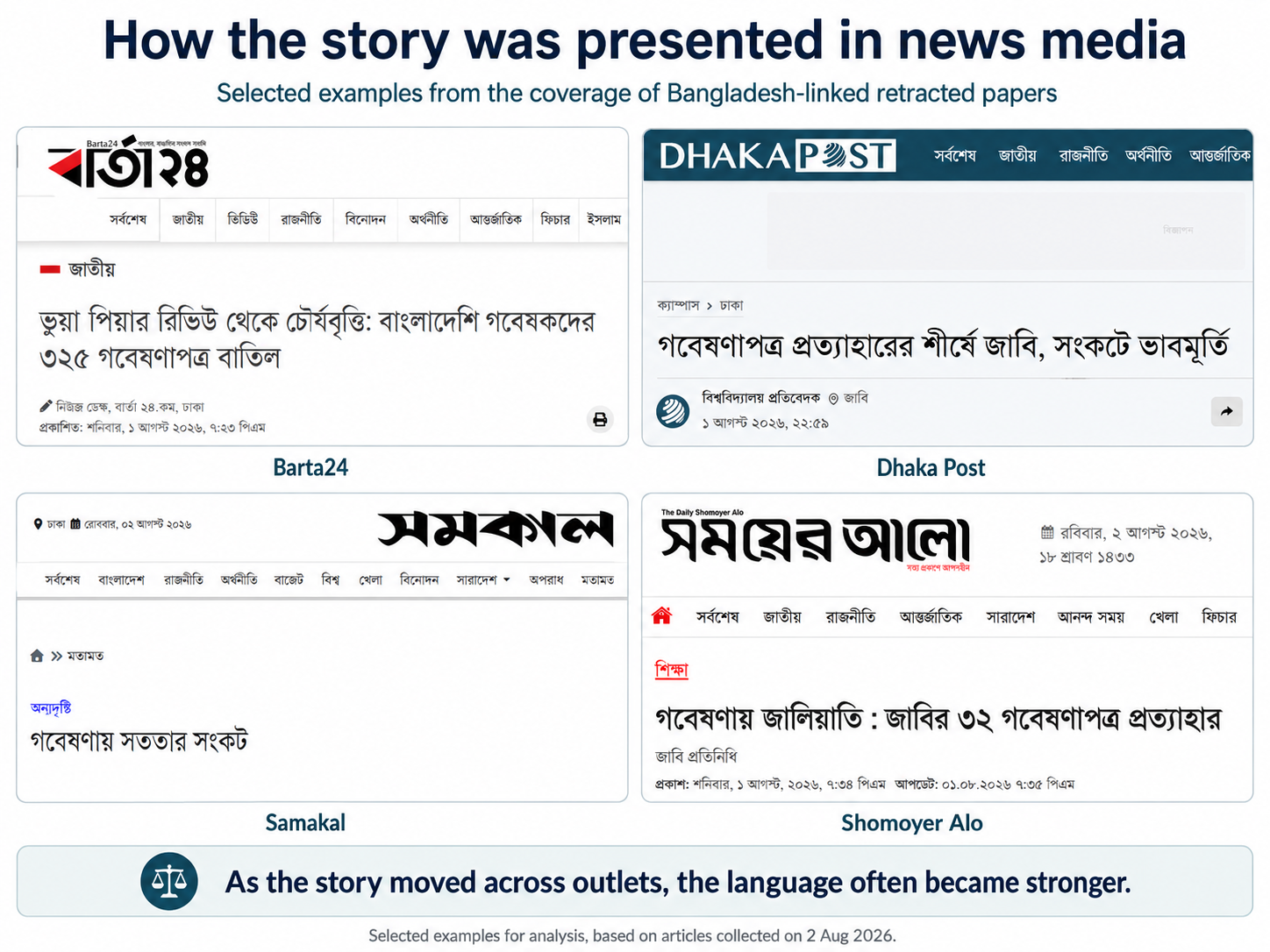
However, the meaning of a statistic depends not only on whether a number has been counted correctly, but also on how it is classified, contextualised and communicated. As the figure of 325 travelled through other news outlets and social media, “retracted papers” were increasingly described as fraudulent research, research theft, scientific deception or evidence that particular institutions had disgraced the country.2–8
This raises several questions. Were all 325 papers retracted for plagiarism? Does every retraction represent proven misconduct? How large is the number relative to Bangladesh’s total research output? How does Bangladesh compare with other countries? And does an author’s affiliation establish that the institution—or every co-author—was responsible?
Retraction is a global phenomenon
Bangladesh is not alone. Tens of thousands of papers have been retracted worldwide. The meaningful questions are why papers were retracted, how often this occurs relative to publication output, and what proportion involved documented misconduct.
Retractions occur across the global research system
A 2025 international study examined misconduct-related retractions across 100 countries from 1996 to 2023. It identified 37,858 such retractions among 79,645,579 publications—approximately 0.048%, or 4.8 per 10,000 publications.9
After adjusting for publication output, the highest overall proportions in that study were reported for Ethiopia (0.35%), Kazakhstan (0.22%), Saudi Arabia (0.18%), Pakistan (0.18%) and China (0.17%). Bangladesh’s overall proportion was approximately 0.08%. In medicine, Bangladesh’s proportion was approximately 0.14%, while Bahrain, Saudi Arabia, Sudan, Iraq and Egypt had higher proportions.9
These results do not make Bangladesh’s retractions unimportant. They show that retractions and misconduct-related retractions are international problems, and that a country’s position cannot be understood from a raw count alone.
Even these normalised figures need caution. They measure documented misconduct-related retractions, not the true prevalence of misconduct. Misconduct that is never detected, investigated or formally retracted remains invisible.
Where do retraction numbers come from?
Many figures in the current discussion come from the Retraction Watch Database, a publicly accessible international database of retracted publications and related notices.10,11 Readers can search it by country, author, affiliation, title, journal, publisher, publication date, notice date, article type, reason, DOI and other fields.
The database is useful because an interested reader does not have to rely only on a newspaper summary. The underlying records can be explored directly. However, a search result is not automatically a complete analysis. Users still need to distinguish retractions from other notices, understand what the dates refer to, remove overlapping records where necessary, interpret reason labels carefully and use a compatible denominator when calculating rates.
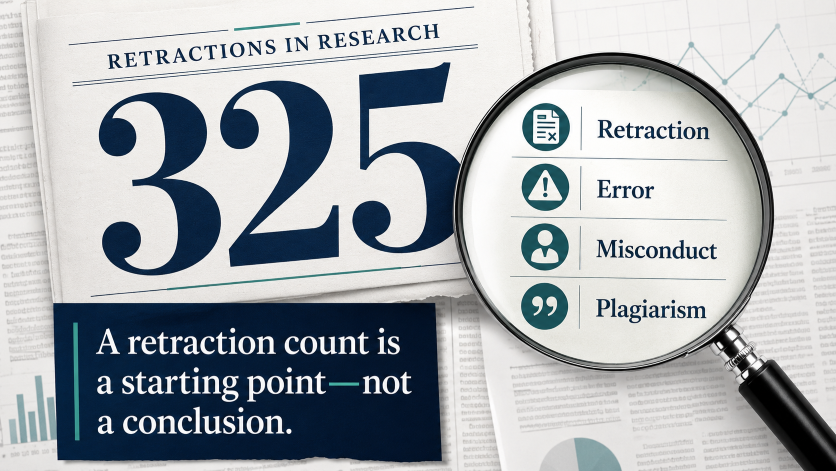
A database count is a starting point—not a conclusion
A defensible interpretation needs transparent search criteria, compatible definitions, careful treatment of overlapping reasons, an appropriate denominator and proportionate language.
What did the original investigation establish?
The newspaper investigation brought together a substantial number of Bangladesh-linked retractions, discussed several recurring concerns, contacted researchers and institutions, and highlighted weaknesses in accountability.1 These are valuable contributions to public discussion.
For a newspaper investigation, readers would not ordinarily expect a full technical protocol or a supplementary dataset containing every included paper. However, several clarifications were important for interpreting the headline figure and were either absent or insufficiently prominent:
- a numerical breakdown of papers by retraction reason;
- a clear distinction between plagiarism, other forms of misconduct, errors and unclear cases;
- Bangladesh’s total publication output for the relevant period;
- a comparison with other countries using the same method;
- clear explanation of how international co-authorship and institutional affiliation should be interpreted; and
- a prominent caution that retraction does not automatically establish misconduct by every author or institution.
These points matter because the headline foregrounded Churi (meaning ‘Theft’), a word most readers would understand as plagiarism or intellectual theft.
How many were actually linked to plagiarism?
To examine that question, we repeated a search of the Retraction Watch Database using the following criteria:
Database: Retraction Watch Database
Search date: 2 August 2026
Country: Bangladesh, selected from the country dropdown
Original-paper publication date: 1 January 2019–30 June 2026
Notice type: Retraction
Country attribution: At least one author affiliation linked to Bangladesh
Plagiarism identification: All displayed reason labels containing the word “Plagiarism”, with unique papers counted once
The search returned 306 Bangladesh-linked retraction records. Because the public interface displays only 50 records at a time, the results were searched in smaller year or month ranges. The reason field was checked for every label containing “Plagiarism”, including categories such as “Euphemisms for Plagiarism”, “Plagiarism of/in Article” and “Plagiarism of Text”. No additional records were found under “Taken from Dissertation/Thesis”, “Taken via Translation” or “Taken via Peer Review”.
After overlapping plagiarism labels were consolidated, the search identified 21 unique plagiarism-related retractions.
21 ÷ 306 × 100 = 6.86%
Thus, under the stated Retraction Watch filters, 21 of the 306 returned Bangladesh-linked retraction records—approximately 6.6%—carried at least one plagiarism-related reason label.
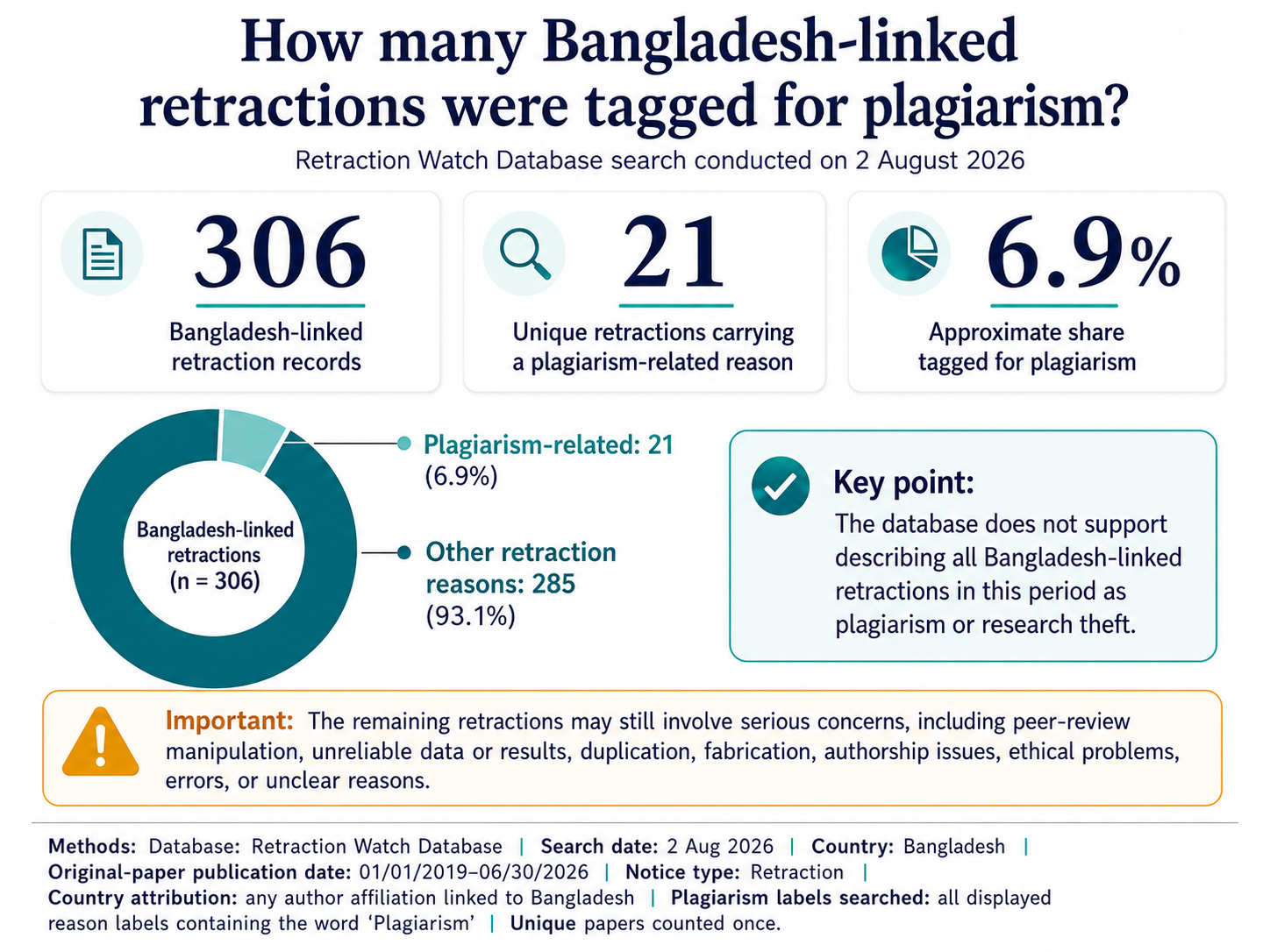
This finding should not be misunderstood. It does not show that the remaining 284 papers were harmless. They may include manipulated peer review, unreliable data or results, fabrication, falsification, duplication, authorship concerns, paper-mill indicators, ethical problems, analytical errors, publisher errors or unclear reasons.
Some of those categories may involve serious misconduct. Others may reflect error or problems for which intent and individual responsibility have not been established. The narrower conclusion is that the database does not support describing the entire set as plagiarism or research theft.
A key finding
Under the stated Retraction Watch filters, 21 of 306 returned Bangladesh-linked retraction records—approximately 6.6%—carried at least one plagiarism-related reason label. The remaining retractions may still involve serious concerns, but they should not automatically be described as plagiarism.
A cautious interpretation is therefore that the headline gave disproportionate prominence to plagiarism relative to the reason labels found through this reproducible search. This is not an allegation that journalists intended to mislead readers. It illustrates how a headline can create a broader impression than the underlying classifications support.
Retraction does not automatically mean misconduct
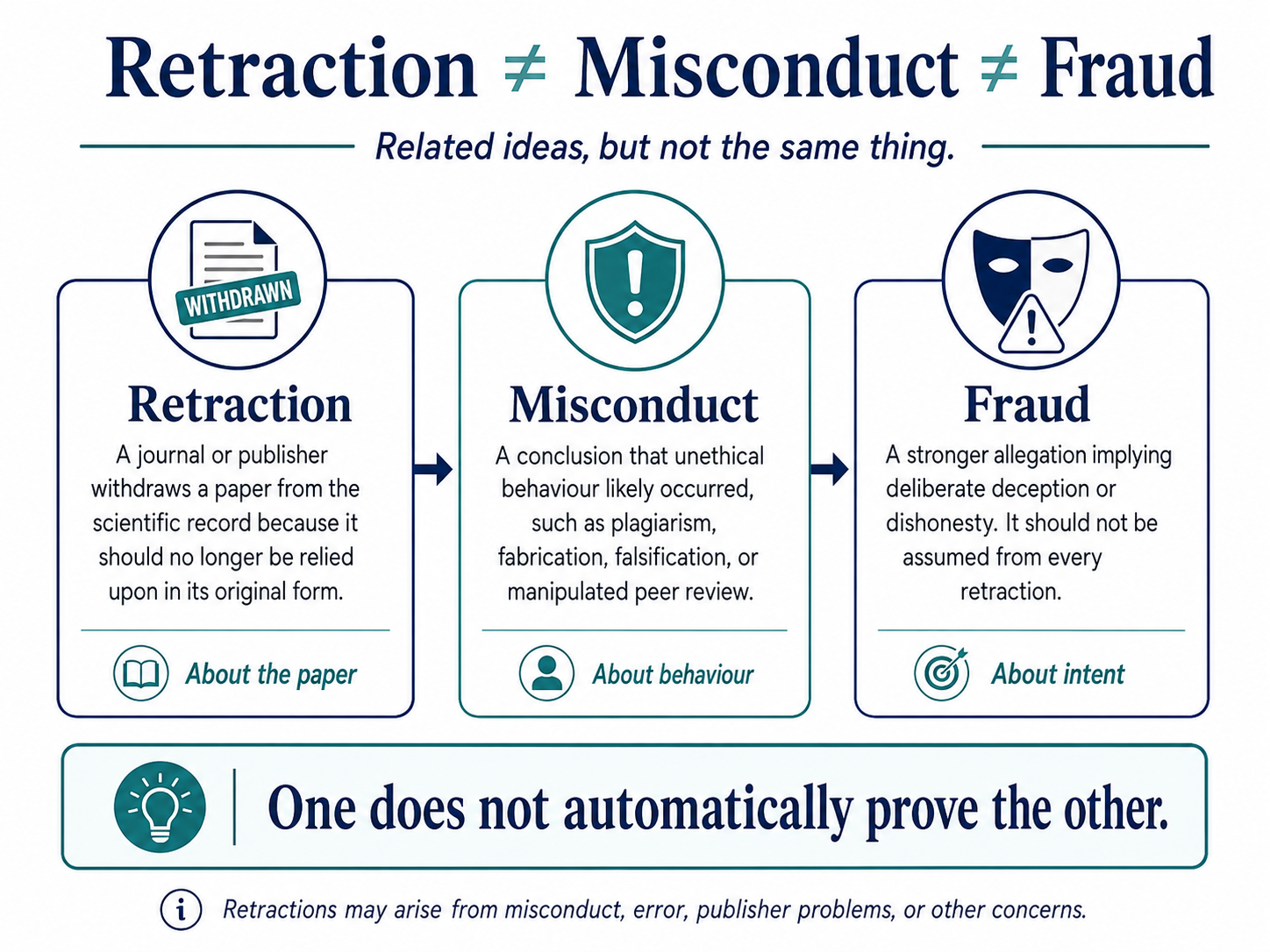
A retraction is an action taken to correct the published record. It indicates that a paper should no longer be relied upon in its original form. A misconduct finding, by contrast, is a conclusion about behaviour.
Clear misconduct may include fabrication, falsification, plagiarism, manipulation of peer review or other intentional deception. But papers may also be retracted because of honest analytical mistakes, invalid conclusions discovered after publication, accidental use of incorrect data, unresolved authorship problems, ethical approval failures, duplicate publication or publisher errors. Retraction Watch maintains numerous distinct reason categories and cautions through its definitions against inferring intentionality from some types of concern.11,12
How the meaning changed as the story travelled
The concern is not limited to one headline. Subsequent reports and publicly visible Facebook posts show how the language became progressively stronger.2–8 Retraction was variously reframed as fraud, deception, theft, fake research or evidence of institutional disgrace.
Database record → Retracted paper → Irregularity → Misconduct → Fraud → Guilty researcher or institution
Each step adds a conclusion that may not have been established at the previous step.
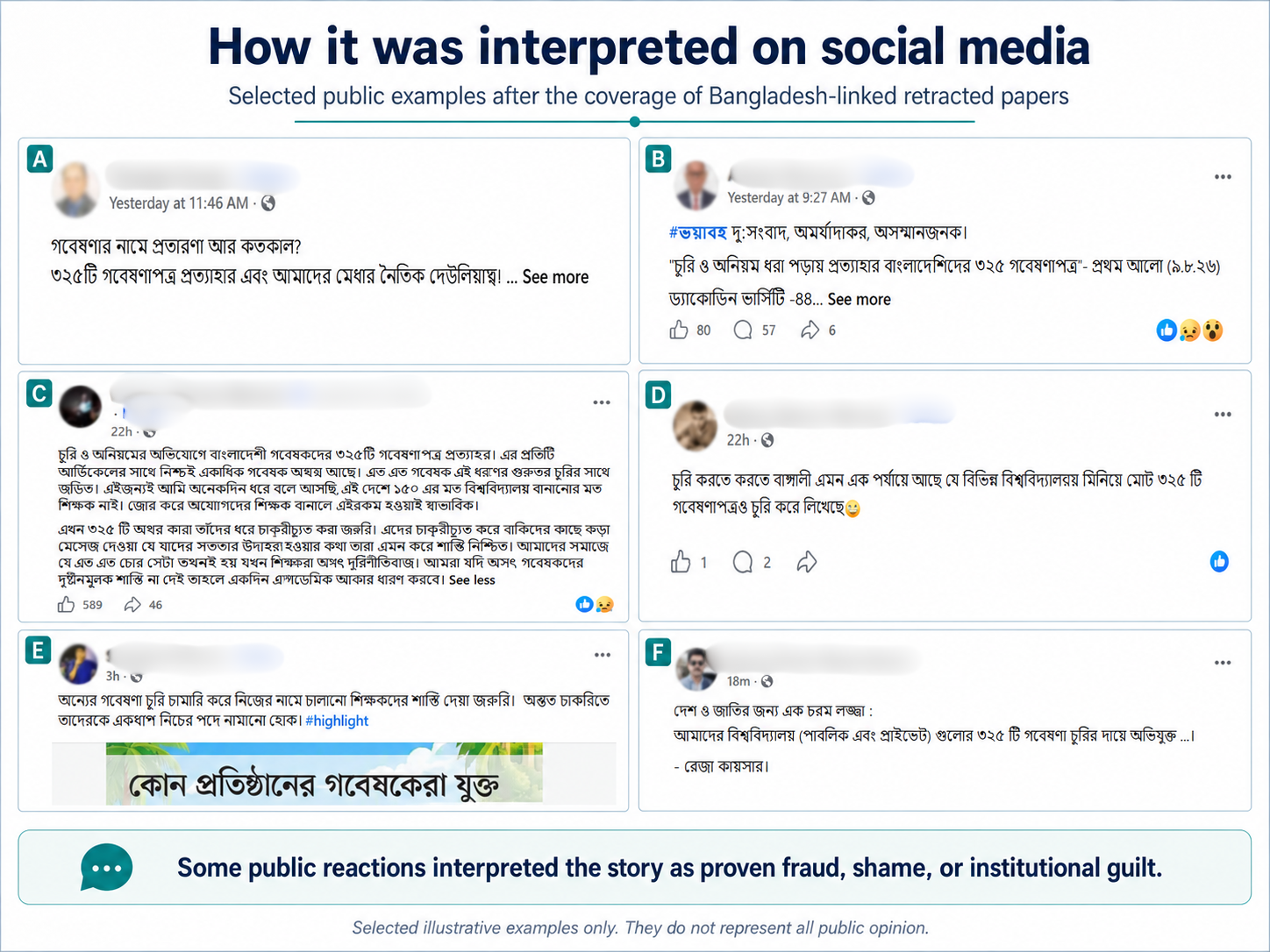
The public examples demonstrate that some readers interpreted the report as 325 confirmed cases of fraud or plagiarism. They do not establish what the wider public believes. The identities of ordinary users have therefore been obscured.
Does an institutional affiliation establish responsibility?
Repeated retractions connected with the same institution deserve attention. They may indicate weaknesses in mentoring, research governance, incentive systems, authorship practice or responses to allegations. But an affiliation alone does not establish institutional misconduct.
A paper may be linked to a university because one of several authors listed that affiliation, because the author later moved, because the study involved several domestic and international institutions, or because the problematic component came from another contributor. Similarly, every co-author should not automatically be presumed equally culpable. Responsibility depends on contribution, access to data, control over analysis, manuscript roles and what each author knew.
Affiliation is a connection—not a verdict
A paper linked to a university is not automatically a university-led paper, and a retraction linked to an institution is not automatically an institutional misconduct finding.
Raw totals from neighbouring countries
Using the same Retraction Watch Database search approach for original papers published from 1 January 2019 to 30 June 2026, notice type restricted to retraction, and country selected through the database dropdown, the following counts were recorded on 2 August 2026:
| Country | Retraction records |
|---|---|
| India | 4,250 |
| Pakistan | 1,337 |
| Bangladesh | 304 |
| Nepal | 55 |
| Sri Lanka | 16 |
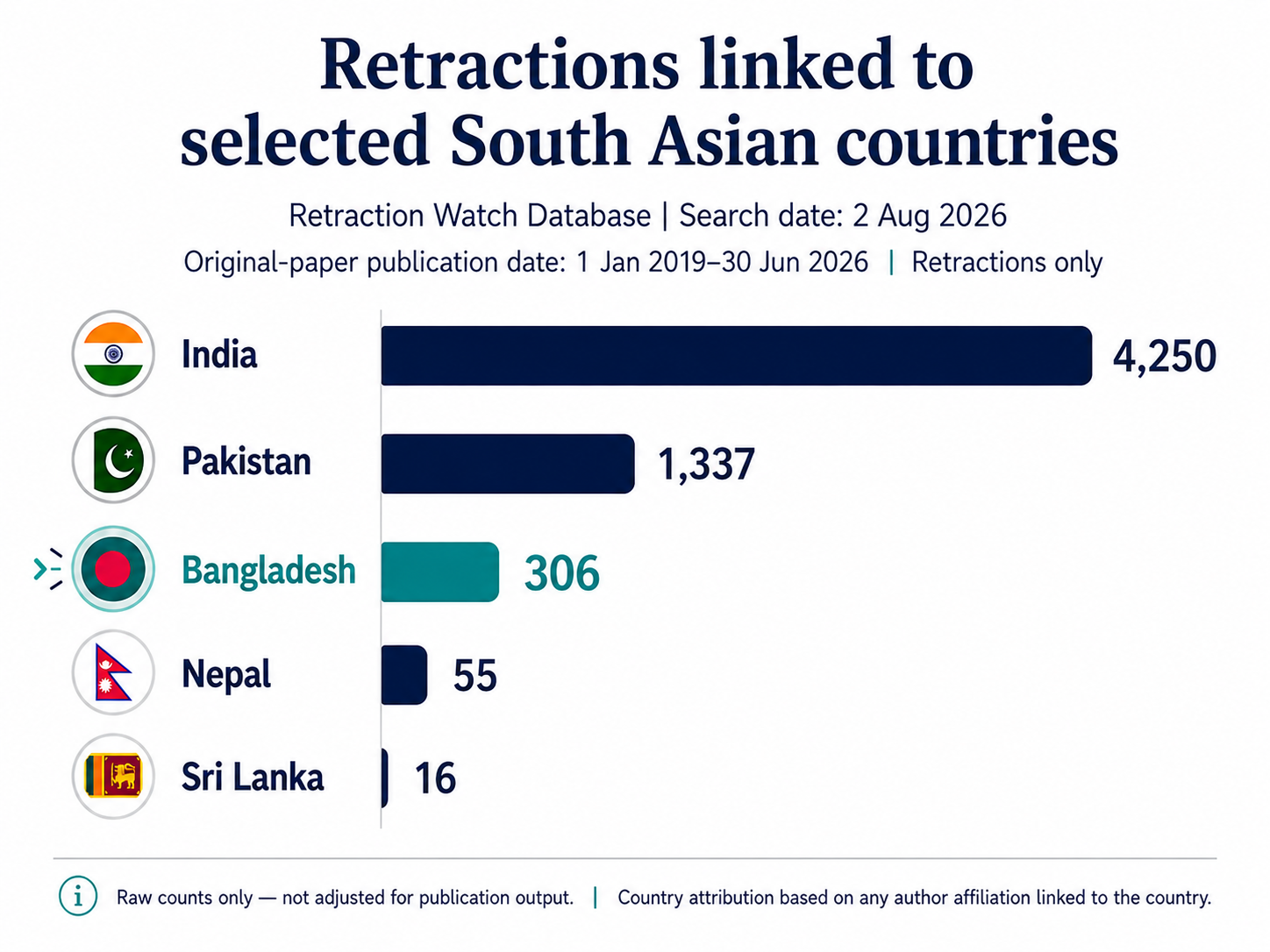
These figures show volume, not rate. Countries differ greatly in how many papers they publish. India’s much larger absolute count cannot be interpreted without considering its much larger research output.
Why a denominator changes the interpretation
A simple hypothetical example shows why a denominator changes the interpretation. Country A may have more retractions in absolute terms, while Country B has the higher retraction proportion because it publishes far fewer papers.
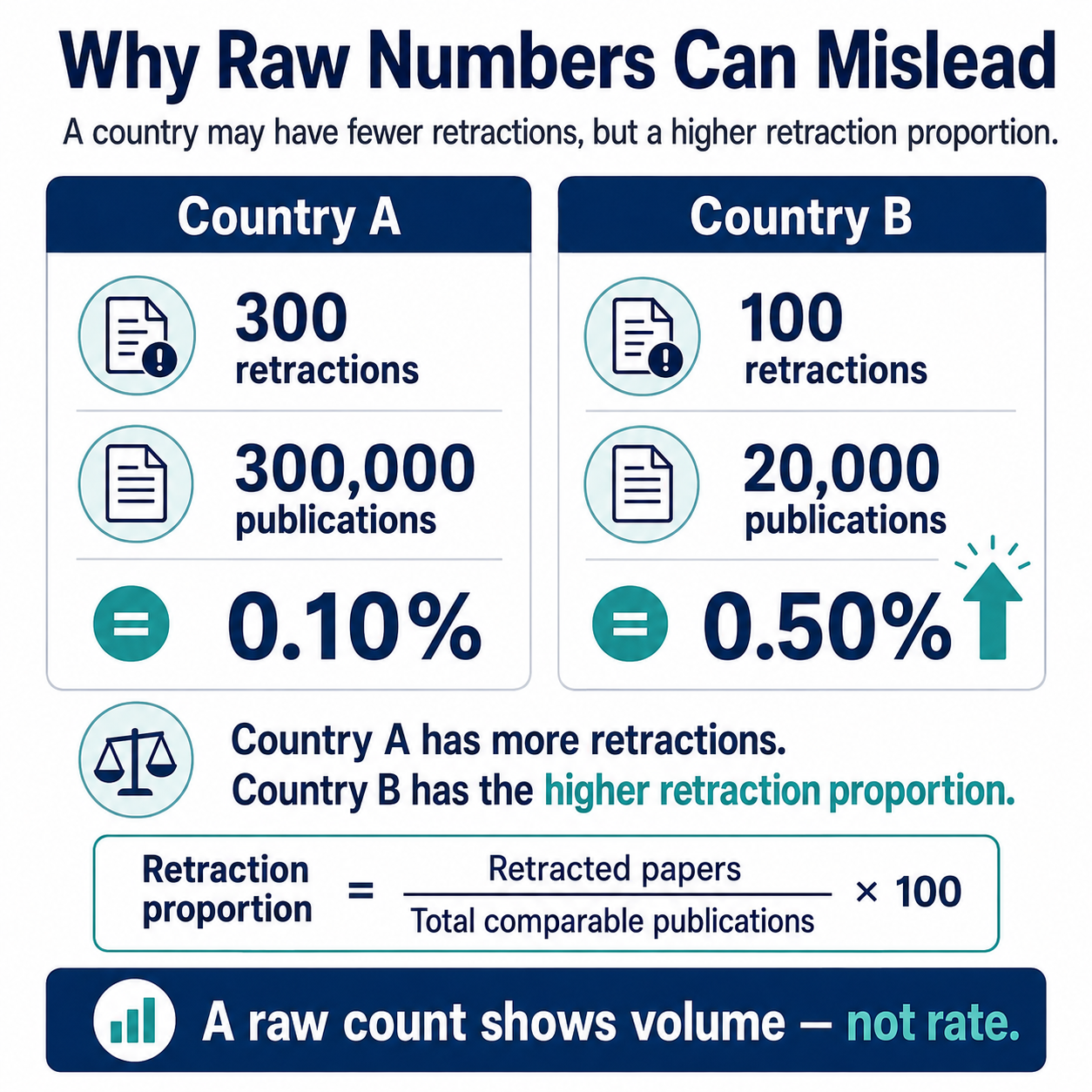
A fair comparison requires total comparable publications as the denominator, along with the same years, publication types, bibliographic coverage and country-counting rules.
What the 2025 international study adds
The study by Sebo and Sebo used a stronger framework for cross-country comparison. It selected retractions classified as misconduct-related, obtained publication output and calculated the proportion relative to that output across 100 countries.9
Its results demonstrate why normalisation matters. Pakistan’s overall misconduct-related retraction proportion was approximately 0.18%, compared with India at approximately 0.10%, Nepal at approximately 0.10% and Bangladesh at approximately 0.08%. In medicine, the proportions were approximately 0.16% for Pakistan, 0.14% for Bangladesh, and 0.12% for both Nepal and India.9
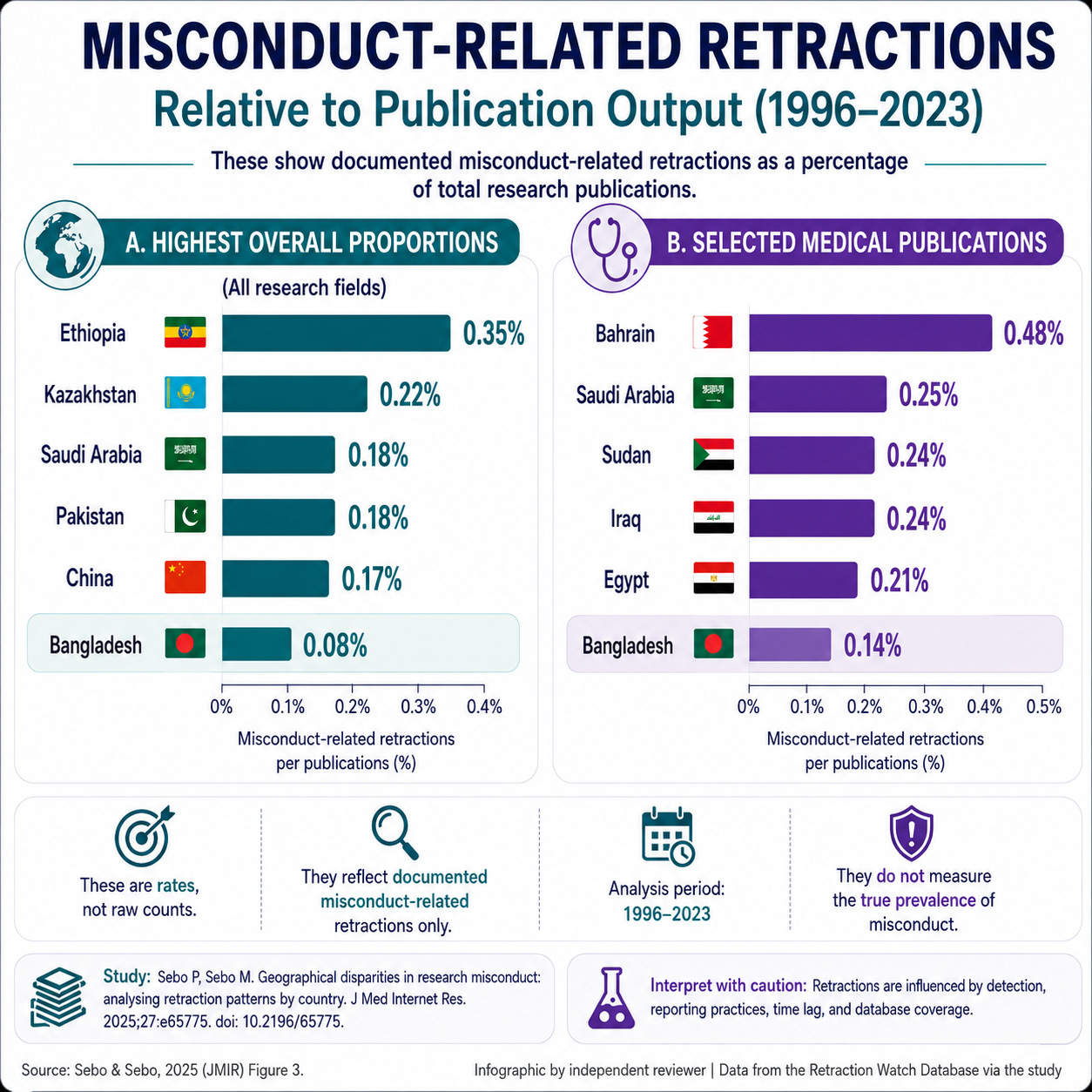
The study has limitations. Retraction may occur years after publication; database coverage and investigative practices vary; and its Retraction Watch numerator covers a broader source universe than its Scopus-based publication denominator. The authors acknowledge these limitations.9 The results should therefore not be presented as a ranking of the world’s “most dishonest” research systems.
What the figure of 325 shows—and what it does not
What it can reasonably show
- A substantial number of Bangladesh-linked papers have been retracted.
- Research integrity deserves serious national attention.
- Some cases may involve grave misconduct.
- Institutional prevention, investigation and accountability need strengthening.
- Further analysis of reasons and repeated patterns is justified.
What it cannot show by itself
- That all 325 papers involved plagiarism.
- That every retraction involved deliberate misconduct.
- That every co-author or affiliated institution was responsible.
- Bangladesh’s retraction rate or relative international position.
- The true national prevalence of research misconduct.
- That Bangladeshi research as a whole is unreliable.
An accurate count can still be misleadingly interpreted
A raw figure measures volume. Without classification and an appropriate denominator, it does not measure a retraction rate—let alone the prevalence of misconduct.
What responsible reporting should include
Research-integrity reporting is necessary and difficult. Journalists may be working with incomplete notices, unresponsive institutions, complex authorship arrangements and changing databases. The aim should not be to discourage reporting, but to make interpretation clearer.
- whether the period refers to publication dates or retraction dates;
- whether the count includes retractions only or other notice types;
- a numerical breakdown by major retraction reason;
- a distinction between documented misconduct, error and unclear cases;
- how internationally co-authored papers and institutional affiliations should be interpreted;
- Bangladesh’s publication output and retractions per 10,000 publications;
- comparisons with other countries using the same method; and
- a clear explanation of limitations.
What Bangladesh should do next
Methodological clarification does not reduce the need for action. Universities, research organisations, funders and journals should strengthen research-integrity and authorship training, mentoring, data governance, independent investigation procedures, whistle-blower protection, methodological review and transparent reporting of investigation outcomes.
Institutions should examine repeated patterns involving the same authors, departments, journals or publishers. At the same time, researchers should not be publicly declared fraudulent solely because their name or affiliation appears on a retracted paper. Accountability must be evidence-based and proportionate.
Conclusion
The reporting of 325 Bangladesh-linked retracted papers raises a legitimate and important alarm. Cases involving plagiarism, fabricated data, manipulated peer review or other deliberate misconduct require investigation and accountability.
But the evidence must be described accurately. Retraction is not automatically equivalent to misconduct. Affiliation does not by itself establish responsibility. Raw country totals do not provide retraction rates. And under our stated Retraction Watch filters, 21 of 306 returned Bangladesh-linked retraction records—approximately 6.6%—carried at least one plagiarism-related reason label.
That finding does not exonerate the remaining papers. It demonstrates that different retraction reasons should not be collapsed into a single label such as plagiarism, theft or fraud.
The goal should not be to discredit investigative journalism or defend unethical researchers. It should be to improve the quality of the public conversation.
Public trust in science is not protected by minimising a troubling number—or by overstating what it proves. It is protected by evidence, transparent methods and proportionate conclusions.
Methodological note on social-media examples
Publicly accessible posts and comments were purposively selected to illustrate how the story was framed and interpreted after publication. They are not a representative sample and should not be used to estimate the prevalence of any opinion. The names and profile photographs of ordinary users have been obscured.
References
- Prothom Alo. চুরি ও অনিয়ম ধরা পড়ায় বাংলাদেশিদের ৩২৫ গবেষণাপত্র প্রত্যাহার [Internet]. Dhaka: Prothom Alo; 2026 [cited 2026 Aug 2]. Available from: https://www.prothomalo.com/bangladesh/dsk36kw511
- Barta24. ভুয়া পিয়ার রিভিউ থেকে চৌর্যবৃত্তি: বাংলাদেশি গবেষকদের ৩২৫ গবেষণাপত্র বাতিল [Internet]. Dhaka: Barta24; 2026 [cited 2026 Aug 2]. Available from: https://barta24.com/details/national/331989
- Kalbela. নানা অনিয়মের অভিযোগে জার্নাল থেকে যবিপ্রবির ১১ গবেষণাপত্র প্রত্যাহার [Internet]. Dhaka: Kalbela; 2026 [cited 2026 Aug 2]. Available from: https://www.kalbela.com/dainikshiksha/campus/314764
- Dhaka Post. গবেষণাপত্র প্রত্যাহারে শীর্ষে জাবি, সংকটে ভাবমূর্তি [Internet]. Dhaka: Dhaka Post; 2026 [cited 2026 Aug 2]. Available from: https://www.dhakapost.com/campus/471697
- Samakal. গবেষণায় সততার সংকট [Internet]. Dhaka: Samakal; 2026 [cited 2026 Aug 2]. Available from: https://samakal.com/opinion/article/365645/
- Shomoyer Alo. গবেষণায় জালিয়াতি: জাবির ৩২ গবেষণাপত্র প্রত্যাহার [Internet]. Dhaka: Shomoyer Alo; 2026 [cited 2026 Aug 2]. Available from: https://www.shomoyeralo.com/news/375769
- Daily Inqilab. একাধিক অনিয়মে আন্তর্জাতিক জার্নাল থেকে নোবিপ্রবির ১০টি গবেষণাপত্র প্রত্যাহার [Internet]. Dhaka: Daily Inqilab; 2026 [cited 2026 Aug 2]. Available from: https://dailyinqilab.com/campus/news/923284
- Public Facebook posts collected as illustrative examples of dissemination and interpretation [Internet]. 2026 [cited 2026 Aug 2]. Available from: post 1; post 2.
- Sebo P, Sebo M. Geographical disparities in research misconduct: analyzing retraction patterns by country. J Med Internet Res. 2025;27:e65775. doi: 10.2196/65775.
- The Center for Scientific Integrity. The Retraction Watch Database [Internet]. New York: The Center for Scientific Integrity; [cited 2026 Aug 2]. Available from: https://retractiondatabase.org/
- Retraction Watch. Retraction Watch Database User Guide [Internet]. New York: The Center for Scientific Integrity; updated 2024 Oct 23 [cited 2026 Aug 2]. Available from: https://retractionwatch.com/retraction-watch-database-user-guide/
- Retraction Watch. Retraction Watch Database User Guide Appendix B: Reasons [Internet]. New York: The Center for Scientific Integrity; [cited 2026 Aug 2]. Available from: https://retractionwatch.com/retraction-watch-database-user-guide/retraction-watch-database-user-guide-appendix-b-reasons/
- Crossref. Retraction Watch: accessing the Retraction Watch Database [Internet]. Oxford: Crossref; [cited 2026 Aug 2]. Available from: https://www.crossref.org/documentation/retrieve-metadata/retraction-watch/
- Committee on Publication Ethics. Retraction guidelines [Internet]. Eastleigh: COPE; 2019 [cited 2026 Aug 2]. Available from: https://publicationethics.org/retraction-guidelines