
• Privacy Policy
  • Terms & Condition
  • Archive

ARK Foundation

  • Home
  • About
    • About Organization
    • Our Partners
    • Global Networks & Leadership
  • Our Team
    • Advisor
    • Executive Director
    • Research and Development
    • Research Uptake & Communications
    • Programme and Training
    • Finance and Administration
    • Data and Field Management
  • Our Work
    • Communicable Disease
    • Non-communicable Disease
    • Multimorbidity
    • Antimicrobial Resistance
    • Maternal, Newborn, Child and Reproductive Health
    • Nutrition
    • Health Systems
    • Climate Change and Environment
    • Gender, Equity and Social Inclusion
  • News & Media
    • Event
    • News
    • Blog
    • Video
    • Newsletter
  • Resources
    • Journal Article
    • Report
    • Working Paper
    • Project Brief
    • Policy Brief
    • Conference Proceedings
    • Achievement
    • Infographics
  • Career
  • Contact
/ Published in Uncategorized

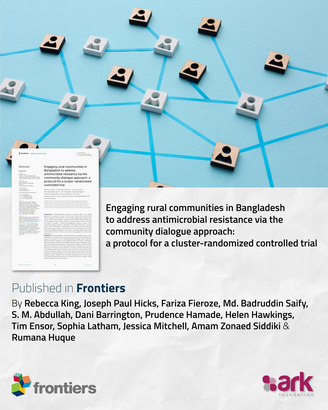
Engaging rural communities in Bangladesh to address antimicrobial resistance via the community dialogue approach: a protocol for a cluster-randomized controlled trial

Click here to read the full article

Introduction: To effectively tackle antibiotic resistance (ABR) a One Health approach is required, focusing on the human, animal and environmental sectors together, and that public education and engagement programs must be part of the overall approach. However, there has been limited research on such programs in low−/middle-income countries (LMICs). Here we describe our plans to evaluate a community-engagement program, known as the community dialogue approach, that takes a One Health approach to tackling ABR in rural communities in Bangladesh, and involves community-led and community-based education and discussion forums. Members of our team previously developed this approach and used it to address other health issues in other LMIC contexts, while our team has previously adapted it for this topic and setting.

Methods: We will use a pragmatic, non-blinded, two-arm, parallel-group, cluster-randomized, controlled trial to primarily evaluate whether the intervention can improve (1) the level of correct and appropriate knowledge about antibiotics, ABR, and antibiotic usage from a One Health perspective, (2) levels of awareness about the existence of antibiotics and ABR, and (3) the relative frequency of self-reported and observable indicators of best practices related to antibiotic usage. Within Cumilla district, we will randomize 50 clusters of villages in a 1:1 ratio. In intervention community clusters trained community volunteers will deliver a set of 11 health education and discussion forums across a 12-month period, while control community clusters will receive no inputs. We will collect outcomes at baseline (pre-randomization) and endline (following the final community dialogue) via two repeated cross-sectional household surveys (each aiming to survey 2,200 participants across all clusters). We will also conduct nested process evaluation and costing studies.

Discussion: Community engagement approaches have successfully addressed other health issues in low resource settings, but there is limited evidence on using community engagement approaches to address ABR in low resource contexts, particularly in Bangladesh. We will closely involve the Bangladeshi health system in this research to ensure feasibility and facilitate scale-up via an embedded approach.

Clinical trial registration: https://doi.org/10.1186/ISRCTN93756764, identifier ISRCTN93756764.
What you can read next

What do we need in a new health budget?
Workshop on ‘Creating Responsive Health System’ at Health Economics Unit, MoHFW
Preparedness of Urban Primary Healthcare Centres of Bangladesh in Managing Diabetes Mellitus and Hypertension

Recent Posts

  • আসন্ন নির্বাচনে রাজনৈতিক দলগুলোর কাছে স্বাস্থ্যখাতে প্রত্যাশা

    আগামী ত্রয়োদশ জাতীয় সংসদ নির্বাচনকে সামনে রেখে ...
  • 𝐋𝐨𝐜𝐚𝐥 𝐑𝐞𝐚𝐥𝐢𝐭𝐢𝐞𝐬 𝐚𝐧𝐝 𝐇𝐞𝐚𝐥𝐭𝐡 𝐂𝐚𝐫𝐞 𝐂𝐡𝐨𝐢𝐜𝐞𝐬: 𝐂𝐨𝐦𝐦𝐮𝐧𝐢𝐭𝐲 𝐏𝐞𝐫𝐬𝐩𝐞𝐜𝐭𝐢𝐯𝐞𝐬 𝐟𝐨𝐫 𝐄𝐪𝐮𝐢𝐭𝐚𝐛𝐥𝐞 𝐔𝐫𝐛𝐚𝐧 𝐏𝐫𝐢𝐦𝐚𝐫𝐲 𝐇𝐞𝐚𝐥𝐭𝐡 𝐂𝐚𝐫𝐞 𝐢𝐧 𝐃𝐡𝐚𝐤𝐚, 𝐁𝐚𝐧𝐠𝐥𝐚𝐝𝐞𝐬𝐡

    Let’s lookback at the impactful contributions f...
  • Identifying barriers and facilitators for health risk behaviours among people with severe mental illness in Bangladesh and Pakistan: a qualitative study

    Read the full article here People with severe m...
  • আসন্ন নির্বাচনে রাজনৈতিক দলগুলোর কাছে স্বাস্থ্যখাতে প্রত্যাশা

    আসন্ন নির্বাচনে রাজনৈতিক দলগুলোর কাছে স্বাস্থ্য...
  • From Intervention to Impact: A Qualitative Process Evaluation of a NCD Intervention to Strengthen Urban Resilience in Urban Dhaka City

    Let’s lookback at the impactful contributions f...
  • An mHealth (Mobile Health) Intervention for Smoking Cessation in People With Tuberculosis: A Cluster Randomized Clinical Trial

    Find the full article here A new research artic...
  • Understanding Access to Primary Healthcare in Dhaka’s Urban Slums: A Qualitative Inquiry into Community Perceptions and Health Equity Challenges

    Find the PDF here or Read HTML version ARK Foun...
  • Bangladesh’s first national EQ-5D health value set unveiled

    ARK Foundation organized a dissemination event ...
  • Major Barriers on Universal Health Coverage in Bangladesh

    In 2020, while the government spent Tk 2,187 cr...
  • Non-communicable Disease Condition in Bangladesh

    Did you know that over 70% of deaths in Banglad...
  • Universal Health Coverage | Ensuring Equity in Every Health Decision

    𝐔𝐧𝐢𝐯𝐞𝐫𝐬𝐚𝐥 𝐇𝐞𝐚𝐥𝐭𝐡 𝐂𝐨𝐯𝐞𝐫𝐚𝐠𝐞 𝐃𝐚𝐲 𝟐𝟎𝟐𝟓 calls us to ...
  • Webinar: Who Gets Left Behind? Addressing Health Vulnerability and Inequity in Urban Contexts

    Thursday 11 December 2025  04.00 – 05.00 ...
  • AMR Situation in Bangladesh

    Only a week-long awareness campaign is not enou...
  • 𝐖𝐨𝐫𝐥𝐝 𝐇𝐞𝐚𝐫𝐭 𝐃𝐚𝐲 𝟐𝟎𝟐𝟓 — 𝐃𝐨𝐧’𝐭 𝐌𝐢𝐬𝐬 𝐚 𝐁𝐞𝐚𝐭

      Heart disease is one of the leading caus...
  • স্বাস্থ্য খাতে সমতা নিশ্চিত করা জরুরি

    প্রফেসর ডঃ রুমানা হক বৈশ্বিক স্বাস্থ্য সূচকে বা...
  • 𝐔𝐧𝐢𝐭𝐞𝐝 𝐀𝐜𝐭𝐢𝐨𝐧 𝐢𝐬 𝐄𝐬𝐬𝐞𝐧𝐭𝐢𝐚𝐥 𝐭𝐨 𝐂𝐨𝐦𝐛𝐚𝐭 𝐭𝐡𝐞 𝐒𝐢𝐥𝐞𝐧𝐭 𝐏𝐚𝐧𝐝𝐞𝐦𝐢𝐜 𝐨𝐟 𝐀𝐧𝐭𝐢𝐦𝐢𝐜𝐫𝐨𝐛𝐢𝐚𝐥 𝐑𝐞𝐬𝐢𝐬𝐭𝐚𝐧𝐜𝐞 (𝐀𝐌𝐑)

    On 24th November, 2025, ARK Foundation arranged...
  • World Diabetes Day 2025

    Isn’t it alarming that diabetes already affects...
  • Our Latest Newsletter is Now Available

    Find the Pdf Here We are pleased to announce th...
  • The Need for Multisectoral Collaboration in the Urban Health Sector

    Find PDF version here While speaking about the ...
  • Efficient & Equitable Health Spending in Bangladesh

    Despite modest changes, Bangladesh’s health sec...

Empower Your Career with ARK Foundation

Discover opportunities to make a difference in health, education, gender equality, and environmental sustainability.

JOIN US

ARK Foundation is a non-government, non-political and not-for-profit organization dedicated to the socio-economic development of Bangladesh. Through evidence-based research, training and communications it provides sustainable solutions for health, education and social development.

ADDRESS

Suite A-1, C-3 & C-4, House # 06, Road # 109,
Gulshan-2, Dhaka, Bangladesh, 1212

Phone: +88 02 55069866

Email: info@arkfoundationbd.org

LOCATION

  • GET SOCIAL

© 2025. All rights reserved. ARK Foundation.

TOP