• Privacy Policy
  • Terms & Condition
  • Archive

ARK Foundation

  • Home
  • About
    • About Organization
    • Our Partners
    • Global Networks & Leadership
  • Our Team
    • Advisor
    • Executive Director
    • Research and Development
    • Research Uptake & Communications
    • Programme and Training
    • Finance and Administration
    • Data and Field Management
  • Our Work
    • Communicable Disease
    • Non-communicable Disease
    • Multimorbidity
    • Antimicrobial Resistance
    • Maternal, Newborn, Child and Reproductive Health
    • Nutrition
    • Health Systems
    • Climate Change and Environment
    • Gender, Equity and Social Inclusion
  • News & Media
    • Event
    • News
    • Blog
    • Video
    • Newsletter
  • Resources
    • Journal Article
    • Report
    • Working Paper
    • Project Brief
    • Policy Brief
    • Conference Proceedings
    • Infographics
    • Posters
  • Career
  • Contact
/ Published in Blog, News and Media

Field Reality: What We Learned While Assessing Smoke-Free Public Places

Written by: Lenik Chakma (Research Assistant)

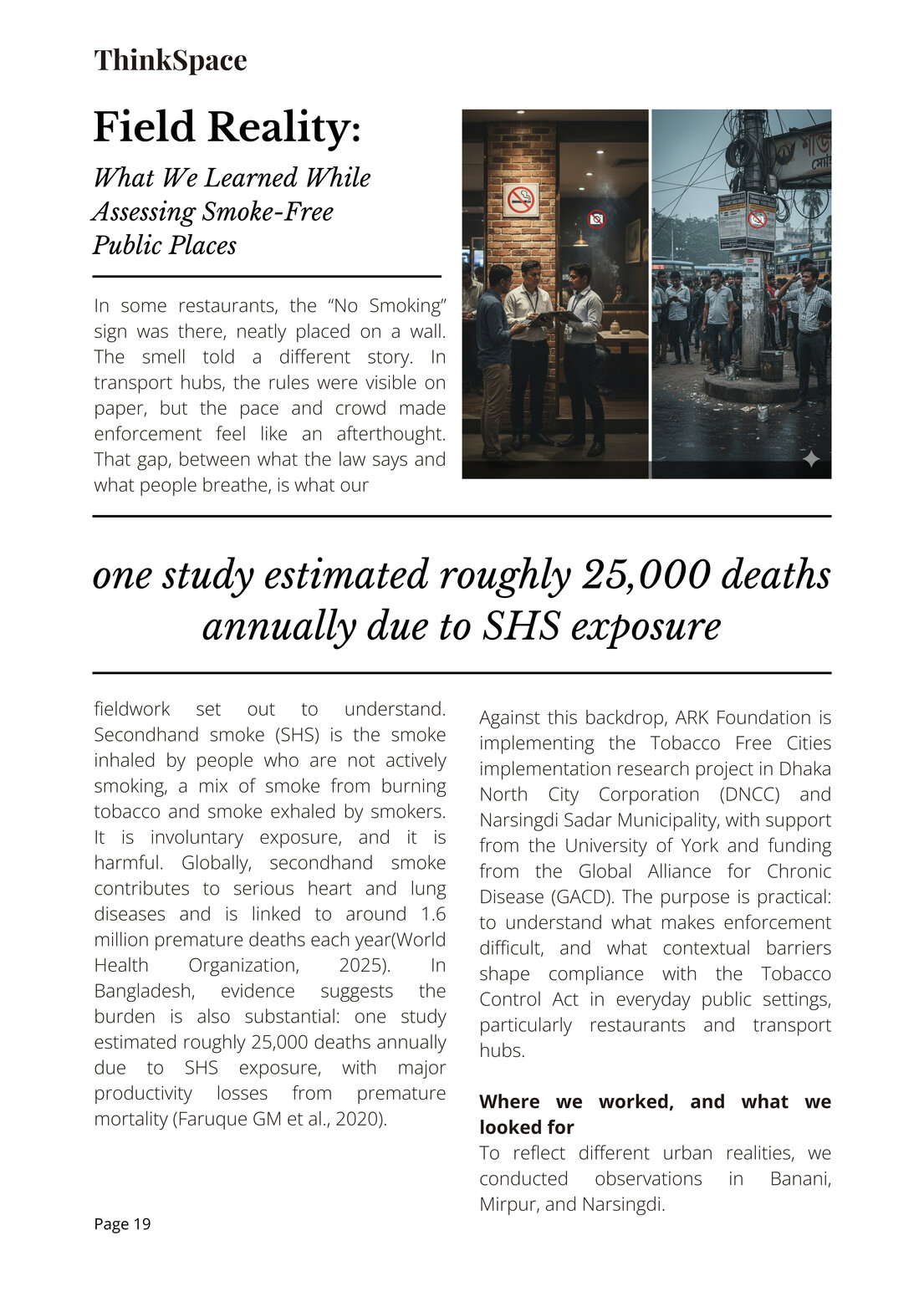
In some restaurants, the “No Smoking” sign was there, neatly placed on a wall. The smell told a different story. In transport hubs, the rules were visible on paper, but the pace and crowd made enforcement feel like an afterthought. That gap, between what the law says and what people breathe, is what our fieldwork set out to understand.

Secondhand smoke (SHS) is the smoke inhaled by people who are not actively smoking, a mix of smoke from burning tobacco and smoke exhaled by smokers. It is involuntary exposure, and it is harmful. Globally, secondhand smoke contributes to serious heart and lung diseases and is linked to around 1.6 million premature deaths each year(World Health Organization, 2025). In Bangladesh, evidence suggests the burden is also substantial: one study estimated roughly 25,000 deaths annually due to SHS exposure, with major productivity losses from premature mortality (Faruque GM et al., 2020).

Against this backdrop, ARK Foundation is implementing the Tobacco Free Cities implementation research project in Dhaka North City Corporation (DNCC) and Narsingdi Sadar Municipality, with support from the University of York and funding from the Global Alliance for Chronic Disease (GACD). The purpose is practical: to understand what makes enforcement difficult, and what contextual barriers shape compliance with the Tobacco Control Act in everyday public settings, particularly restaurants and transport hubs.

Where we worked, and what we looked for

To reflect different urban realities, we conducted observations in Banani, Mirpur, and Narsingdi. Banani represented an upscale, highly commercial area with a dense restaurant environment. Mirpur represented a mixed-income setting within a growing entertainment and commercial zone. Narsingdi provided a semi-urban comparison.

In each area, we observed restaurants (at least one hour) and transport hubs (at least three hours). We focused on a few clear indicators that any visitor would notice: whether “No Smoking” signs were present and visible, whether active smoking was observed, and whether there were clear signs of smoke exposure such as ashtrays, cigarette butts, or a persistent smell.

What the field made clear

The biggest lesson was that collecting reliable evidence in real public spaces is rarely straightforward. In restaurants, long observation periods were sometimes disrupted by peak-hour crowds and staff expectations that observers should place orders or explain their presence repeatedly. In more sensitive settings, such as shisha venues and bars, access and documentation were complicated by security and operating restrictions.

Across both restaurants and transport hubs, ethical and privacy considerations also limited photography. Even when active smoking was visible, capturing images inside premises was often not appropriate. This meant our documentation relied heavily on careful observation, structured note-taking, and consistency across data collectors.

Talking to people: the survey reality

After observations, we conducted brief interviews with restaurant owners, managers, staff, and customers to understand what they knew about the law, how they viewed it, and what they practiced in daily operations. Since each interview took 15–20 minutes, participation was not always easy. Owners and staff were often unavailable during busy hours, while customers cited time constraints, leading to refusals or incomplete interviews. Some restaurants had irregular operating hours, requiring repeated schedule adjustments.

One moment captured the “field reality” perfectly. During a visit to a restaurant near a college at around 5:00 PM, an interview with the manager was interrupted by a sudden rush of students after classes ended. The manager was the only staff member and had to switch immediately to serving customers. We could not shift to interviewing customers either, because most were uniformed students under 18 and ineligible under our ethics protocol. We returned after 9:30 PM, once the rush had passed, to complete the interview.

Why this matters

These observations are not just background details. They show how compliance is shaped by crowd dynamics, business pressures, venue type, and what is realistically enforceable in public spaces. In the field, smoke-free policy is not a checkbox. It is a series of small decisions, made in busy places, that determine whether people are protected or exposed.

Originally published in ThinkSpace Vol:1 (February, 2026)

References:

Faruque GM, Ahmed M, Huq I, Parven R, Wadood SN, Chowdhury SR, Hussain AKM G, Haifley G, Drope J, & Nargis N. (2020). The Economic Cost of Tobacco Use in Bangladesh: A Health Cost Approach.

World Health Organization. (2025). Tobacco. https://www.who.int/health-topics/tobacco#tab=tab_1
What you can read next

Latest Edition of ARK Foundation’s Newsletter
Non-communicable Disease Condition in Bangladesh
Misuse of Antibiotic । এন্টিবায়োটিক ওষুধের যথেচ্ছা ব্যবহার

Recent Posts

  • Where antibiotics enter the city: what we are learning with drug sellers in Mirpur

    Written by: Asiful Haidar Chowdhury (Senior Res...
  • Closing the Gap: How Urban Primary Health Care Can Achieve Health Equity

    Written by: Marhouba Khan Asfi (Research Assist...
  • Field Reflections from CHORUS Project 1 and 2: Listening Between Appointments, Streets, and Silence

    Written by: Nabila Binth Jahan (Junior Research...
  • When Public Spaces Aren’t Truly Public: Making Physical Activity Safer for Women and Girls in Urban Bangladesh

    Written by: Umme Salma Anee (Senior Research As...
  • Addressing the Knowledge Deficit: Health Education and Public Awareness in Bangladesh

    Written by: Kazi Fatin Sami (Research Assistant...
  • Behind the Numbers: Verifying Immunization Coverage in the Rohingya Camps

    Written by: Ibrahim Hasan (Research Assistant) ...
  • The Hidden Tax on Health: Why Diabetes is Bankrupting Bangladesh’s Families

    Written by: Sirat-E-Rowshan Islam (Research Upt...
  • Social determinants of health (SDOH) and its relationship with clinical and economic outcomes in people with type 2 diabetes in Bangladesh

    Social determinants of health and its relations...
  • Universal Health Coverage needs more than a bigger budget. It needs institutions and skills

    As the nation is heading towards its 13th natio...
  • Developing and evaluating an adapted behavioral activation intervention for people with depression and diabetes (DiaDeM)

    DiaDeM stands for “Developing and evaluating an...
  • ThinkSpace: Quarterly Research Digest

    ARK Foundation is pleased to launch ThinkSpace,...
  • CHORUS Annual Partners’ Meeting

    The CHORUS Partners’ Meeting officially commenc...
  • আসন্ন নির্বাচনে রাজনৈতিক দলগুলোর কাছে স্বাস্থ্যখাতে প্রত্যাশা

    আগামী ত্রয়োদশ জাতীয় সংসদ নির্বাচনকে সামনে রেখে ...
  • 𝐋𝐨𝐜𝐚𝐥 𝐑𝐞𝐚𝐥𝐢𝐭𝐢𝐞𝐬 𝐚𝐧𝐝 𝐇𝐞𝐚𝐥𝐭𝐡 𝐂𝐚𝐫𝐞 𝐂𝐡𝐨𝐢𝐜𝐞𝐬: 𝐂𝐨𝐦𝐦𝐮𝐧𝐢𝐭𝐲 𝐏𝐞𝐫𝐬𝐩𝐞𝐜𝐭𝐢𝐯𝐞𝐬 𝐟𝐨𝐫 𝐄𝐪𝐮𝐢𝐭𝐚𝐛𝐥𝐞 𝐔𝐫𝐛𝐚𝐧 𝐏𝐫𝐢𝐦𝐚𝐫𝐲 𝐇𝐞𝐚𝐥𝐭𝐡 𝐂𝐚𝐫𝐞 𝐢𝐧 𝐃𝐡𝐚𝐤𝐚, 𝐁𝐚𝐧𝐠𝐥𝐚𝐝𝐞𝐬𝐡

    Let’s lookback at the impactful contributions f...
  • Identifying barriers and facilitators for health risk behaviours among people with severe mental illness in Bangladesh and Pakistan: a qualitative study

    Read the full article here People with severe m...
  • আসন্ন নির্বাচনে রাজনৈতিক দলগুলোর কাছে স্বাস্থ্যখাতে প্রত্যাশা

    আসন্ন নির্বাচনে রাজনৈতিক দলগুলোর কাছে স্বাস্থ্য...
  • Engaging rural communities in Bangladesh to address antimicrobial resistance via the community dialogue approach: a protocol for a cluster-randomized controlled trial

    Click here to read the full article Introductio...
  • From Intervention to Impact: A Qualitative Process Evaluation of a NCD Intervention to Strengthen Urban Resilience in Urban Dhaka City

    Let’s lookback at the impactful contributions f...
  • An mHealth (Mobile Health) Intervention for Smoking Cessation in People With Tuberculosis: A Cluster Randomized Clinical Trial

    Find the full article here A new research artic...
  • Understanding Access to Primary Healthcare in Dhaka’s Urban Slums: A Qualitative Inquiry into Community Perceptions and Health Equity Challenges

    Find the PDF here or Read HTML version ARK Foun...

Empower Your Career with ARK Foundation

Discover opportunities to make a difference in health, education, gender equality, and environmental sustainability.

JOIN US

ARK Foundation is a non-government, non-political and not-for-profit organization dedicated to the socio-economic development of Bangladesh. Through evidence-based research, training and communications it provides sustainable solutions for health, education and social development.

ADDRESS

Suite A-1, C-3 & C-4, House # 06, Road # 109,
Gulshan-2, Dhaka, Bangladesh, 1212

Phone: +88 02 55069866

Email: info@arkfoundationbd.org

LOCATION

  • GET SOCIAL

© 2025. All rights reserved. ARK Foundation.

TOP