• Privacy Policy
  • Terms & Condition
  • Archive

ARK Foundation

  • Home
  • About
    • About Organization
    • Our Partners
    • Global Networks & Leadership
  • Our Team
    • Advisor
    • Executive Director
    • Research and Development
    • Research Uptake & Communications
    • Programme and Training
    • Finance and Administration
    • Data and Field Management
  • Our Work
    • Communicable Disease
    • Non-communicable Disease
    • Multimorbidity
    • Antimicrobial Resistance
    • Maternal, Newborn, Child and Reproductive Health
    • Nutrition
    • Health Systems
    • Climate Change and Environment
    • Gender, Equity and Social Inclusion
  • News & Media
    • Event
    • News
    • Blog
    • Video
    • Newsletter
  • Resources
    • Journal Article
    • Report
    • Working Paper
    • Project Brief
    • Policy Brief
    • Conference Proceedings
    • Infographics
    • Posters
  • Career
  • Contact
/ Published in Blog, News and Media

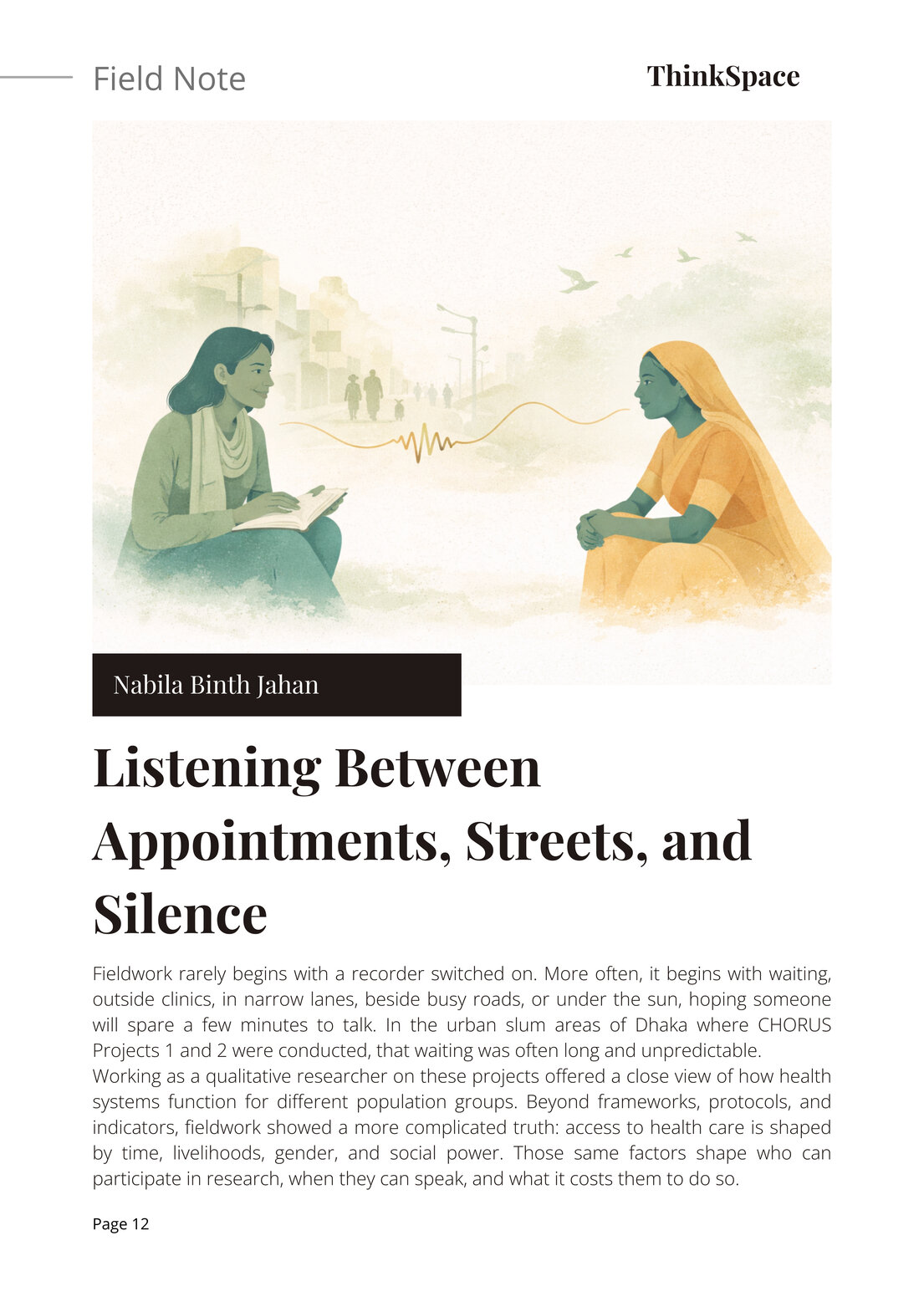
Listening Between Appointments, Streets, and Silence

Written by: Nabila Binth Jahan (Junior Research Associate)

Fieldwork rarely begins with a recorder switched on. More often, it begins with waiting, outside clinics, in narrow lanes, beside busy roads, or under the sun, hoping someone will spare a few minutes to talk. In the urban slum areas of Dhaka where CHORUS Projects 1 and 2 were conducted, that waiting was often long and unpredictable.

Working as a qualitative researcher on these projects offered a close view of how health systems function for different population groups. Beyond frameworks, protocols, and indicators, fieldwork showed a more complicated truth: access to health care is shaped by time, livelihoods, gender, and social power. Those same factors shape who can participate in research, when they can speak, and what it costs them to do so.

Engaging Participants in Their Daily Lives

Fieldwork in Dhaka’s urban slums was rarely straightforward. From the start, data collection meant working around constrained schedules and the everyday realities of survival, informal labour, mobility, and social pressure.

Many participants worked long hours in informal or mobile jobs, where even a short interview could mean losing income. People checked the time repeatedly. Some agreed to speak only if we kept it brief. Interviews were postponed, interrupted, or completed in short segments between work tasks. Scheduling depended on narrow time windows, early mornings, late evenings, or brief breaks, and we often returned to the same lanes more than once to complete a single conversation.

Silence was not only the absence of words. Sometimes it was a glance that signaled someone was listening. Sometimes it was a pause before answering, as if the safest response was the shortest one. In a few cases, the interview had to happen in fragments, with certain topics avoided entirely. These moments were reminders that participation is never only about willingness. It is shaped by safety, privacy, and whether speaking openly carries social or economic risk.

Inside the Health Facilities

If community interviews were constrained by livelihoods and time, facilities brought a different kind of pressure. Clinics were consistently crowded and fast-paced. Patients waited shoulder-to-shoulder, and providers moved quickly from one person to the next. The next patient often stepped forward before the previous interaction had fully ended.

Conversations with doctors and nurses happened in brief gaps between consultations or at the end of long shifts. Providers were generally cooperative, but many were visibly fatigued and pressed for time, sometimes speaking while standing, scanning the waiting area, or apologizing for having to cut the conversation short. Even when people wanted to engage, the system rarely made space for it.

Reflections and Closing Thoughts

This experience reinforced one practical lesson : flexibility is not a helpful add-on in field research, it is the work. Future studies in similar settings should plan for shorter interview windows, repeated engagement, and schedules that respect the realities of participants’ and providers’ lives.

At the same time, adaptability does not erase inequity. Some people will always be harder to reach, not because they do not matter, but because their lives leave them less room to pause. If we want research to represent diverse urban realities, we have to design it around the people who have the least time, the least privacy, and the most to lose by speaking.

Originally published in ThinkSpace Vol:1 (February, 2026)


What you can read next

ARK Foundation, Bangladesh, co-creating urban health interventions to improve NCD service delivery
ARK’s SIMPLE Solution to the Urban Data Dearth
Low budget or management flaws? Experts flag inefficiency in health spending

Recent Posts

  • The Karlson-Holm-Breen (KHB) Method: Why Logistic Mediation Results Might Be Misleading?

    Read pdf here Written by Ibrahim Hasan and S M ...
  • South Asian Coalition of Policy and Evidence for Equitable food systems (SCOPE)

    The South Asian Coalition of Policy and Evidenc...
  • Fragmentation in urban health service provision? A plurality of providers is the answer

    Read it here or download PDF  Abdullah Rafi, fr...
  • International Women’s Day 2026

      When women give knowledge, care, and lea...
  • In-country public-private partnerships hold the key to promoting inclusiveness in Dutch trade and international cooperation agenda

    Read the PDF here...
  • COVID-19 and Tobacco

    Read the PDF here  ...
  • Taxation on Sugar-Sweetened Beverages (SSBs) in Bangladesh: What should we do?

    Read the PDF here...
  • Public Private Partnership in Improving Access and Utilization of Health Care Services: Scopes, Opportunities and Challenges

    Find the PDF here  ...
  • Influencing TB policy and practice in Bangladesh using a Public-Private Mix approach

    Read the PDF here Policy messages: TB case noti...
  • How can public-private partnerships enhance the use of long acting contraceptive methods in Bangladesh?

    Read the PDF here Using a public-private partne...
  • Improving the quality of care at community clinics in rural Bangladesh through new approaches

    Read the PDF here Key messages The training was...
  • Integrating tobacco cessation within the TB programme: Findings from the ‘TB & Tobacco’ study

    Find the PDF here Integrating tobacco cessation...
  • The Complicated Cigarette Tax Structure in Bangladesh is Causing Expansion of the Low-Tier Cigarette Market and Lower Tax Revenue

    Find the PDF here Implementing a uniform ad val...
  • Digital Health in Dhaka | Simple App | Transforming Urban Healthcare | Channel 24 | ARK Foundation

      Digital health is reshaping urban health...
  • বাংলাদেশে স্বাস্থ্যবিমা: বাস্তবসম্মত সমাধান নাকি শুধু আলোচনা? | Channel 24 | ARK Foundation

    স্বাস্থ্যসেবার ব্যয় কি নাগালের বাইরে চলে যাচ্ছ...
  • Course: Project Management in Public Health

    Download the prospectus from here Introduction ...
  • Precision at Scale: Managing 3,559 Survey Clusters in the World’s Largest Refugee Settlement

    Find the pdf version here or read it here By  Z...
  • The Areca Nut Paradox in Bangladesh: A Rapid Review of Cultural Embeddedness, Public Health Risks, Livelihood Dependence, and Policy Gaps

    Read it here or download the PDF version By Nab...
  • Why does it matter? Childhood obesity among school going children in Urban Bangladesh: Potential Way Forward

    Read the PDF here Written by Badruddin Saify Fo...
  • বৈষম্য কমাতে চাই কার্যকর প্রাথমিক স্বাস্থ্যসেবা | Prof. Dr. Liaquat Ali | ARK Foundation | Channel24

    স্বাস্থ্যসেবা কি শুধু প্রতিশ্রুতির মধ্যেই আটকে ...

Empower Your Career with ARK Foundation

Discover opportunities to make a difference in health, education, gender equality, and environmental sustainability.

JOIN US

ARK Foundation is a non-government, non-political and not-for-profit organization dedicated to the socio-economic development of Bangladesh. Through evidence-based research, training and communications it provides sustainable solutions for health, education and social development.

ADDRESS

Suite A-1, C-3 & C-4, House # 06, Road # 109,
Gulshan-2, Dhaka, Bangladesh, 1212

Phone: +88 02 55069866

Email: info@arkfoundationbd.org

LOCATION

  • GET SOCIAL

© 2025. All rights reserved. ARK Foundation.

TOP