Highlights:
- Flawed preparation blamed for failing to identify priorities
- Despite potential, primary healthcare underfunded
- Managerial inefficiency hampers fund utilisation
- NCDs underprioritised despite rising deaths
- Women, child health budget cut again
- Need skilled managers, better planning
- Private sector unregulated, inequitable care
- Budget usually slashed significantly in revisions
The health sector is facing major budgetary challenges due to flawed preparation processes that fail to identify priorities, leading to inefficient fund allocation and poor utilisation, experts said.
They also said there is a lack of managerial efficiency, as well, in implementing the health budget.
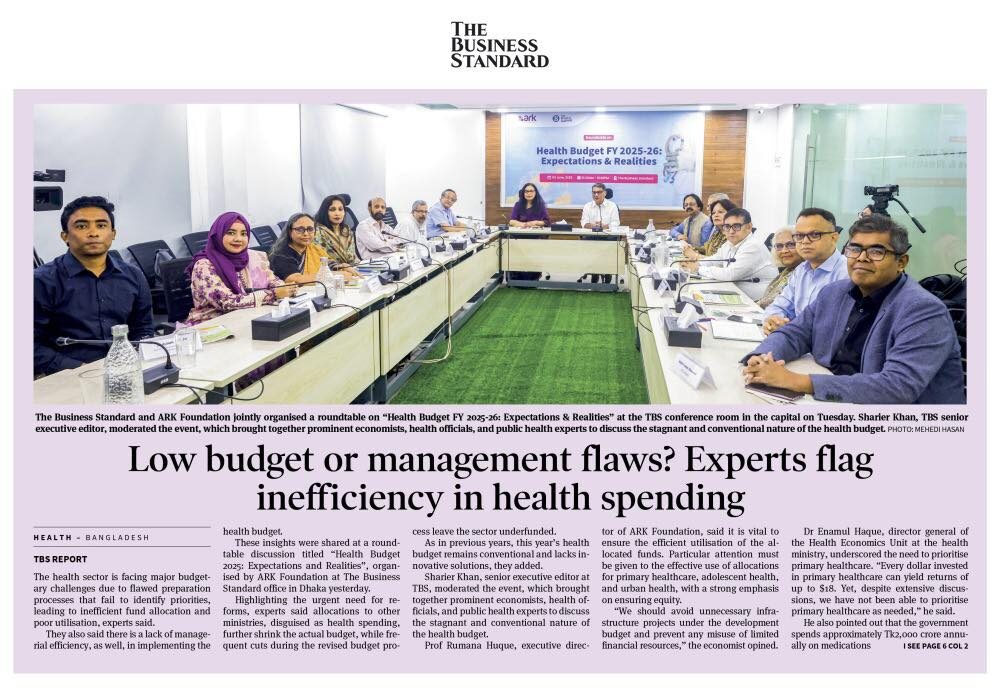
These insights were shared at a roundtable discussion titled “Health Budget 2025: Expectations and Realities”, organised by ARK Foundation at The Business Standard office in Dhaka yesterday (4 June).
Highlighting the urgent need for reforms, experts said allocations to other ministries, disguised as health spending, further shrink the actual budget, while frequent cuts during the revised budget process leave the sector underfunded.
As in previous years, this year’s health budget remains conventional and lacks innovative solutions, they added.
Sharier Khan, senior executive editor at TBS, moderated the event, which brought together prominent economists, health officials, and public health experts to discuss the stagnant and conventional nature of the health budget.
Prof Rumana Huque, executive director of ARK Foundation, said it is vital to ensure the efficient utilisation of the allocated funds. Particular attention must be given to the effective use of allocations for primary healthcare, adolescent health, and urban health, with a strong emphasis on ensuring equity.
“We should avoid unnecessary infrastructure projects under the development budget and prevent any misuse of limited financial resources,” the economist opined.
Dr Enamul Haque, director general of the Health Economics Unit at the health ministry, underscored the need to prioritise primary healthcare. “Every dollar invested in primary healthcare can yield returns of up to $18. Yet, despite extensive discussions, we have not been able to prioritise primary healthcare as needed,” he said.
He also pointed out that the government spends approximately Tk2,000 crore annually on medications for hypertension and diabetes, which accounts for around 5% of total pharmaceutical expenditure.
Addressing the issue of underutilisation, Dr Enamul said in the absence of a sector-wide programme, Primary Health Care must now be integrated into the Development Project Proposal (DPP). It is crucial to clearly define the health ministry’s financing mechanisms. “Without a sound budgeting process, it becomes difficult to identify priority areas and effectively utilise allocated resources. This inability to spend is one of the reasons the health sector’s budget remains stagnant,” he added.
He further said that “including medicines and vaccines under the revenue budget is a step in the right direction,” but stressed the need for “skilled managers – professionals trained in health management” to bring meaningful reform.
Without a sound budgeting process, it becomes difficult to identify priority areas and effectively utilise allocated resources. This inability to spend is one of the reasons the health sector’s budget remains stagnant
Dr Enamul Haque, director general of the Health Economics Unit, Health Services Division
Highlighting managerial gaps, Prof Dr Liaquat Ali, member of the Healthcare Reform Commission, said, “There is a significant gap in our managerial capacity when it comes to implementing the budget. Recent steps such as tax exemptions for insulin and cancer medications, along with tax relief for hospitals, are commendable.”
However, there must be robust monitoring to assess the real impact of these measures on public welfare, and hospitals must be held accountable for delivering results, he added.
Criticising budgetary inconsistencies, Public health expert Dr Muhammod Abdus Sabur, said, “It’s like a conjurer’s trick — the original budget versus the revised one. Initially, 5.3% has been allocated to the health sector, but this could drop to around 3% in the revised budget.”
He added that “funds meant for health frequently go to other ministries,” citing the example of Tk4,000 crore allocated for poor patients, which “might be transferred to the Ministry of Social Welfare.”
Dr Sabur stressed, “If such transfers of health funds to other ministries are curbed, the actual budget for the health sector will naturally increase.”
Women’s health also remains a key concern. Dr Halida Hanum Akhter, founder of Society for Health Promotion Links, said, “In our country, maternal mortality is still high, yet the budget for women’s and child health has decreased. Most women still do not receive the four antenatal care visits. The budget should be allocated for those people whose lives are at risk if they do not get the service.”
Prof Dr Syed Zakir Hossain, line director of NCD (non-communicable diseases) Control, said, “1% of Bangladesh’s population die from non-communicable diseases, causing 51% of premature deaths—higher than in other countries. Despite this, only 4% of the health budget is allocated to NCDs, which is inadequate.”
He pointed to frequent delays in medicine supply due to late budget releases at NCD corners and urged for “better budget allocation, utilisation, and monitoring.”
Public health expert Dr MH Choudhury Lelin said, “This year’s healthcare budget remains unchanged, with no clear responsibility assigned for urban health services, although 32% of the population live in cities.”
He noted some positive steps, such as reduced prices for anti-cancer drugs and sanitary napkins.
Yasmin H Ahmed, project adviser at Bangladesh Health Watch, called for “practical implementation” of the Health Reform Commission’s report.
Meanwhile, Dr Mahbub Elahi Chowdhury, senior scientist at icddr,b, advocated for increased accountability in the largely unregulated private health sector.
In 2016, the government started piloting the Shasthyo Shurokhsha Karmasuchi (SSK) programme, and although positive results were seen, it was not taken to the national level,” he added.
Dr Mahmuda Ali from Dhaka North City Corporation mentioned that they will increase the budget for primary health care this year.
Originally published in The Daily Business Standard on June 5, 2025. Find the report here.