Read the article here or download PDF version
Abstract
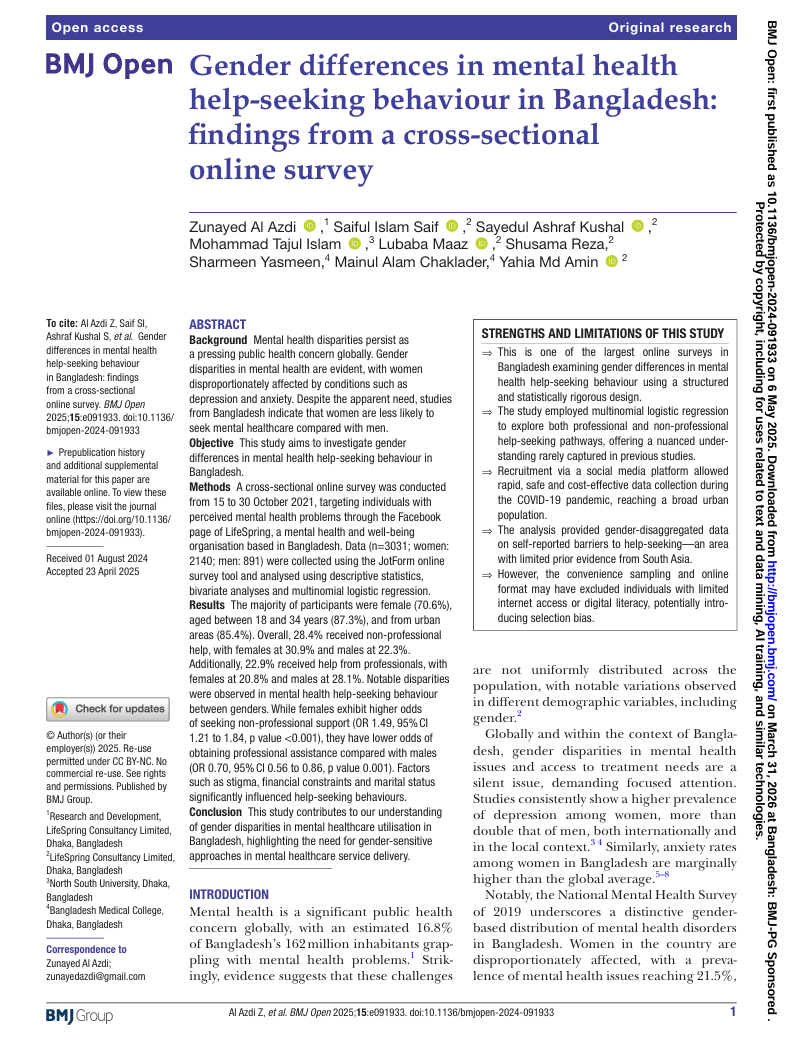
Background Mental health disparities persist as a pressing public health concern globally. Gender disparities in mental health are evident, with women disproportionately affected by conditions such as depression and anxiety. Despite the apparent need, studies from Bangladesh indicate that women are less likely to seek mental healthcare compared with men.
Objective This study aims to investigate gender differences in mental health help-seeking behaviour in Bangladesh.
Methods A cross-sectional online survey was conducted from 15 to 30 October 2021, targeting individuals with perceived mental health problems through the Facebook page of LifeSpring, a mental health and well-being organisation based in Bangladesh. Data (n=3031; women: 2140; men: 891) were collected using the JotForm online survey tool and analysed using descriptive statistics, bivariate analyses and multinomial logistic regression.
Results The majority of participants were female (70.6%), aged between 18 and 34 years (87.3%), and from urban areas (85.4%). Overall, 28.4% received non-professional help, with females at 30.9% and males at 22.3%. Additionally, 22.9% received help from professionals, with females at 20.8% and males at 28.1%. Notable disparities were observed in mental health help-seeking behaviour between genders. While females exhibit higher odds of seeking non-professional support (OR 1.49, 95% CI 1.21 to 1.84, p value <0.001), they have lower odds of obtaining professional assistance compared with males (OR 0.70, 95% CI 0.56 to 0.86, p value 0.001). Factors such as stigma, financial constraints and marital status significantly influenced help-seeking behaviours.
Conclusion This study contributes to our understanding of gender disparities in mental healthcare utilisation in Bangladesh, highlighting the need for gender-sensitive approaches in mental healthcare service delivery.
Data availability statement
Data are available upon reasonable request. The data sets generated and/or analysed during the current study are not publicly available due to ethical restrictions but are available from the corresponding author, ZAA, on reasonable request.
This is an open access article distributed in accordance with the Creative Commons Attribution Non Commercial (CC BY-NC 4.0) license, which permits others to distribute, remix, adapt, build upon this work non-commercially, and license their derivative works on different terms, provided the original work is properly cited, appropriate credit is given, any changes made indicated, and the use is non-commercial. See: http://creativecommons.org/licenses/by-nc/4.0/.
Introduction
Mental health is a significant public health concern globally, with an estimated 16.8% of Bangladesh’s 162 million inhabitants grappling with mental health problems.1 Strikingly, evidence suggests that these challenges are not uniformly distributed across the population, with notable variations observed in different demographic variables, including gender.2
Globally and within the context of Bangladesh, gender disparities in mental health issues and access to treatment needs are a silent issue, demanding focused attention. Studies consistently show a higher prevalence of depression among women, more than double that of men, both internationally and in the local context.3 4 Similarly, anxiety rates among women in Bangladesh are marginally higher than the global average.5–8
Notably, the National Mental Health Survey of 2019 underscores a distinctive gender-based distribution of mental health disorders in Bangladesh. Women in the country are disproportionately affected, with a prevalence of mental health issues reaching 21.5%, compared with 15.7% in men.5 This disparity extends across various mental health conditions, with women being twice as likely as men to experience common mental disorders such as depression and anxiety.9–12
Several factors contribute to the gender disparities observed in mental health outcomes in Bangladesh. An evident employment gap between the sexes, particularly pronounced in rural areas, further compounds the challenges faced by women.13 In rural contexts, where discrimination against females is prevalent, accessing mental health services becomes a formidable task due to societal stigmatisation and concerns about privacy.14
Despite the apparent need, studies highlight that women in Bangladesh are less likely to seek mental healthcare than men.15 This disparity is largely attributed to a complex interplay of socio-cultural and economic factors, including social stigma, traditional beliefs, gender norms, religious taboos, financial constraints, limited access to resources, mobility restrictions and the need for permission from male family members.16–18 Even among those affected, a mere 11.6% of women sought mental healthcare compared with 12.4% of men according to the national mental health survey.5 Stigma further compounds the issue, with women reporting more mental health-related stigma than their male counterparts.19 This situation is exacerbated by a lack of awareness regarding where and when to seek mental healthcare, particularly among vulnerable groups like women with mental health conditions.10 11
Against this backdrop, this study seeks to enhance understanding of gender differences in mental health help-seeking behaviours in Bangladesh. By examining these disparities, it aims to identify the barriers that hinder care utilisation and inform the development of tailored interventions that address the unique needs of underserved populations and promote equitable access to mental health services.
To guide this analysis, the study addresses the following research questions:
-
What are the gender differences in professional and non-professional mental health help-seeking behaviours among individuals in Bangladesh reporting mental health concerns?
-
What socio-demographic factors are associated with these help-seeking behaviours?
-
What are the gender-specific barriers to mental health help-seeking?
By answering these questions, the study intends to support gender-responsive mental health strategies and contribute to evidence-based service planning in low-resource settings like Bangladesh.
Methods
Study design and study population
A cross-sectional online survey was conducted from 15 to 30 October 2021 to investigate the help-seeking behaviours of individuals with a history of perceived mental health problems in Bangladesh. According to the World Health Organization (WHO) Bangladesh COVID-19 Situation Report published on 1 November 2021, the country was experiencing a decline in COVID-19 cases at that time. However, given the constraints imposed by the COVID-19 pandemic, logistical challenges and budget considerations, an online approach was adopted to safely reach a diverse national sample. The study targeted the general population in Bangladesh with internet access.
Sampling method
We employed a convenience sampling strategy to recruit study subjects, leveraging the extensive reach of LifeSpring’s Facebook page, connecting with over 1 million Bangladeshis. To promote engagement, a short video was shared on the page explaining the study objectives and encouraging participation. Out of 64 666 video views, 7763 (12.00%) individuals accessed the online survey.
On accessing the survey, participants were required to complete a screening section to determine eligibility. They were asked four yes/no questions: (1) whether they wished to participate after reading the study information, (2) whether they had ever experienced mental health problems (either diagnosed or self-perceived), (3) whether they were Bangladeshi citizens and (4) whether they were aged 18 years or older. Only those who responded ‘yes’ to all four questions were allowed to proceed to the main survey.
Data collection
Data were collected using the JotForm online survey tool after initial screening based on inclusion criteria. The survey, open from 15 to 30 October 2021, covered screening for enrolment criteria, demographics, mental health help-seeking behaviours and personal experiences. Of the 7763 who accessed the online survey, 3031 (39.04%) individuals completed the questionnaire. The survey included optional entry into a lottery through which five participants were randomly selected to receive free consultation sessions with a mental health professional from the organisation.
Survey tool
The survey instrument consisted of approximately 50 structured questions, including both fixed-choice and branching questions. Items covered demographics, history of mental health issues, patterns of professional and non-professional help-seeking, perceived barriers and facilitators to care, and opinions on the mental health system in Bangladesh. The questionnaire was developed based on prior studies and expert consultation, with items adapted to the cultural and health system context. The tool was pilot-tested with 15 participants to ensure clarity and usability. The estimated time to complete the survey was 5–7 min. On completion, participants were provided with brief information about available mental health resources for further support. The full questionnaire is included as an online supplemental file.
Supplemental material
Data analysis
As most survey questions were marked as mandatory in the online platform and participants could not submit incomplete responses, the data set used for analysis had no missing values for the key variables. Participants retained the option to exit the survey at any point before submission. Two responses were excluded from the analysis as the participants did not disclose their gender, which was essential for gender-based comparisons. For analysis, descriptive statistics, such as frequencies, proportions, means and SD, were used to describe the demographic characteristics of study subjects and their help-seeking behaviours. Bivariate analyses were conducted to outline the gender differences in demographic characteristics and assess the association of demographic characteristics with help-seeking behaviours, using the χ2 test, while the z-test assessed differences in reasons for not seeking help. The dependent variable, help-seeking behaviour, was categorised into three levels: (1) no help received (coded as 0, the comparison group; n=1476); (2) help from non-professionals (coded as 1; n=860) and (3) help received from professionals (coded as 2; n=695). Multinomial logistic regression was employed to examine the relationship between help-seeking behaviour and gender, after controlling for demographic variables associated with gender (p value <0.05) in bivariate analyses, and checking multicollinearity. All tests were two-sided, and a p value of <0.05 was deemed statistically significant. Analyses were performed using SPSS V.26 and Stata V.13.
Patient and public involvement
Although patients and the public were not formally involved in the study design or conduct, informal consultations within the research team and feedback from pilot participants were incorporated to refine the survey tools and improve their clarity and accessibility.
Results
The study included 3031 participants who completed the online survey, of which 2140 (70.6%) were females and 891 (29.4%) were males (table 1). The mean age was 27 years (SD 6.8), with most participants between 18 and 34 years old (87.3%). The majority resided in urban areas (85.4%) and held a graduate degree or above (78.9%). About one-third (32.6%) reported monthly family incomes exceeding BDT 50 000 (approximately US$412), considered relatively high in the Bangladeshi context and may be broadly classified as higher socio-economic status, given that the national average monthly household income is considerably lower.20 Just under half (45.5%) were married. In terms of occupation, 49.3% were students, while 16.8% were homemakers, 20.3% had jobs, 3.4% ran businesses and 10.3% specified other occupations.
Gender differences in socio-demographic factors and help-seeking behaviours
Overall, 48.7% of participants did not seek any help for mental health problems. Among those who did seek help, 28.4% received assistance from non-professionals only, while 22.9% obtained help from professionals. Among those who sought professional help, about 26% consulted medical doctors and 74% consulted psychiatrists or psychologists. Non-professional support predominantly came from friends/relatives (57%) or family members (34.2%), with smaller proportions accessing religious healers (3.5%), homeopaths (1.6%), traditional healers (1.2%) or other contacts (2.6%) (table 2).
Mental health help-seeking behaviour
Examining barriers among those not seeking help (n=1476) (table 3), lack of accompaniment deterred more females (44.3%) than males (26.2%) (p<0.001). However, stigma impeded significantly more males (47.7%) versus females (40.3%) (p=0.005). Also, financial constraints affected relatively more males (38.5%) than females (32.1%) (p=0.011). Furthermore, more males (26.9%) did not find it necessary to seek help than females (20.0%) when suffering from mental health problems (p=0.002).
Reasons for not seeking help for mental health problems (multiple response)
Females had higher adjusted odds of seeking non-professional support versus not seeking help (adjusted OR (aOR) 1.49, 95% CI 1.21 to 1.84, p<0.001) yet lower adjusted odds of obtaining professional assistance relative to males (aOR 0.70, 95% CI 0.56 to 0.86, p=0.001), after controlling for income, education, marital status and occupation (table 4). Also, relative to those earning over BDT 50 000 monthly, participants with incomes between BDT 30 000 and 50 000 had 0.78 times lower adjusted odds (95% CI 0.61 to 0.99, p=0.039) of seeking professional mental health services. Additionally, unmarried participants had 0.66 times lower adjusted odds than married/widowed individuals (95% CI 0.51 to 0.85, p=0.001) of obtaining help from professionals. Unadjusted ORs from the bivariate analysis are presented in online supplemental table 1 for reference.
Supplemental material
Gender differences in mental health help-seeking behaviour: multinomial logistic regression analysis
Discussion
The present study investigates the gender differences in mental health help-seeking behaviour within the context of Bangladesh, shedding light on various facets influencing individuals’ choices regarding seeking assistance for mental health problems. Our findings underscored several significant trends in help-seeking behaviour, including the prevalence of non-professional support, the impact of stigma and financial constraints, and the role of socio-cultural factors.
One notable observation from our study was the considerable proportion of individuals (48.7%) who did not seek any help for their mental health issues. This finding aligns with previous research indicating a pervasive lack of awareness about mental health conditions in Bangladesh.21 Despite this, among those aware of mental health conditions, a positive attitude towards seeking professional help was observed, suggesting that efforts to raise awareness could potentially improve help-seeking behaviour.
Moreover, our results revealed a preference for non-professional support over professional assistance, with a majority of individuals turning to friends/relatives or family members. The high reliance on informal sources of support aligns with findings from earlier studies in Bangladesh, which have highlighted the widespread use of non-professional care for mental health concerns.15 It also mirrors findings from research on health-seeking behaviour for other health issues, such as physical violence and serious health conditions like stroke, indicating a broader trend of seeking non-professional help for various health concerns.22 23
Gender disparities emerged as a significant theme in our study, with distinct differences noted in the barriers faced by males and females. Females were more likely to seek non-professional support, possibly reflecting their reliance on social support networks and cultural norms that encourage seeking help from close contacts.24 Conversely, males were disproportionately affected by stigma and financial constraints, which hindered their access to professional assistance.22 25
Socio-cultural factors, such as gender roles and marital status, also played a pivotal role in shaping help-seeking behaviour. Research indicates that women in Bangladesh often require guardians’ permission to access healthcare, reflecting the influence of gender norms on health-seeking practices.26 Additionally, the perceived availability of social support among married or widowed individuals may encourage them to seek professional help, highlighting the importance of supportive relationships in facilitating help-seeking behaviour.27
The COVID-19 pandemic has further exposed the fragility of mental health service delivery in Bangladesh, exacerbating existing barriers to care. Studies reported alarmingly high rates of anxiety (87%) and depression (64%) during the pandemic, especially among women, who faced increased burdens as caregivers and health workers.28 Women’s mental health was additionally affected by economic insecurity, isolation and increased risks of abuse and workplace vulnerabilities in patriarchal households.29 The pandemic underscored the inadequacy of centralised services and the urgent need for decentralised, community-based mental health interventions.30 Moreover, financial constraints and urban service disparities further restricted access, particularly for economically disadvantaged women.31 These recent developments highlight the importance of reforming mental health systems to be more gender-responsive, accessible and resilient to future shocks.
In interpreting these findings, it is important to consider the broader context of mental health service provision in Bangladesh. While our study defined ‘professional help’ primarily as care provided by psychiatrists and psychologists, other mental health professionals such as counsellors and therapists also operate in limited capacities.4 However, the availability of these services is heavily skewed towards urban areas, with only around 260 psychiatrists and 565 psychologists nationwide. Psychosocial interventions are largely restricted to tertiary hospitals, and integration into primary care remains limited despite efforts like mhGAP training (WHO’s Mental Health Gap Action Programme to strengthen mental health services in primary care settings).32 Public facilities often face resource constraints, and while government hospitals do offer some outpatient psychiatric services, these are not fully subsidised, leading to out-of-pocket costs for patients. As a result, comprehensive, publicly funded mental healthcare remains limited and largely inaccessible to many, especially in rural areas. Mental health receives only 0.44% of the national health budget, with most funds directed to psychiatric hospitals.33 These systemic gaps help contextualise the low use of professional services and the gender disparities observed in our study, underscoring the need to expand affordable, community-based and gender-sensitive mental healthcare.
The findings from our study resonate with global evidence highlighting the complex interplay of individual, social and structural factors in shaping mental health help-seeking behaviour. While females may face fewer stigmas around acknowledging mental health issues, structural barriers such as the availability and affordability of services pose significant challenges.34 In the Bangladeshi context, women often require the explicit or implicit permission of a male guardian—typically a father, husband or brother—to seek healthcare, including for mental health concerns.26 35–37 This gendered dependence can delay or entirely prevent timely help-seeking, especially in households where mental health is poorly understood or stigmatised.16 38 Addressing this challenge requires a culturally tailored, multilevel approach. Community-based mental health literacy programmes should target not only women, but also male family members, to build shared understanding and support for care-seeking.39 Integrating mental health awareness into school curricula and local government outreach can also help shift societal norms. Policy efforts should include safeguards to ensure women and adolescent girls can access services confidentially and without needing third-party permission, particularly in public and school-based health systems.40 These strategies are essential for removing structural gatekeeping and enabling women to exercise autonomy over their mental health decisions.
In recent years, several public and non-governmental initiatives have emerged to promote mental health awareness and help-seeking in Bangladesh. The National Mental Health Strategic Plan (2020–2030) outlines the goals to decentralise services, reduce stigma and integrate mental health into primary care. Non-governmental organisations and private organisations have also launched mental health hotlines, online counselling services and awareness campaigns through social media platforms.41 Universities and youth-focused organisations have started peer support initiatives and campus-based mental health programmes, although their coverage remains limited.42 43 These efforts reflect the growing recognition of the need to normalise mental health conversations and expand accessible care pathways.
In conclusion, the study provides valuable insights into gender differences in mental health help-seeking behaviour in Bangladesh. By understanding the intricate interplay of socio-cultural, economic and individual factors influencing help-seeking behaviour, policymakers and healthcare providers can develop more inclusive and accessible mental health services that cater to the diverse needs of the population.
Limitations
This study has several limitations to note. First, the cross-sectional design limited our ability to assess causal relationships between demographic factors and help-seeking behaviours. Second, our online recruitment strategy may have biased the sample towards literate, tech-savvy social media users, limiting generalisability. Additionally, the offer of an optional post-survey lottery for free consultations may have introduced self-selection bias, potentially attracting individuals with unmet mental health needs who were motivated by the chance to receive care. Third, self-reported data could be subject to recall errors or social desirability biases. In-person interviews could facilitate more accurate reporting in future studies.
Fourth, while we found no evidence of multicollinearity among predictors, there may be unmeasured confounding variables that influence help-seeking, like mental health knowledge, stigma, social support or symptom severity.
Additionally, the inclusion criteria required participants to self-identify as having experienced mental health problems and be willing to complete an online survey. This may have biased the sample towards individuals who were more open or comfortable discussing mental health concerns, potentially under-representing those with more severe conditions or higher levels of stigma.
Finally, while the study focused on gender differences in mental health help-seeking behaviours, other relevant factors such as cultural beliefs and geographical location were not comprehensively explored. Future research endeavours should address these limitations to provide a more comprehensive understanding of mental health service utilisation and inform targeted interventions to promote equitable access to care.
We also acknowledge that while technical safeguards such as IP restrictions and CAPTCHA were applied to limit duplicate or automated responses, the possibility of residual bias due to undetected entries cannot be entirely ruled out.
Despite these limitations, this study contributes valuable insights into the challenges and disparities faced by individuals seeking help for mental health issues in Bangladesh.
Conclusion
This study clearly illustrates gender disparities in seeking professional help for mental health and calls for concerted efforts to bridge the gap between genders in service utilisation. It also advocates for gender-sensitive and culturally responsive approaches to promote mental well-being in Bangladesh. Further research is warranted to investigate the intersectionality of gender with other socio-cultural factors, laying the foundation for more equitable and accessible mental healthcare systems.
Data availability statement
Data are available upon reasonable request. The data sets generated and/or analysed during the current study are not publicly available due to ethical restrictions but are available from the corresponding author, ZAA, on reasonable request.
Ethics statements
Patient consent for publication
Ethics approval
The study received ethical approval (reference number: PHFBD-ERC-SF10/2021) from the Public Health Foundation, Bangladesh (PHF, BD), which is a non-governmental, non-profit public health research and advocacy organisation. It operates an independent Institutional Review Board (IRB) that provides ethical review and approval for health-related research projects in Bangladesh. The PHF, BD IRB, is particularly engaged in reviewing operational, implementation and social science research involving human participants. Before enrolment, participants were provided with a consent form outlining the survey objectives, emphasising the voluntary nature of participation and informing them of their right to decline involvement. Only those affirming comprehension and willingness to participate proceeded. No identifiable information was collected, except for those entering the optional post-survey lottery (n=1594), who provided phone numbers for contact if selected.
Acknowledgments
We acknowledge Dr Nasima Akhter from Teesside University, London, England, for her valuable suggestions and feedback on the study. Her input significantly enhanced the presentation of the findings and evidence in the manuscript.
References
Footnotes
-
X @azdi_16
-
Contributors ZAA conceptualised the study and led the design and coordination. SIS and SAK contributed to the development of the survey tool and data collection. ZAA and MTI conducted the data analysis and supported the interpretation of the results. All authors contributed to drafting the manuscript, critically reviewed its content and approved the final version for submission. ZAA is the guarantor of this work and accepts full responsibility for the conduct of the study, the integrity of the data and the accuracy of the data analysis. The grammar and language of certain sections, particularly the introduction and discussion, were refined using professional editing assistance. Following this, the complete draft underwent a thorough review by all the authors, who provided feedback. The suggestions were subsequently addressed by the lead author.
-
Funding The authors have not declared a specific grant for this research from any funding agency in the public, commercial or not-for-profit sectors.
-
Competing interests None declared.
-
Patient and public involvement Patients and/or the public were not involved in the design, or conduct, or reporting, or dissemination plans of this research.
-
Provenance and peer review Not commissioned; externally peer reviewed.
-
Supplemental material This content has been supplied by the author(s). It has not been vetted by BMJ Publishing Group Limited (BMJ) and may not have been peer-reviewed. Any opinions or recommendations discussed are solely those of the author(s) and are not endorsed by BMJ. BMJ disclaims all liability and responsibility arising from any reliance placed on the content. Where the content includes any translated material, BMJ does not warrant the accuracy and reliability of the translations (including but not limited to local regulations, clinical guidelines, terminology, drug names and drug dosages), and is not responsible for any error and/or omissions arising from translation and adaptation or otherwise.