
• Privacy Policy
  • Terms & Condition
  • Archive

ARK Foundation

  • Home
  • About
    • About Organization
    • Our Partners
    • Global Networks & Leadership
  • Our Team
    • Advisor
    • Executive Director
    • Research and Development
    • Research Uptake & Communications
    • Programme and Training
    • Finance and Administration
    • Data and Field Management
  • Our Work
    • Communicable Disease
    • Non-communicable Disease
    • Multimorbidity
    • Antimicrobial Resistance
    • Maternal, Newborn, Child and Reproductive Health
    • Nutrition
    • Health Systems
    • Climate Change and Environment
    • Gender, Equity and Social Inclusion
  • News & Media
    • Event
    • News
    • Blog
    • Video
    • Newsletter
  • Resources
    • Journal Article
    • Report
    • Working Paper
    • Project Brief
    • Policy Brief
    • Conference Proceedings
    • Infographics
    • Posters
  • Career
  • Contact
/ Published in Nutrition, Our Work

South Asian Coalition of Policy and Evidence for Equitable food systems (SCOPE)

The South Asian Coalition of Policy and Evidence for Equitable food systems (SCOPE) is a regional collaboration of research and policy institutions working to advance equitable, sustainable, and resilient food systems in South Asia. SCOPE brings together diverse expertise across nutrition, public health, agriculture, climate, gender, and political economy to generate and mobilise evidence that informs policy and practice.

This coalition was inaugurated on 13th November 2025, during the annual regional meeting 2025 under the project ‘Sugar Sweetened Beverage (SSB) Packaging and Labelling in Five South Asian COuntries: Bridging the POlicy, Perception and Co-creation’ funded by International Development Research Centre  (IDRC). The coalition is coordinated by ARK Foundation (Bangladesh) as the Secretariat, and includes member institutions: Aga Khan University (Pakistan),Centre for Health Innovation and Policy (CHIP) Foundation (India), HERD International (Nepal), and Institute of Policy Studies (Sri Lanka).
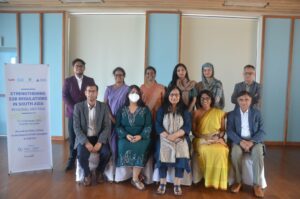
SCOPE aims to strengthen south–south collaboration by synthesising policy-relevant evidence, supporting cross-country learning, and fostering dialogue between researchers, policymakers, and civil society. Through collaborative research, knowledge translation, and capacity strengthening, the coalition seeks to address structural inequities in food systems and contribute to healthier, more just outcomes for populations across South Asia.

Find more on:

LinkedIn: SCOPE: South Asian Coalition of Policy and Evidence for Equitable Food Systems

X: @SCOPE_SA2025

What you can read next

Identifying barriers and facilitators for a healthy diet, physical activity, and good sleep in people with severe mental illness (SMI) in Bangladesh and Pakistan: information to develop an intervention to support people with SMI to live a healthier life (LIFT).
Children Learning About Second-hand Smoking (CLASS-III)
Utilisation and Effectiveness of Women Friendly Hospital Initiative: Problems, Prospects and Way Forward

Recent Posts

  • mHealth intervention (mTB-Tobacco) for smoking cessation in people with drug-sensitive pulmonary tuberculosis in Bangladesh and Pakistan: protocol for an adaptive design, cluster randomised controlled trial (Quit4TB)

    Read the article here or download the PDF versi...
  • Gender differences in mental health help-seeking behaviour in Bangladesh: findings from a cross-sectional online survey

    Read the article here or download PDF version A...
  • Designing a strategic purchasing framework for urban primary healthcare services in Bangladesh: a protocol for a mixed-method study with a discrete choice experiment

    Find the article here or download PDF version A...
  • Expansion of low-price cigarette market and its implications for cigarette tax revenue: Evidence from Bangladesh

    Read the article here or download the PDF versi...
  • Engaging rural communities in Bangladesh to address antimicrobial resistance via the community dialogue approach: a protocol for a cluster-randomized controlled trial

    Read the article here or download the PDF versi...
  • Associations between sociodemographic characteristics and knowledge about antibiotics and antibiotic resistance and usage of antibiotics from a One Health perspective in rural Bangladesh: a descriptive cross-sectional study

    Find the article here or download the PDF versi...
  • Perceived barriers and the price inflating effects of informal payments in fresh food retailing in urban Bangladesh

    Find it here or download the PDF version  ...
  • Facilitators and challenges to access fresh fruits and vegetables in a low to middle income group in Bangladesh: Consumers’ perception

    Find it here or download the PDF version Abstra...
  • How prepared are urban primary care facilities to manage hypertension and type 2 diabetes in Dhaka, Bangladesh? A cross-sectional descriptive study of government urban dispensaries and NGO clinics

    Find the article here or download the PDF versi...
  • Tobacco cessation intervention for individuals with severe mental illness in Bangladesh, India, and Pakistan: protocol for a multi-country feasibility randomised controlled trial (SCIMITAR-SA)

    Read the article here or download the PDF versi...
  • When Cities Grow, Movement Shrinks: Urbanisation and Physical Activity in Bangladesh

    Find the PDF here Written by Riona Khan and S M...
  • Patient and provider perspectives of pluralistic primary care services in urban Bangladesh: a qualitative study

    Read it here or find PDF here Abstract Backgrou...
  • The Karlson-Holm-Breen (KHB) Method: Why Logistic Mediation Results Might Be Misleading?

    Read pdf here Written by Ibrahim Hasan and S M ...
  • Fragmentation in urban health service provision? A plurality of providers is the answer

    Read it here or download PDF  Abdullah Rafi, fr...
  • International Women’s Day 2026

      When women give knowledge, care, and lea...
  • In-country public-private partnerships hold the key to promoting inclusiveness in Dutch trade and international cooperation agenda

    Read the PDF here...
  • COVID-19 and Tobacco

    Read the PDF here  ...
  • Taxation on Sugar-Sweetened Beverages (SSBs) in Bangladesh: What should we do?

    Read the PDF here...
  • Public Private Partnership in Improving Access and Utilization of Health Care Services: Scopes, Opportunities and Challenges

    Find the PDF here  ...
  • Influencing TB policy and practice in Bangladesh using a Public-Private Mix approach

    Read the PDF here Policy messages: TB case noti...

Empower Your Career with ARK Foundation

Discover opportunities to make a difference in health, education, gender equality, and environmental sustainability.

JOIN US

ARK Foundation is a non-government, non-political and not-for-profit organization dedicated to the socio-economic development of Bangladesh. Through evidence-based research, training and communications it provides sustainable solutions for health, education and social development.

ADDRESS

Suite A-1, C-3 & C-4, House # 06, Road # 109,
Gulshan-2, Dhaka, Bangladesh, 1212

Phone: +88 02 55069866

Email: info@arkfoundationbd.org

LOCATION

  • GET SOCIAL

© 2025. All rights reserved. ARK Foundation.

TOP