Integrating tobacco cessation within the TB programme: Findings from the ‘TB & Tobacco’ study
Key Messages:
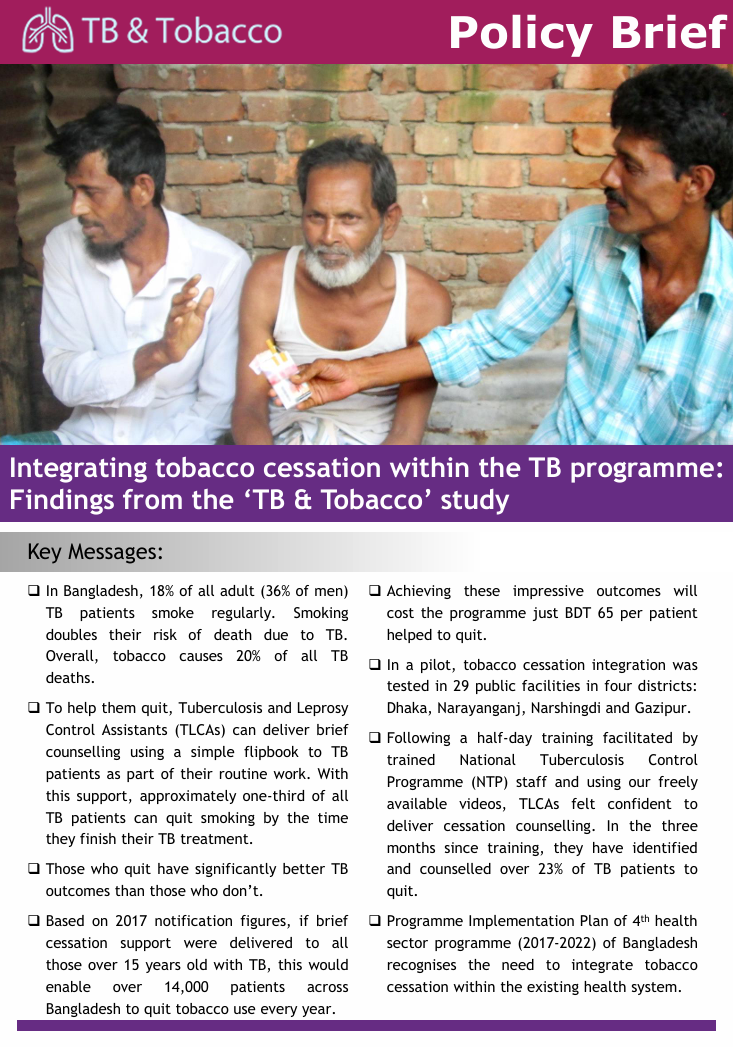
- In Bangladesh, 18% of all adult (36% of men) TB patients smoke regularly. Smoking doubles their risk of death due to TB. Overall, tobacco causes 20% of all TB deaths.
- To help them quit, Tuberculosis and Leprosy Control Assistants (TLCAs) can deliver brief counselling using a simple flipbook to TB patients as part of their routine work. With this support, approximately one-third of all TB patients can quit smoking by the time they finish their TB treatment.
- Those who quit have significantly better TB outcomes than those who don’t.
- Based on 2017 notification figures, if brief cessation support were delivered to all those over 15 years old with TB, this would enable over 14,000 patients across Bangladesh to quit tobacco use every year.
- Achieving these impressive outcomes will cost the programme just BDT 65 per patient helped to quit.
- In a pilot, tobacco cessation integration was tested in 29 public facilities in four districts: Dhaka, Narayanganj, Narshingdi and Gazipur.
- Following a half-day training facilitated by trained National Tuberculosis Control Programme (NTP) staff and using our freely available videos, TLCAs felt confident to deliver cessation counselling. In the three months since training, they have identified and counselled over 23% of TB patients to quit.
- Programme Implementation Plan of 4th health sector programme (2017-2022) of Bangladesh recognises the need to integrate tobacco cessation within the existing health system.
TB & Tobacco in Bangladesh
The link between TB & Tobacco
According to the Global Tuberculosis Report (WHO, 2018), 4% of the estimated 10 million people who contracted TB disease in 2017 reside in Bangladesh. We know that 20% of the TB disease burden can be attributed to tobacco.
From infection to the outcome, tobacco is negatively associated with TB. Tobacco smoking almost doubles the risk of TB infection. Tobacco causes worse cavity lesions and tobacco users take longer to convert to sputum negative and are more than twice as likely to die from TB than no-users.
GATS (2017) Bangladesh shows that overall prevalence of tobacco use is 35%. The GATS survey shows a decreasing trend of tobacco use in Bangladesh that should be taken as a good sign indicating better awareness in the masses and stronger implementation of anti-smoking laws.
Our Research
In a recently concluded trial in Bangladesh, we recruited 1527 TB patients who smoked on a regular basis. While they all received a brief (about 8 minutes) behavioural support session delivered by TB health workers, half also received a relatively cheap smoking-cessation drug ‘Cytisine’ while the other half received placebo. Approximately one-third of all TB patients that took part in the trial stopped smoking at 6 months.
A vast majority of those who stopped smoking remained abstinent even after 12 months; Cytisine did not offer much additional benefit. These results were based on biochemical tests, not just patients’ word.
Our study shows that short and simple counselling by TB health professional in routine care can help almost a third of TB patients who smoke to quit.
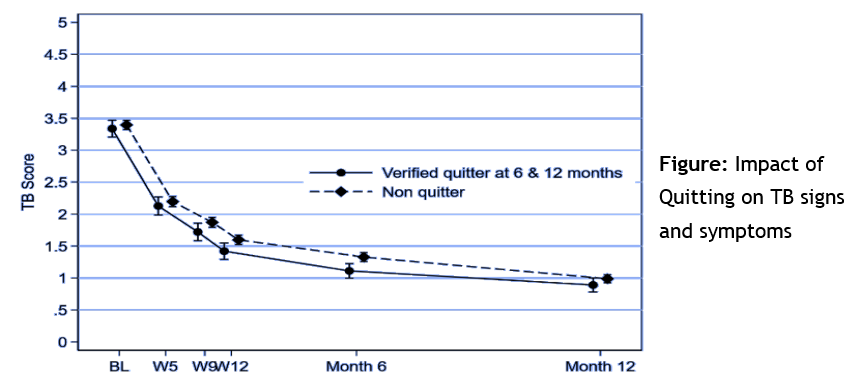
For those patients who were able to quit, there was a significant improvement in their scores of TB signs and symptoms from baseline (BL) when they were diagnosed with TB and received the counselling (please see the figure below).
By helping people with TB to quit, TB health professionals can help their patients to recover from their TB, live healthier lives and reduce TB in Bangladesh.
Tobacco Cessation in Four Districts
Building on the impressive quit rates achieved in the trial, we joined forces with the National TB Control programme to evaluate a 6-month piloting of cessation support. We identified strategic changes required to the health system to overcome the identified barriers, namely:
- a training of trainers and roll out of a brief training for health workers,
- revision of supervision guidelines to include monitoring of provision of cessation, and
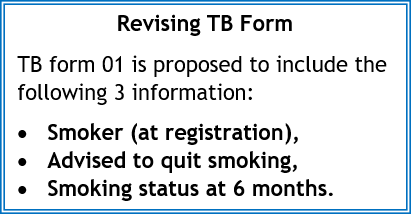
- the inclusion of three key indicators within recording and reporting forms (please see the box on the right).
The project trained 4 Programme Organisers (PO) and 32 TLCAs from 29 facilities in 4 districts in a half-day training session. The training session was kept short and simple, using our training videos and only taking between 3 and 4 hours. We assessed their confidence to deliver cessation support before and after the training and found their confidence scores went up.
“We were able to explain the patients what we were taught. And it is a good thing that we are advising them to stay healthy by avoiding smoking.” (Interview with TLCA)
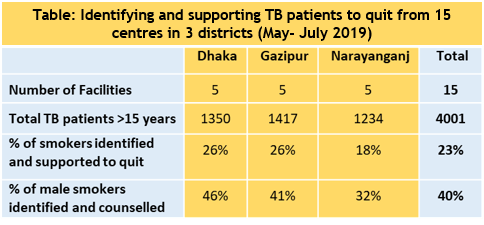
We collected data from 15 facilities in 3 districts between May and July, 2019. TLCAs didn’t find collecting this data on the revised TB forms a burden:
“I don’t think that for data collection it will be a challenge.” (Interview with TLCA)
TLCAs also shared how filling in the tobacco column helped them remember to ask about tobacco use:
“We tend to forget about this topic at that moment when the rush is on. It would have been easy to ask and suggest the patient, if there was a written question about tobacco product consumption {on the reporting form}.”
Revising TB Form
TB form 01 is proposed to include the following 3 information:
- Smoker (at registration),
- Advised to quit smoking,
- Smoking status at 6 months.

Between May and July 2019, TLCAs were able to identify and support over 23% of all TB patients and 40% of male TB patients to quit smoking.
The data on the revised forms will ultimately allow policy makers to see the proportion of TB patients who are smokers and are able to quit at the end of the treatment. It will also enable the TB care providers to deliver effective behavioural support to tobacco users to quit smoking.
Recommendations:
Action plan can be developed to integrate tobacco cessation into the routine work of the TB programme, with a focus on:
- Training trainers who can roll-out tobacco cessation training to health workers (TLCAs)
- Revising TB reporting forms to include the 3 measures of i) tobacco status, ii) advice and iii) quit at 6 months
- Revising supervision checklists and guidelines to include tobacco cessation
All materials are freely available:
All materials including Flipbook, Leaflet, Posters, Health Worker Guide, Training Slides and Videos are available in Bangla and English:
https://tbandtobacco.org/
You will also find our research papers showing the evidence behind the cessation strategies.