Download PDF here or read the HTML version
Written by Prof. Rumana Huque & Abdullah M. Rafi
Every year, Bangladesh announces a new national budget with promises of stronger healthcare, expanded services, and increased investment in public wellbeing. Headlines celebrate larger allocations for the health sector, policymakers speak of reform, and percentages are highlighted to demonstrate commitment. Yet, by the end of the fiscal year, a different story quietly emerges, one that receives far less attention.
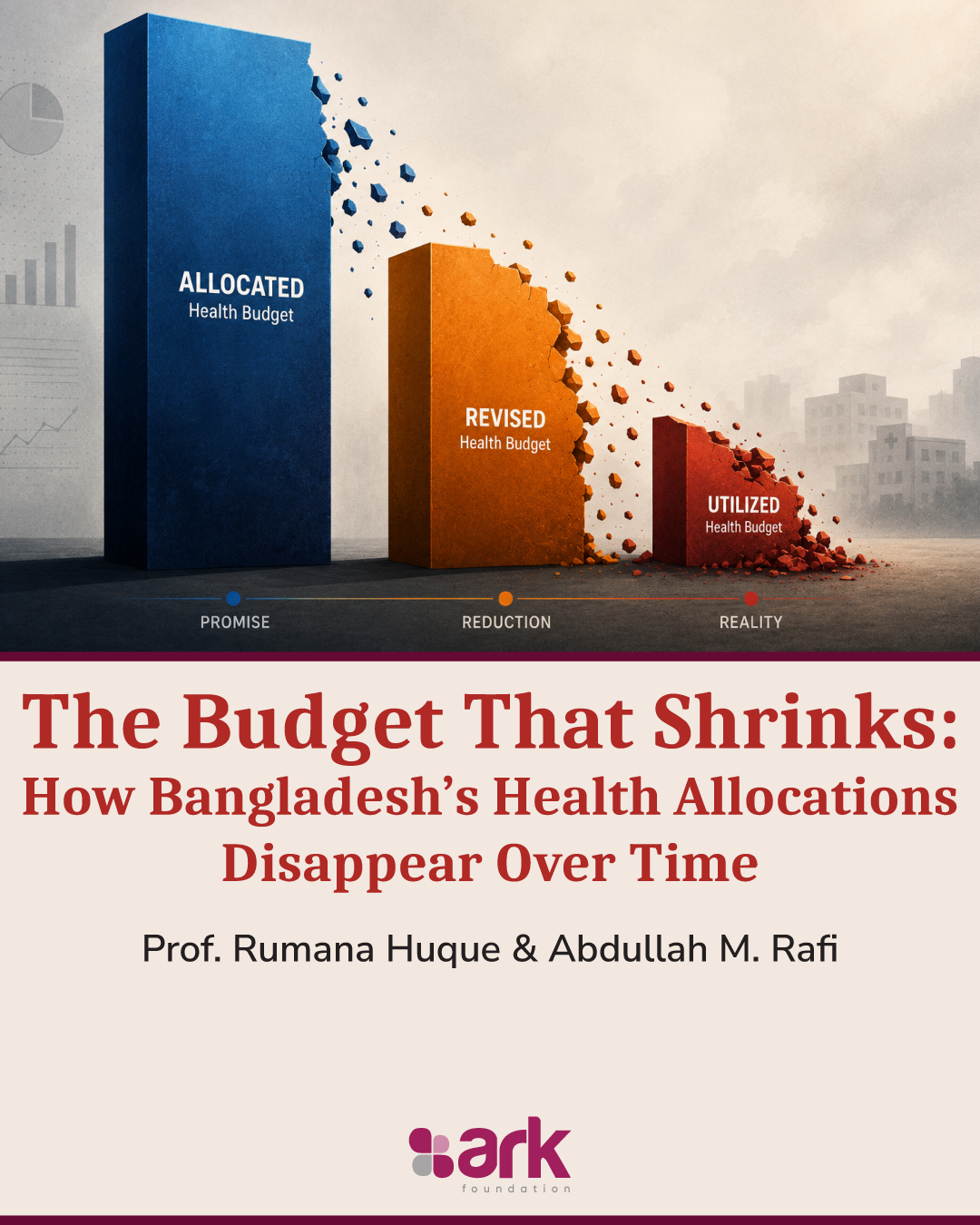
The health budget in Bangladesh does not simply remain underfunded. More critically, it shrinks over time. This pattern has become so normalized that many now overlook the widening gap between what is announced and what is ultimately spent. The real concern is not only how much money is allocated to health, but how much of that allocation survives through the budget cycle.
The concern begins even before budget revisions occur. Bangladesh allocates only around 5.3 percent of its national budget to health, a share that has shown little improvement over time. More worrying, government health expenditure as a proportion of GDP has declined from 0.73 percent in 2010 to just 0.45 percent in 2023. While neighboring countries have steadily increased public investment in health, Bangladesh has moved in the opposite direction, raising important questions about whether healthcare is receiving the priority required to support the country’s long-term development goals.
A closer look at recent budget data illustrates the problem clearly. In FY2023-24, the revised development allocation for the health sector stood at approximately BDT 11,336 crore. In FY2024-25, the proposed development allocation increased substantially to around BDT 20,190 crore. On paper, this appeared to signal a major expansion in health investment. However, after revision, the allocation fell sharply to around BDT 5,069 crore, representing a reduction of nearly two-thirds from the original proposal.
This is not an isolated incident. It reflects a recurring cycle in Bangladesh’s public finance system, announce a large health budget, revise it downward months later, and ultimately spend far less than promised.
The same trend is visible in medical education. Budgets initially presented as ambitious are later reduced substantially in revised allocations. In many cases, only a small fraction of the originally announced development funds are actually utilized. Yet public discussions rarely focus on revised budgets.
Budget debates, television talk shows, newspaper analyses, and social media conversations overwhelmingly occur during the announcement phase. At that moment, governments receive political credit for increasing allocations, while the eventual cuts remain largely invisible to the public. By the time revised budgets are released, public attention has shifted elsewhere.
This creates a misleading narrative. Citizens are encouraged to believe that health spending is rising steadily, when in practice much of the allocation never materializes.
The explanation often given is that the health sector lacks “absorptive capacity” in other words, it cannot spend the allocated money efficiently. Certainly, institutional inefficiencies exist, and reforms are needed. But this explanation alone hides deeper structural realities.
Development funds in the health sector are frequently delayed because Operational Plans (OPs) and Development Project Proposals (DPPs) remain pending for months. Approval bottlenecks at different administrative levels slow implementation before projects can even begin. In many cases, by the time approvals arrive, the fiscal year is already nearing its end. The consequence is predictable which is low expenditure, followed by budget cuts during revisions. Ironically, these cuts are then used as evidence that the sector ‘cannot spend money.’
The consequences of these delays are visible across the health system. Despite repeated commitments to strengthen service delivery, the Directorate General of Health Services (DGHS) alone reportedly has more than 48,000 vacant positions. Recruitment delays, combined with budget execution challenges, leave hospitals and health facilities struggling to provide services, particularly in rural and underserved areas. The issue, therefore, is not simply whether the sector can spend money, but whether the systems needed to translate allocations into services are functioning effectively.
Meanwhile, sectors with faster spending mechanisms, particularly infrastructure and construction-related projects, are often better positioned to absorb redirected funds. Large-scale construction projects move quickly through financial systems, making them more attractive within political and bureaucratic structures.
As a result, health becomes one of the easiest sectors from which funds can be reduced. This issue extends beyond accounting procedures as it directly affects people’s lives. Bangladesh continues to face severe shortages of healthcare workers, particularly in rural and underserved urban areas. Health facilities remain unevenly distributed, while primary healthcare systems lack adequate support.
At the same time, budget speeches repeatedly promise expanded recruitment of doctors and nurses, new healthcare facilities, and improved services. Yet thousands of sanctioned posts remain vacant year after year.
The contradiction is difficult to ignore. There is also a broader governance problem surrounding health-related expenditures. Significant amounts of money allocated under the banner of healthcare are sometimes spent through ministries and institutions outside the core health system. Parallel hospitals, fragmented projects, and politically driven allocations dilute already limited resources.
The result is a healthcare landscape where infrastructure may expand on paper, but service delivery remains weak in practice. This raises an uncomfortable but necessary question, are we measuring commitment to health through announcements or through actual expenditure and outcomes?
A meaningful health budget cannot be evaluated solely by headline figures. It must be assessed based on how much money is released, how efficiently it is utilized, and whether it improves healthcare access for ordinary citizens. Bangladesh often speaks of achieving major milestones through reducing poverty and strengthening human capital. But none of these ambitions are achievable without sustained investment in public health.
The cost of underinvestment is ultimately borne by citizens. Bangladesh has one of the highest out-of-pocket health expenditures in South Asia, with households directly financing approximately 79.3 percent of total health spending. Such a heavy reliance on personal expenditure means that illness can quickly become a financial crisis for many families, pushing vulnerable households further into poverty and undermining efforts to achieve equitable access to healthcare.
A population burdened by illness cannot contribute productively to economic growth. Families pushed into poverty by medical expenses cannot escape vulnerability. Development goals cannot be separated from healthcare realities. This is why revised budgets deserve far greater scrutiny. Media, civil society, researchers, and policymakers should pay as much attention to budget reductions as they do to budget announcements.