Read the article here or download the PDF version
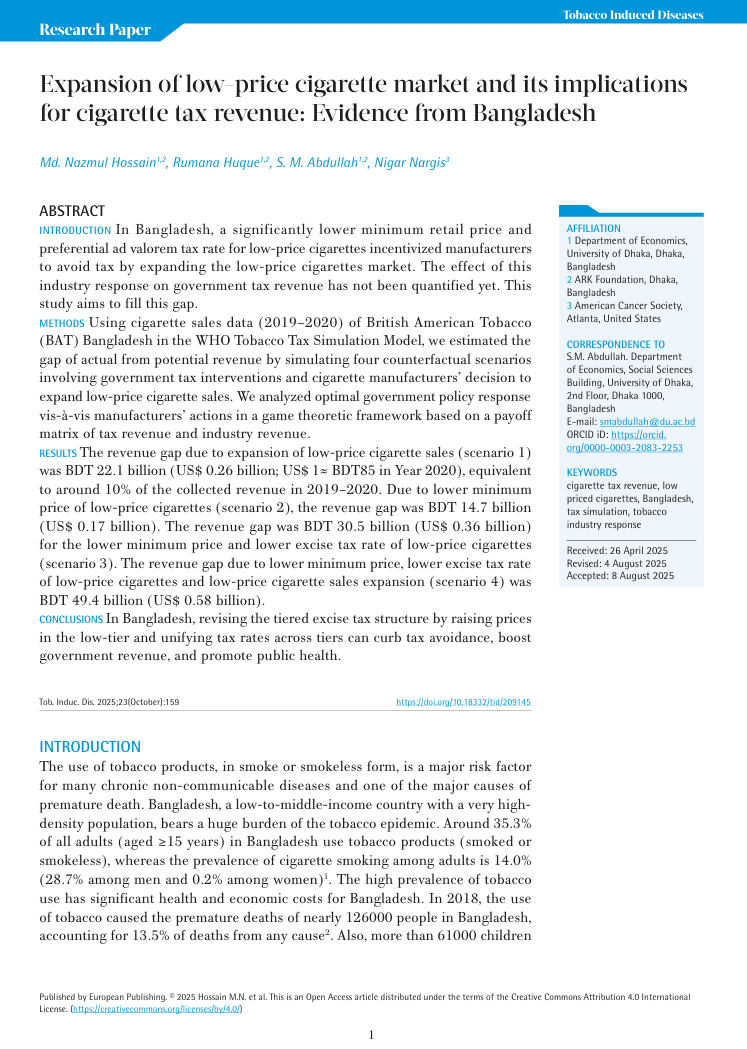
In Bangladesh, a significantly lower minimum retail price and preferential ad valorem tax rate for low-price cigarettes incentivized manufacturers to avoid tax by expanding the low-price cigarettes market. The effect of this industry response on government tax revenue has not been quantified yet. This study aims to fill this gap.
Methods:
Using cigarette sales data (2019–2020) of British American Tobacco (BAT) Bangladesh in the WHO Tobacco Tax Simulation Model, we estimated the gap of actual from potential revenue by simulating four counterfactual scenarios involving government tax interventions and cigarette manufacturers’ decision to expand low-price cigarette sales. We analyzed optimal government policy response vis-à-vis manufacturers’ actions in a game theoretic framework based on a payoff matrix of tax revenue and industry revenue.
Results:
The revenue gap due to expansion of low-price cigarette sales (scenario 1) was BDT 22.1 billion (US$ 0.26 billion; US$ 1≈ BDT85 in Year 2020), equivalent to around 10% of the collected revenue in 2019–2020. Due to lower minimum price of low-price cigarettes (scenario 2), the revenue gap was BDT 14.7 billion (US$ 0.17 billion). The revenue gap was BDT 30.5 billion (US$ 0.36 billion) for the lower minimum price and lower excise tax rate of low-price cigarettes (scenario 3). The revenue gap due to lower minimum price, lower excise tax rate of low-price cigarettes and low-price cigarette sales expansion (scenario 4) was BDT 49.4 billion (US$ 0.58 billion).
Conclusions:
In Bangladesh, revising the tiered excise tax structure by raising prices in the low-tier and unifying tax rates across tiers can curb tax avoidance, boost government revenue, and promote public health.