
• Privacy Policy
  • Terms & Condition
  • Archive

ARK Foundation

  • Home
  • About
    • About Organization
    • Our Partners
    • Global Networks & Leadership
  • Our Team
    • Advisor
    • Executive Director
    • Research and Development
    • Research Uptake & Communications
    • Programme and Training
    • Finance and Administration
    • Data and Field Management
  • Our Work
    • Communicable Disease
    • Non-communicable Disease
    • Multimorbidity
    • Antimicrobial Resistance
    • Maternal, Newborn, Child and Reproductive Health
    • Nutrition
    • Health Systems
    • Climate Change and Environment
    • Gender, Equity and Social Inclusion
  • News & Media
    • Event
    • News
    • Blog
    • Video
    • Newsletter
  • Resources
    • Journal Article
    • Report
    • Working Paper
    • Project Brief
    • Policy Brief
    • Conference Proceedings
    • Infographics
    • Posters
  • Career
  • TRAINING
  • Contact
/ Published in News, News and Media

Gender and Intersectionality Webinar – 10 January 2022

A webinar was arranged on ‘Gender and Intersectionality Planning” on 10th January 2022.  The objective of the webinar was to provide guidance on using the gender and intersectionality framework (CHORUS’ Gender and Intersectionality Guide) to reflect on the data collection and to further shape the health systems intervention to be developed as part of the current CHORUS projects.
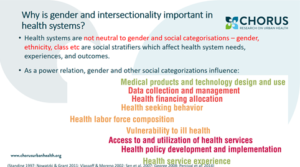
The webinar was led by Sushama Kanan, from ARK Foundation in Bangladesh, who provided a brief overview of the gender and intersectionality guidance and how to use it, looking at the Morgan et al. 2016 framework. She emphasized why gender and intersectionality are important for health systems research and how to ensure all dimensions of gender and the intersections with poverty and other social characteristics are incorporated into health systems research.
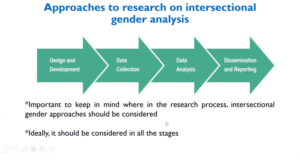
Abriti Arjyal from Herd International, Nepal, discussed the WHO TDR toolkit and provided an understanding of how it relates to the gender guidelines. She focused on examining the different steps that researchers need to consider while using the toolkit. She explained how gender power relations intersect with other social stratifiers, such as wealth, caste and disability, to create impact people’s lives. She highlighted the gender relations domains in terms of social stratifiers and infectious disease of poverty domain.

Dr. Joe Hicks from the University of Leeds then presented on how gender and intersectionality variables can be included during the secondary data analysis and designing the quantitative data collection (sampling tool) and analysis. In particular, he explained how we can look at the interactions between intersecting variables (gender, wealth, etc) rather than only exploring their additive effect.
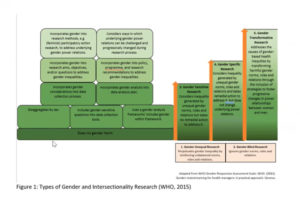
Dr Helen Elsey shared the WHO Gender Resource Assessment Scale (WHO, 2011. This can be found in the Gender and Intersectionality Guide). She pointed out the importance of talking about gender in research and considering gender and intersectionality during intervention design, and ensuring gender inequality is not perpetuated through research work. Under the WHO Scale, gender specific research takes action to remedy unequal norms and transformative research addresses root causes of inequality to transform social norms. While we are working for our project 1 research to be gender sensitive, we can use our intervention co-creating approach to take remedial or even transformative action to ensure no group is disadvantaged.

Read the full story: https://chorusurbanhealth.org/gender-and-intersectionality-webinar-10-january-2022/

What you can read next

Workshop on RESPOND intervention design
Men’s Health in Urban Bangladesh – Is the Urban Primary Healthcare System Leaving Men behind?
CLASS III awareness-raising animation video on Second-Hand Smoke (SHS) exposure

Recent Posts

  • 𝐂𝐨𝐦𝐦𝐮𝐧𝐢𝐭𝐲-𝐥𝐞𝐝 𝐑𝐞𝐬𝐩𝐨𝐧𝐬𝐢𝐯𝐞 𝐚𝐧𝐝 𝐄𝐟𝐟𝐞𝐜𝐭𝐢𝐯𝐞 𝐔𝐫𝐛𝐚𝐧 𝐇𝐞𝐚𝐥𝐭𝐡 𝐒𝐲𝐬𝐭𝐞𝐦𝐬 (𝐂𝐇𝐎𝐑𝐔𝐒) — 𝐖𝐡𝐚𝐭’𝐬 𝐍𝐞𝐱𝐭?

    One of ARK Foundation’s major urban health init...
  • Experts urge action as misinformation threatens vaccination efforts

    Read the report here As measles cases resurface...
  • Webinar on 𝐒𝐭𝐚𝐧𝐝𝐢𝐧𝐠 𝐰𝐢𝐭𝐡 𝐒𝐜𝐢𝐞𝐧𝐜𝐞 𝐢𝐧 𝐭𝐡𝐞 𝐀𝐠𝐞 𝐨𝐟 𝐌𝐢𝐬𝐢𝐧𝐟𝐨𝐫𝐦𝐚𝐭𝐢𝐨𝐧: 𝐏𝐫𝐨𝐭𝐞𝐜𝐭𝐢𝐧𝐠 𝐏𝐮𝐛𝐥𝐢𝐜 𝐇𝐞𝐚𝐥𝐭𝐡

     Join us for an insightful discussion: “𝐒𝐭𝐚𝐧𝐝𝐢𝐧...
  • Air Pollution is Changing: The Hidden Climate Risks We are Not Talking About

    Read the blog here or download the PDF version ...
  • mHealth intervention (mTB-Tobacco) for smoking cessation in people with drug-sensitive pulmonary tuberculosis in Bangladesh and Pakistan: protocol for an adaptive design, cluster randomised controlled trial (Quit4TB)

    Read the article here or download the PDF versi...
  • Gender differences in mental health help-seeking behaviour in Bangladesh: findings from a cross-sectional online survey

    Read the article here or download PDF version A...
  • Designing a strategic purchasing framework for urban primary healthcare services in Bangladesh: a protocol for a mixed-method study with a discrete choice experiment

    Find the article here or download PDF version A...
  • Expansion of low-price cigarette market and its implications for cigarette tax revenue: Evidence from Bangladesh

    Read the article here or download the PDF versi...
  • Engaging rural communities in Bangladesh to address antimicrobial resistance via the community dialogue approach: a protocol for a cluster-randomized controlled trial

    Read the article here or download the PDF versi...
  • Associations between sociodemographic characteristics and knowledge about antibiotics and antibiotic resistance and usage of antibiotics from a One Health perspective in rural Bangladesh: a descriptive cross-sectional study

    Find the article here or download the PDF versi...
  • Perceived barriers and the price inflating effects of informal payments in fresh food retailing in urban Bangladesh

    Find it here or download the PDF version  ...
  • Facilitators and challenges to access fresh fruits and vegetables in a low to middle income group in Bangladesh: Consumers’ perception

    Find it here or download the PDF version Abstra...
  • How prepared are urban primary care facilities to manage hypertension and type 2 diabetes in Dhaka, Bangladesh? A cross-sectional descriptive study of government urban dispensaries and NGO clinics

    Find the article here or download the PDF versi...
  • Tobacco cessation intervention for individuals with severe mental illness in Bangladesh, India, and Pakistan: protocol for a multi-country feasibility randomised controlled trial (SCIMITAR-SA)

    Read the article here or download the PDF versi...
  • When Cities Grow, Movement Shrinks: Urbanisation and Physical Activity in Bangladesh

    Find the PDF here Written by Riona Khan and S M...
  • Patient and provider perspectives of pluralistic primary care services in urban Bangladesh: a qualitative study

    Read it here or find PDF here Abstract Backgrou...
  • The Karlson-Holm-Breen (KHB) Method: Why Logistic Mediation Results Might Be Misleading?

    Read pdf here Written by Ibrahim Hasan and S M ...
  • South Asian Coalition of Policy and Evidence for Equitable food systems (SCOPE)

    The South Asian Coalition of Policy and Evidenc...
  • Fragmentation in urban health service provision? A plurality of providers is the answer

    Read it here or download PDF  Abdullah Rafi, fr...
  • International Women’s Day 2026

      When women give knowledge, care, and lea...

Empower Your Career with ARK Foundation

Discover opportunities to make a difference in health, education, gender equality, and environmental sustainability.

JOIN US

ARK Foundation is a non-government, non-political and not-for-profit organization dedicated to the socio-economic development of Bangladesh. Through evidence-based research, training and communications it provides sustainable solutions for health, education and social development.

ADDRESS

Suite A-1, C-3 & C-4, House # 06, Road # 109,
Gulshan-2, Dhaka, Bangladesh, 1212

Phone: +88 02 55069866

Email: info@arkfoundationbd.org

LOCATION

  • GET SOCIAL

© 2025. All rights reserved. ARK Foundation.

TOP