• Privacy Policy
  • Terms & Condition
  • Archive

ARK Foundation

  • Home
  • About
    • About Organization
    • Our Partners
    • Global Networks & Leadership
  • Our Team
    • Advisor
    • Executive Director
    • Research and Development
    • Research Uptake & Communications
    • Programme and Training
    • Finance and Administration
    • Data and Field Management
  • Our Work
    • Communicable Disease
    • Non-communicable Disease
    • Multimorbidity
    • Antimicrobial Resistance
    • Maternal, Newborn, Child and Reproductive Health
    • Nutrition
    • Health Systems
    • Climate Change and Environment
    • Gender, Equity and Social Inclusion
  • News & Media
    • Event
    • News
    • Blog
    • Video
    • Newsletter
  • Resources
    • Journal Article
    • Report
    • Working Paper
    • Project Brief
    • Policy Brief
    • Conference Proceedings
    • Infographics
    • Posters
  • Career
  • Contact
/ Published in Event, News and Media

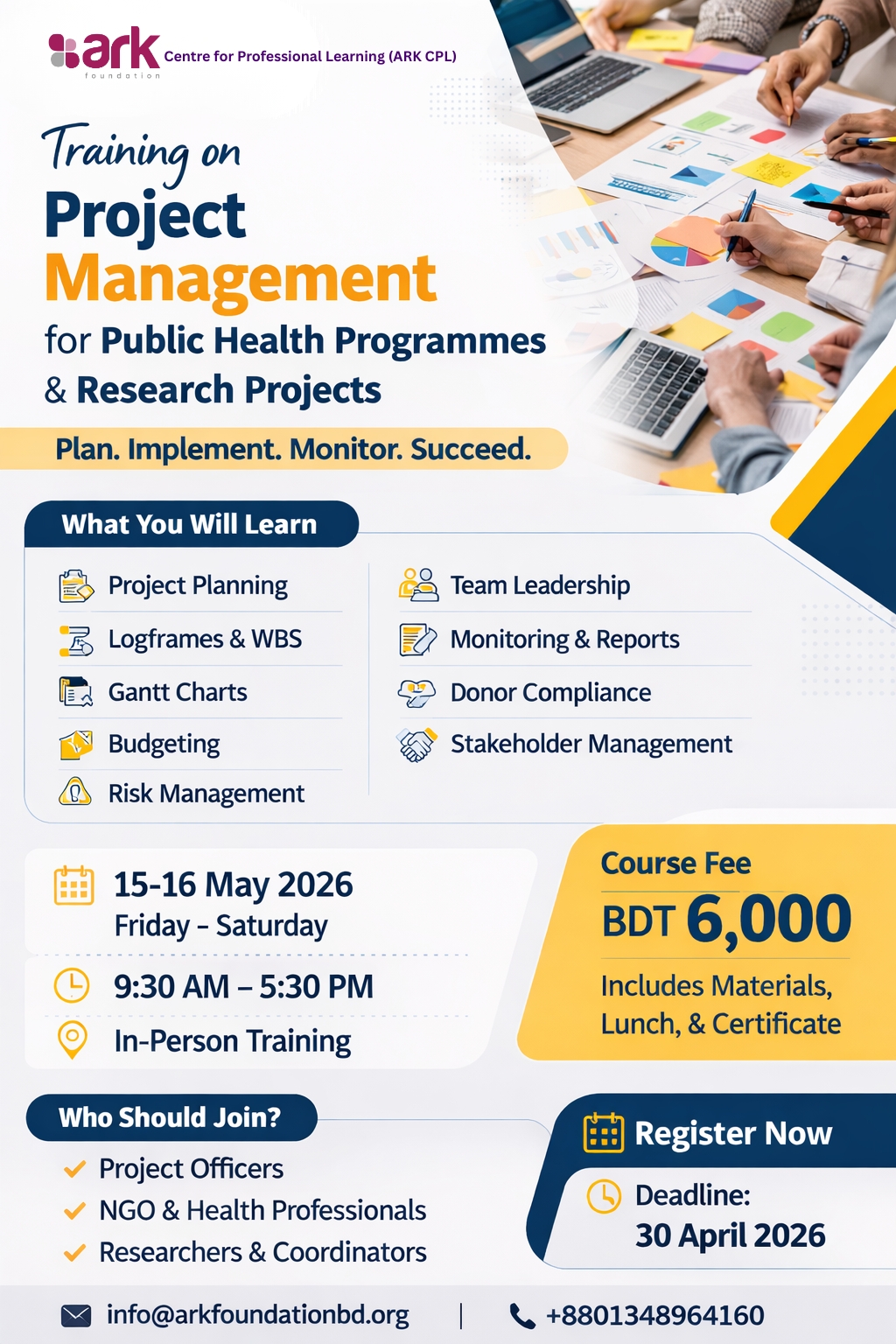
Course: Project Management in Public Health

Download the prospectus from here

Introduction

Public health projects often appear well designed at the proposal stage but face significant challenges during implementation. Issues in planning, budgeting, team coordination, monitoring, and stakeholder management can delay progress and weaken impact.

This 16-hour long professional training is designed to equip participants with practical project management skills required to successfully plan, implement, and monitor public health programmes and research initiatives.

The course is tailored for early to mid-level professionals working in research, NGOs, development programmes, and healthcare settings.

Learning Objectives

By the end of this course, participants will be able to:

  • Translate public health ideas into structured, results-oriented project plans
  • Develop simplified log frames and operational work plans
  • Create basic Gantt charts for project scheduling
  • Understand and track project budgets effectively
  • Identify and mitigate project risks using practical tools
  • Strengthen monitoring and donor reporting practices
  • Manage teams and stakeholders in complex implementation environments
  • Make informed decisions when addressing project challenges

Course Structure & Content

The training is conducted over two days (9:30 AM – 5:30 PM) and combines structured instruction with practical exercises and case discussions.

Key topics covered include:

  • Public health project lifecycle and governance
  • Translating project ideas into results frameworks and logframes
  • Work Breakdown Structure (WBS) and operational planning
  • Developing basic project schedules using Gantt charts
  • Understanding project budgets and resource allocation
  • Identifying and managing project risks using risk matrices
  • Managing field teams and supervision challenges
  • Monitoring project progress and adaptive management
  • Writing effective donor reports and managing stakeholders

Participants will also receive a Project Management Toolkit containing practical templates such as logframe structures, planning formats, and monitoring tools that can be directly applied in their professional work.

Target Participants

This course is designed specifically for professionals working in public health, research, and development programmes rather than corporate project management environments.

Ideal participants include:

  • Project Officers, Coordinators, and Research Associates
  • Programme staff working in NGOs or development organisations
  • Public health professionals managing research or implementation projects
  • Early- to mid-career professionals (1–7 years of experience)
  • Individuals transitioning into project leadership roles

Training Details

  • Dates: 15-16 May 2026 (Friday-Saturday)
  • Duration: 16 hours | 9:30 AM – 5:30 PM
  • Format: In-person interactive training
  • Batch Size: Limited to 15 participants to ensure quality interaction and discussion

Fees & Registration

  • Course Fee: BDT 6,000 (Includes training materials, lunch, refreshments, and certificate).
  • Certification: Participants will be awarded a certificate from ARK CPL upon 100% attendance and successful completion of the course.
  • How to Apply: Click the registration link and fill in the Google Form to submit your application.
  • Deadline: Please complete your registration by 30th April 2026.

Selection and Admission Procedure

Participants will be selected based on the relevance of their professional background and on a first-come, first-served basis. Shortlisted applicants will be notified via email, SMS, or telephone.

Selected participants will be required to confirm their seat by completing the course fee payment within the specified timeframe.

For further queries relating to the course, please contact:

Email: info@arkfoundationbd.org

Mobile: +8801348964160 (Available during office hours only)
What you can read next

World Tuberculosis Day: Effectiveness and cost-effectiveness of an mHealth intervention (mTB-Tobacco) for smoking cessation in people with tuberculosis (Quit4TB Trial)
Muslim Communities Learning About Second Hand Smoking
How can we bridge the healthcare gap between urban and rural Bangladesh?

Recent Posts

  • Precision at Scale: Managing 3,559 Survey Clusters in the World’s Largest Refugee Settlement

    Find the pdf version here or read it here By  Z...
  • The Areca Nut Paradox in Bangladesh: A Rapid Review of Cultural Embeddedness, Public Health Risks, Livelihood Dependence, and Policy Gaps

    Read it here or download the PDF version By Nab...
  • Why does it matter? Childhood obesity among school going children in Urban Bangladesh: Potential Way Forward

    Read the PDF here Written by Badruddin Saify Fo...
  • How SCIMITAR-SA turns barriers into better support to quit tobacco

    Find the HTML version  SCIMITAR-SA is built aro...
  • Strengthening Tobacco Cessation Through Local Adaptation

    Find the HTML version here  WP1 focuses on adap...
  • 𝐒𝐂𝐈𝐌𝐈𝐓𝐀𝐑-𝐒𝐀 | 𝐒𝐞𝐯𝐞𝐧 𝐒𝐞𝐬𝐬𝐢𝐨𝐧𝐬 𝐭𝐨 𝐐𝐮𝐢𝐭 𝐓𝐨𝐛𝐚𝐜𝐜𝐨

    Find it here A tobacco cessation intervention d...
  • Factors associated with knowledge, attitude, practice and training interest of drug sellers in shaping antimicrobial resistance: A cross-sectional study in urban Bangladesh

    Find the PDF here  or HTML version here  ...
  • Country Case Studies on Implementation of Drowning Prevention Activities

    This study will consist of ten in-depth country...
  • Where antibiotics enter the city: what we are learning with drug sellers in Mirpur

    Written by: Asiful Haidar Chowdhury (Senior Res...
  • Closing the Gap: How Urban Primary Health Care Can Achieve Health Equity

    Written by: Marhouba Khan Asfi (Research Assist...
  • Field Reflections from CHORUS Project 1 and 2: Listening Between Appointments, Streets, and Silence

    Written by: Nabila Binth Jahan (Junior Research...
  • When Public Spaces Aren’t Truly Public: Making Physical Activity Safer for Women and Girls in Urban Bangladesh

    Written by: Umme Salma Anee (Senior Research As...
  • Addressing the Knowledge Deficit: Health Education and Public Awareness in Bangladesh

    Written by: Kazi Fatin Sami (Research Assistant...
  • Behind the Numbers: Verifying Immunization Coverage in the Rohingya Camps

    Written by: Ibrahim Hasan (Research Assistant) ...
  • Field Reality: What We Learned While Assessing Smoke-Free Public Places

    Written by: Lenik Chakma (Research Assistant) I...
  • The Hidden Tax on Health: Why Diabetes is Bankrupting Bangladesh’s Families

    Written by: Sirat-E-Rowshan Islam (Research Upt...
  • Social determinants of health (SDOH) and its relationship with clinical and economic outcomes in people with type 2 diabetes in Bangladesh

    Social determinants of health and its relations...
  • Universal Health Coverage needs more than a bigger budget. It needs institutions and skills

    As the nation is heading towards its 13th natio...
  • Developing and evaluating an adapted behavioral activation intervention for people with depression and diabetes (DiaDeM)

    DiaDeM stands for “Developing and evaluating an...
  • ThinkSpace: Quarterly Research Digest

    ARK Foundation is pleased to launch ThinkSpace,...

Empower Your Career with ARK Foundation

Discover opportunities to make a difference in health, education, gender equality, and environmental sustainability.

JOIN US

ARK Foundation is a non-government, non-political and not-for-profit organization dedicated to the socio-economic development of Bangladesh. Through evidence-based research, training and communications it provides sustainable solutions for health, education and social development.

ADDRESS

Suite A-1, C-3 & C-4, House # 06, Road # 109,
Gulshan-2, Dhaka, Bangladesh, 1212

Phone: +88 02 55069866

Email: info@arkfoundationbd.org

LOCATION

  • GET SOCIAL

© 2025. All rights reserved. ARK Foundation.

TOP