
• Privacy Policy
  • Terms & Condition
  • Archive

ARK Foundation

  • Home
  • About
    • About Organization
    • Our Partners
    • Global Networks & Leadership
  • Our Team
    • Advisor
    • Executive Director
    • Research and Development
    • Research Uptake & Communications
    • Programme and Training
    • Finance and Administration
    • Data and Field Management
  • Our Work
    • Communicable Disease
    • Non-communicable Disease
    • Multimorbidity
    • Antimicrobial Resistance
    • Maternal, Newborn, Child and Reproductive Health
    • Nutrition
    • Health Systems
    • Climate Change and Environment
    • Gender, Equity and Social Inclusion
  • News & Media
    • Event
    • News
    • Blog
    • Video
    • Newsletter
  • Resources
    • Journal Article
    • Report
    • Working Paper
    • Project Brief
    • Policy Brief
    • Conference Proceedings
    • Infographics
    • Posters
  • Career
  • Contact
/ Published in Journal Article, Resources

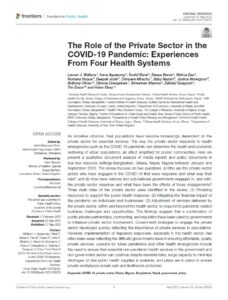
The Role of the Private Sector in the COVID-19 Pandemic: Experiences From Four Health Systems

As societies urbanize, their populations have become increasingly dependent on the private sector for essential services. The way the private sector responds to health emergencies such as the COVID-19 pandemic can determine the health and economic wellbeing of urban populations, an effect amplified for poorer communities.

Here we present a qualitative document analysis of media reports and policy documents in four low resource settings-Bangladesh, Ghana, Nepal, Nigeria-between January and September 2020. The review focuses on two questions: (i) Who are the private sector actors who have engaged in the COVID-19 first wave response and what was their role?; and (ii) How have national and sub-national governments engaged in, and with, the private sector response and what have been the effects of these engagements? Three main roles of the private sector were identified in the review. (1) Providing resources to support the public health response. (2) Mitigating the financial impact of the pandemic on individuals and businesses. (3) Adjustment of services delivered by the private sector, within and beyond the health sector, to respond to pandemic-related business challenges and opportunities.

The findings suggest that a combination of public-private partnerships, contracting, and regulation have been used by governments to influence private sector involvement. Government strategies to engage the private sector developed quickly, reflecting the importance of private services to populations. However, implementation of regulatory responses, especially in the health sector, has often been weak reflecting the difficulty governments have in ensuring affordable, quality private services. Lessons for future pandemics and other health emergencies include the need to ensure that essential non-pandemic health services in the government and non-government sector can continue despite elevated risks, surge capacity to minimize shortages of vital public health supplies is available, and plans are in place to ensure private workplaces remain safe and livelihoods protected.

NOTE: The study in Nepal, Nigeria, and Bangladesh was part of CHORUS funded by UK Aid, from the UK Government, Grant 301132 (involving HE, TE, MD, OO, RH, JN, SB, ZQ, DB, CM, BN, AO, SS, DJ, and IA). In Ghana (involving LJW, IA, AO, and JN) the study was funded jointly by IDRC, Grant 109479 as part of the CATALYSE project (Exploring and learning from evidence, policy and systems responses to COVID-19 in West and Central Africa) and UK Aid as part of CHORUS (Community-led Responsive and Elective Urban Health Systems). The funders had no role in study design, data collection and analysis, decision to publish, or preparation of the manuscript.
PDF Version | HTML Version

What you can read next

Smokeless tobacco supply chain in South Asia – A comparative analysis using the WHO Framework Convention on Tobacco Control
Engaging rural communities in Bangladesh to tackle AMR through the Community Dialogue Approach (CDA)
𝐖𝐨𝐫𝐥𝐝 𝐇𝐞𝐚𝐫𝐭 𝐃𝐚𝐲 𝟐𝟎𝟐𝟓 — 𝐃𝐨𝐧’𝐭 𝐌𝐢𝐬𝐬 𝐚 𝐁𝐞𝐚𝐭

Recent Posts

  • The Karlson-Holm-Breen (KHB) Method: Why Logistic Mediation Results Might Be Misleading?

    Read pdf here Written by Ibrahim Hasan and S M ...
  • South Asian Coalition of Policy and Evidence for Equitable food systems (SCOPE)

    The South Asian Coalition of Policy and Evidenc...
  • Fragmentation in urban health service provision? A plurality of providers is the answer

    Read it here or download PDF  Abdullah Rafi, fr...
  • International Women’s Day 2026

      When women give knowledge, care, and lea...
  • In-country public-private partnerships hold the key to promoting inclusiveness in Dutch trade and international cooperation agenda

    Read the PDF here...
  • COVID-19 and Tobacco

    Read the PDF here  ...
  • Taxation on Sugar-Sweetened Beverages (SSBs) in Bangladesh: What should we do?

    Read the PDF here...
  • Public Private Partnership in Improving Access and Utilization of Health Care Services: Scopes, Opportunities and Challenges

    Find the PDF here  ...
  • Influencing TB policy and practice in Bangladesh using a Public-Private Mix approach

    Read the PDF here Policy messages: TB case noti...
  • How can public-private partnerships enhance the use of long acting contraceptive methods in Bangladesh?

    Read the PDF here Using a public-private partne...
  • Improving the quality of care at community clinics in rural Bangladesh through new approaches

    Read the PDF here Key messages The training was...
  • Integrating tobacco cessation within the TB programme: Findings from the ‘TB & Tobacco’ study

    Find the PDF here Integrating tobacco cessation...
  • The Complicated Cigarette Tax Structure in Bangladesh is Causing Expansion of the Low-Tier Cigarette Market and Lower Tax Revenue

    Find the PDF here Implementing a uniform ad val...
  • Digital Health in Dhaka | Simple App | Transforming Urban Healthcare | Channel 24 | ARK Foundation

      Digital health is reshaping urban health...
  • বাংলাদেশে স্বাস্থ্যবিমা: বাস্তবসম্মত সমাধান নাকি শুধু আলোচনা? | Channel 24 | ARK Foundation

    স্বাস্থ্যসেবার ব্যয় কি নাগালের বাইরে চলে যাচ্ছ...
  • Course: Project Management in Public Health

    Download the prospectus from here Introduction ...
  • Precision at Scale: Managing 3,559 Survey Clusters in the World’s Largest Refugee Settlement

    Find the pdf version here or read it here By  Z...
  • The Areca Nut Paradox in Bangladesh: A Rapid Review of Cultural Embeddedness, Public Health Risks, Livelihood Dependence, and Policy Gaps

    Read it here or download the PDF version By Nab...
  • Why does it matter? Childhood obesity among school going children in Urban Bangladesh: Potential Way Forward

    Read the PDF here Written by Badruddin Saify Fo...
  • বৈষম্য কমাতে চাই কার্যকর প্রাথমিক স্বাস্থ্যসেবা | Prof. Dr. Liaquat Ali | ARK Foundation | Channel24

    স্বাস্থ্যসেবা কি শুধু প্রতিশ্রুতির মধ্যেই আটকে ...

Empower Your Career with ARK Foundation

Discover opportunities to make a difference in health, education, gender equality, and environmental sustainability.

JOIN US

ARK Foundation is a non-government, non-political and not-for-profit organization dedicated to the socio-economic development of Bangladesh. Through evidence-based research, training and communications it provides sustainable solutions for health, education and social development.

ADDRESS

Suite A-1, C-3 & C-4, House # 06, Road # 109,
Gulshan-2, Dhaka, Bangladesh, 1212

Phone: +88 02 55069866

Email: info@arkfoundationbd.org

LOCATION

  • GET SOCIAL

© 2025. All rights reserved. ARK Foundation.

TOP