
Project note: This article is a public summary of implementation learning from an antimicrobial stewardship pilot conducted in selected public hospitals in Bangladesh. The full academic analysis is under development for peer-reviewed publication.
Antibiotics save lives. But when they are used too often, too broadly, or without enough diagnostic support, they can make future infections harder to treat. This is the challenge of antimicrobial resistance, or AMR. In Bangladesh, where many hospitals manage high patient loads with limited laboratory capacity and medicine supply constraints, improving antibiotic use is both urgent and practical.
To help address this challenge, the Communicable Disease Control (CDC) unit of the Directorate General of Health Services (DGHS), with support from World Health Organization (WHO) Bangladesh, ARK Foundation piloted an Antimicrobial Stewardship initiative in six public hospitals across Cumilla and Dinajpur. The pilot covered three levels of care: Upazila Health Complexes, District/General Hospitals, and Medical College Hospitals.
The purpose was to test whether practical, facility-owned stewardship actions could be introduced into routine public hospital services to support safer and more rational antibiotic use.
A practical package for busy hospitals
Antimicrobial stewardship, often called AMS, means supporting health workers to use antibiotics responsibly. It is not about withholding treatment from patients who need it. It is about helping clinicians choose the right antibiotic, at the right dose, for the right duration, with review when more information becomes available.
The pilot introduced a simple, facility-based AMS package designed for real hospital settings. AMS committees were established in all participating hospitals, bringing together hospital leaders, clinicians, pharmacists, nurses, laboratory staff, and other relevant teams to review antibiotic use and discuss practical actions.
Health workers received hands-on training on antimicrobial stewardship, standard treatment guidelines, infection prevention and control, and rational antibiotic use. National standard treatment guidelines were promoted to support more consistent clinical decision-making.
One of the main activities was prescription survey and feedback. Project teams and facility staff reviewed antibiotic prescriptions and discussed findings with clinical teams in a supportive, non-punitive way. This helped create space for honest discussion and practical improvement.
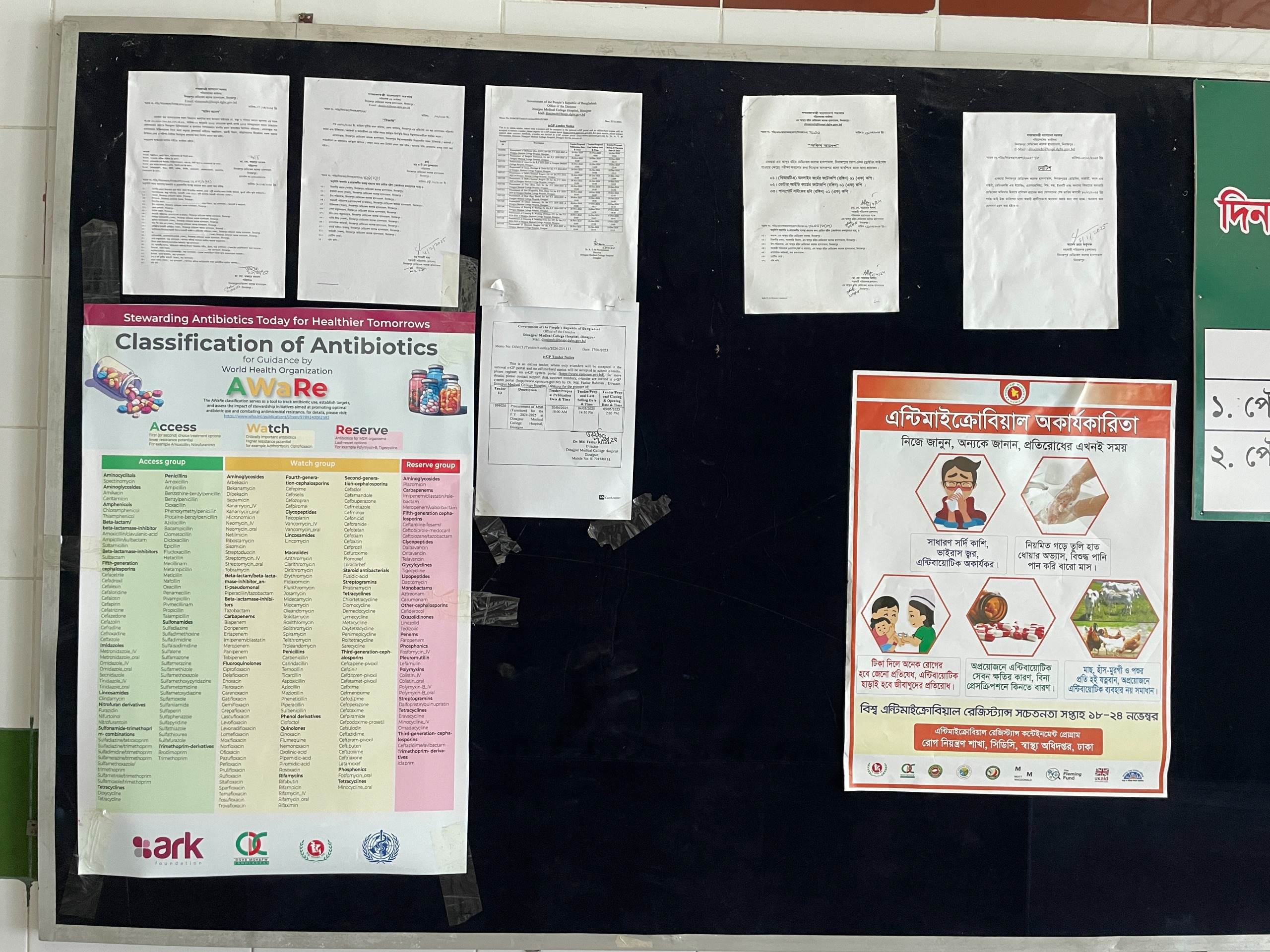
The pilot also introduced facility-level controls for selected antibiotics, including restriction and preauthorization steps for higher-risk medicines. Information, education, and communication materials were displayed in wards and staff areas as reminders of stewardship principles. Project Research Physicians supported regular follow-up, helped facilities track prescribing patterns, and provided on-the-job mentoring.
What the pilot showed
The pilot demonstrated that antimicrobial stewardship can be introduced in public hospitals using simple tools, local ownership, and regular feedback.
Across the participating hospitals, the proportion of inpatients receiving antibiotics fell from nearly three-quarters at baseline to about three-fifths by the end of the pilot. The strongest improvements were seen in secondary-level hospitals, while tertiary hospitals showed more modest change, reflecting heavier patient loads, more complex cases, and greater pressure on hospital systems.
The findings also showed that reducing total antibiotic use is only part of the story. The share of broad-spectrum Watch-category antibiotics increased during the pilot period, pointing to a major system issue: hospitals need reliable availability of recommended Access-category antibiotics if clinicians are expected to follow standard treatment guidance.
Diagnostic capacity was another major constraint. Culture and sensitivity testing remained limited, making it difficult for clinicians to shift from empirical treatment to more targeted therapy. This shows that antimicrobial stewardship cannot succeed through prescription review alone. It must be supported by better laboratory services, stronger infection prevention and control, reliable medicine supply, and routine use of prescribing data.
The way forward
Bangladesh already has national policy direction on AMR and antimicrobial stewardship. The challenge is turning policy into daily practice inside hospitals. This pilot helped show what that can look like.
Future scale-up should focus on keeping AMS committees active, continuing prescription survey and feedback, strengthening standard treatment guideline use, and ensuring that recommended Access-category antibiotics are available in hospital stores. Laboratory capacity, especially culture and sensitivity testing, also needs to be strengthened so clinicians can make more targeted treatment decisions.
Antimicrobial stewardship is not a one-time training, a committee formed on paper, or a poster on a wall. It is a hospital habit. This pilot showed that the habit can begin, even in busy public hospitals, when teams have practical tools, supportive feedback, and institutional commitment.