Read the blog here or download the PDF version
Written by Sirat-E-Rowshan Islam (Research Uptake & Communication Officer, ARK Foundation)
When we think about air pollution in Bangladesh, we are talking about the same few things: the black smoke from an old bus, the smoggy skyline in winter, nicotine smoke from cigarettes, or the chimneys of brick kilns, which surround the edges of the city. Checking our phones to see the levels of air quality index (AQI) has now become a new habit, and we have gotten used to the deep reds and purples signifying the air to be unhealthy or dangerous.
With the increasing growth and modernization in cities such as Dhaka, it is changing the character of air pollution. There are new types of pollution that are not easily visible, yet they are no less dangerous. It is present in the dust of uncontrolled construction works, the toxins of the unofficial recycling shops, and in the chemical processes that are caused by increasing heat. We are transitioning out of a smoke crisis to a ‘toxicity’ crisis. Such a shift is dangerous for our health as well as for our climate, since we cannot visualize the threat level, it is far more difficult to make people believe the danger.
Climate Change is Making Pollution Worse
We often treat climate change and air pollution as two separate issues. We think of climate change as something that causes floods or cyclones, whereas air pollution is a factor that damages our lungs. But in reality, they are closely connected.
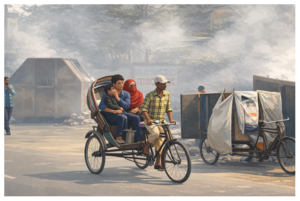
Over the past few summers, living in Dhaka, you can really feel the heat is getting higher each year.The heat is more oppressive, the air is more dense. It is not only uncomfortable to go out in the afternoon, but it also becomes really exhausting. And in the case of rickshaw pullers, street vendors, construction workers, and school children walking home, the heat is now accompanied by a burning chest and a drying throat, also cases like heat stroke have increased.
What we fail to notice in this changing scenario is that the increase in temperatures is not just making us sweat, they are transforming even the air. In situations that involve an increase in the temperature of the weather, the reaction of the pollutants varies and creates harmful gases near the earth surface. Pollution can also be held by warm air longer, such as in congested cities such as Dhaka, because the natural airflow is blocked by infrastructural traffic and buildings.
That is to say, the extreme heat we are experiencing are not just because of the high temperature, the harmful particle in the air is making it worse. This not only causes climate change but is also quietly turning the air we breathe into a daily health risk.
The ‘Tesla’ of Bangladesh: The Silent Lead Crisis for the Environment
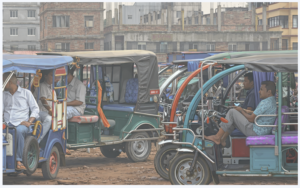
The expansion of battery-powered rickshaws in Bangladesh can be seen as a triumph of green transportation, but behind the scenes, it has a very high cost to the environment. According to a report by Dhaka Tribune, the majority of these four million vehicles use lead-acid batteries that do not have a formal recycling system. Expired batteries are not treated in safe workstations, and usually, they are taken to informal workshops where they can be dismantled manually.
“Ayesha was seven years old and spent her afternoons playing on the streets in front of her family’s small house. Her mother started to observe that she was very quiet. Later, she started complaining that she had a headache, she could not keep pace with her classmates, and she was frequently too tired to play. Initially, her parents believed that it was stress or malnutrition.
But through a routine health check-up, it was found that Ayesha’s blood contained high amounts of lead. Her family was shocked. She had never played with a battery or handled factory stuff. However, a few yards down the road on the other side of their house, there were daily casual battery repairs and charging. The lead dust was fine and was deposited on the window sills, mixed with the soil, and getting into their house by open doors and ventilation.”
The children in Dhaka are experiencing a silent yet catastrophic public health emergency, as overall lead exposure to battery-powered rickshaws and unsafe recycling activities threatens to permanently affect a whole generation. A report published in the Dhaka Tribune shows that these battery-run rickshaws will release about 20 kilograms of lead per vehicle annually, and that is 800 million kilograms of lead every year flowing into our ecosystem. These toxins do not remain in the soil only; they find their way into our rivers and wetlands and find their way into the food chain in fish and crops. A recent survey conducted by ICDDRB showed a horrifying truth: the blood lead levels of children in Dhaka are almost ten times higher than normal. This uncontrolled lead exposure has now been called by experts as a cancer risk at an advanced stage, because the toxic metals, such as cadmium and mercury, are polluted into the air and water we rely on. Unless we act at once, the process of making our life easier on roads will create a lasting, poisonous mark on the health of the succeeding generation.
Heavy Metals in the Wind
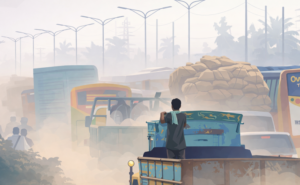 It isn’t just lead. The increasing demand of electronics and industrial products has left a huge informal recycling industry. When we discard our old phones, computers, other electronics or industrial scraps, they usually fall into the hands of workers who subject them to heat or chemicals to get the precious metals such as copper and gold. The result of this process is a cocktail of heavy metals, such as cadmium and chromium, etc., into the air. When these particles fall on the dust in our streets, they do not fade away. This poisonous dust is again released into the air during the dry season, or when a heatwave scorches the earth. Whenever we pass a motor or even a puff of wind, we are breathing the fumes of our industrial rubbish.
The unregulated waste disposal procedure of Bangladesh is also a reason for climate change.. Due to extreme flood and other natural disaster the formal waste colletion sytem collapse and trash piles up on the street corners and canals. To dispose these waste people usually open burn plastics, synthetic cloths and also electronic waste. . This emits dioxins and other very cancer-causing chemicals into the air.. This pattern of burning wastes leads urban residents face a constant cycle of exposure to harmful toxins.
At the Edge of Risk: Why Bangladesh Cannot Wait
Bangladesh is not like the other countries where such climate risks can be controlled easily. Due to our rapid urbanization, our environmental regulations are slack and our informal economies are huge. According to a study by World Population Prospects, United Nations (UN), it shows that in 2024 almost 33% of the total population live in the urban areas, whereas during liberation war of 1971 the ratio was only 8%. Around 1980s people started to move more rapidly to the urban areas, in search of better opportunities. Due to this, most of the low-income neighborhoods are located near the industrial areas. Consider an example of a street vendor working ten hours a day on one side of a busy intersection or a family in a tin-shed house on the outskirts of an informal battery recycling center. They are also the first to be exposed to the heaviest levels of pollution, they are the first to be exposed to the harshest heat, and in most instances, they are the first to lack access to healthcare in case they fall ill. To them, bad air is not a number on a smartphone; it is a daily menace to their existence. This makes air pollution a public health inequity.
Bangladesh is particularly prone to this due to the fact that our environmental policy is still lagging behind our economic development. We are creating the future faster than ever, but we are abandoning our safety nets for the environment. To make the situation better, what we must change is not only stricter air monitoring, but a more interrelated approach. The policy on climate, transport planning, waste management, and public health cannot be considered as separate sectors. The use of cleaner energy, recycling of batteries in a safer manner, regulation of industrial emissions, and protection of the informal workers should be included in the climate action plans.
Meanwhile, cities should have an early warning system of heat and air pollution to ensure that individuals take preventative measures. Communities and schools must have awareness programs to learn about such hidden dangers as lead and toxic dust. By cutting down on pollution, we can save human life and the climate. We must develop clean air policies, which will be helpful for lower disease rates and slow global warming at the same time. Our current decisions will either make our cities healthier and resilient or unsafe to our future generation.
References:
- https://www.dhakatribune.com/bangladesh/401230/millions-of-battery-vehicles-fuel-power-theft
- https://theclimatewatch.com/dhaka-children-face-lead-poisoning-linked-to-e-rickshaws/
- https://www.edf.org/health/how-are-our-air-and-climate-connectedWorld Urbanization Prospects, United Nations (UN),
https://data.worldbank.org/indicator/SP.URB.TOTL.IN.ZS?locations=BD