By Professor. Rumana Huque
Bangladesh has committed itself to achieving universal health coverage (UHC), ensuring that everyone can access necessary health services without suffering financial hardship. Yet, out-of-pocket payments continue to finance most healthcare, forcing families to borrow money, sell assets, or forego treatment altogether. Recognising this challenge, the government’s Health Care Financing Strategy identified health insurance as a key instrument to reduce out-of-pocket spending and accelerate progress towards UHC. More than a decade later, however, the country remains at the pilot stage.
The usual explanation is that Bangladesh’s large informal workforce makes introducing social health insurance difficult. Nearly 85 percent of the workforce is employed informally, often without regular salaries, written contracts, or employer records. Traditional social insurance systems were designed for economies where payroll deductions could be collected from workers and employers with relative ease. But Bangladesh’s real challenge is not simply to figure out financing; it is also the absence of three essential foundations: a mature insurance market; a health system capable of supporting insurance; and institutions able to implement it.
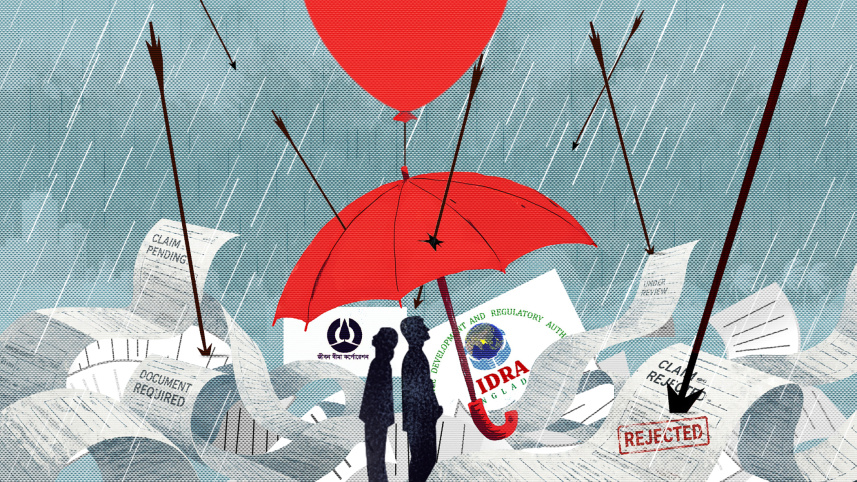
The first challenge is the insurance market itself. Insurance is dependent on trust. That is, people pay today because they believe they will receive benefits tomorrow. In Bangladesh, that kind of confidence is weak. For many households struggling to meet daily expenses, insurance remains a luxury rather than a necessity. Even among those who purchase insurance, experiences are often not encouraging. For many Bangladeshis, insurance is also synonymous with life insurance alone. Policies are typically sold by commission-based agents whose incentives favour acquiring new customers rather than ensuring existing policyholders continue paying premiums. Many policies lapse because premiums are not maintained, often without clients fully understanding the consequences. When claims are later rejected, families conclude that insurers collect premiums but avoid paying benefits. Whether justified or not, such experiences have created a deep trust deficit that inevitably extends to perceptions about health insurance.
The market reflects this reality. Insurance penetration sits at around 0.4 percent of GDP, among the lowest in South Asia, while insurance density remains only a fraction of that in neighbouring countries. Although Bangladesh has 82 insurance companies (36 life and 46 non-life insurers), only a handful actively offer health insurance and none specialises exclusively in it. Unlike India, where dedicated health insurers have developed expertise in provider contracting and claims management, health insurance in Bangladesh remains largely an extension of life insurance. Yet, illness and death are fundamentally different risks requiring different products, management, and regulation. A 15 percent value-added tax on insurance premiums also makes health insurance more expensive and discourages both households and donor-supported schemes.
A second challenge lies within the health system. Insurance finances healthcare; but it cannot create doctors, hospitals, or medicines. Unless quality services are available, insurance cards hold little value. Bangladesh’s public hospitals remain overcrowded and understaffed, while shortages of medicines and diagnostic and specialist services persist. Public facilities have limited managerial autonomy to contract with insurers, and dependable private providers remain concentrated in major cities. The lack of reliable provider networks is one of the biggest barriers to expanding health insurance.
The Philippines expanded insurance coverage through PhilHealth, yet governance challenges and continued out-of-pocket payments meant that broader coverage did not always translate into effective financial protection. In India, Kerala’s impressive health outcomes similarly rest on sustained investment in primary healthcare, education, and accountable local governance, with insurance complementing, rather than substituting for, a strong public health system. The lesson is consistent across these experiences: health insurance succeeds when paired with a capable health system, not when it is expected to compensate for systemic weaknesses.
The third, and perhaps least discussed, challenge is institutional. Health insurance is not simply another programme to be administered by the Ministry of Health and Family Welfare. It requires a dedicated organisation capable of enrolling beneficiaries, pooling funds, purchasing healthcare, negotiating with providers, processing claims, and ensuring accountability. Bangladesh currently lacks such an institutional home.
The health ministry leads health policy and service delivery, the Insurance Development and Regulatory Authority (IDRA) regulates insurers, and the Health Economics Unit develops financing strategies. But no institution has the mandate, capacity, or authority to implement and manage a national health insurance programme. Such fragmented governance has left Bangladesh with promising pilot projects but no clear pathway to scaling them nationally.
Thailand addressed this challenge by establishing the National Health Security Office (NHSO), an autonomous public purchasing agency responsible for managing the universal coverage scheme, while the country’s Ministry of Public Health retained responsibility for policy and service delivery.
Bangladesh need not copy Thailand’s institutional model, but it does need comparable governance reform. A national health insurance programme requires a clearly mandated implementing agency with the authority to purchase services, manage funds, and hold insurance providers accountable. Creating such an institution will require strong political commitment and sustained leadership from the health ministry, in close collaboration with the finance ministry, the insurance regulator, and both public and private healthcare providers. This needs to be accompanied by restructuring within the health ministry and its directorates to clearly separate policymaking, service delivery, and strategic purchasing.
However, insurance-related constraints should not delay progress towards achieving UHC. The immediate priority is for the government to make a clear strategic choice on the country’s health financing model and sequence reforms accordingly. Bangladesh should first strengthen its tax-funded health system by increasing public investment in primary healthcare, improving district hospitals, accrediting both public and private providers, and expanding access to essential medicines and diagnostics without user fees.
At the same time, institutional reforms are needed to establish a dedicated purchasing authority, strengthen regulation, and improve accountability across the healthcare system. As these foundations mature, Bangladesh can gradually assess the feasibility of introducing social health insurance, beginning with groups that are easy to enrol, such as government employees and formal workers, while continuing tax-financed coverage for poorer and more vulnerable populations. This phased approach will recognise that UHC is a journey rather than a single, broad reform. The success of Bangladesh’s UHC will ultimately depend not on the financing mechanism alone, but on the political commitment towards it and related institutional reforms.
Dr Rumana Huque is professor in the Department of Economics at Dhaka University and executive director at ARK Foundation.
Originally published in the daily Star, access here