• Privacy Policy
  • Terms & Condition
  • Archive

ARK Foundation

  • Home
  • About
    • About Organization
    • Our Partners
    • Global Networks & Leadership
  • Our Team
    • Advisor
    • Executive Director
    • Research and Development
    • Research Uptake & Communications
    • Programme and Training
    • Finance and Administration
    • Data and Field Management
  • Our Work
    • Communicable Disease
    • Non-communicable Disease
    • Multimorbidity
    • Antimicrobial Resistance
    • Maternal, Newborn, Child and Reproductive Health
    • Nutrition
    • Health Systems
    • Climate Change and Environment
    • Gender, Equity and Social Inclusion
  • News & Media
    • Event
    • News
    • Blog
    • Video
    • Newsletter
  • Resources
    • Journal Article
    • Report
    • Working Paper
    • Project Brief
    • Policy Brief
    • Conference Proceedings
    • Infographics
    • Posters
  • Career
  • Contact
/ Published in Blog, News and Media

Field Reality: What We Learned While Assessing Smoke-Free Public Places

Written by: Lenik Chakma (Research Assistant)

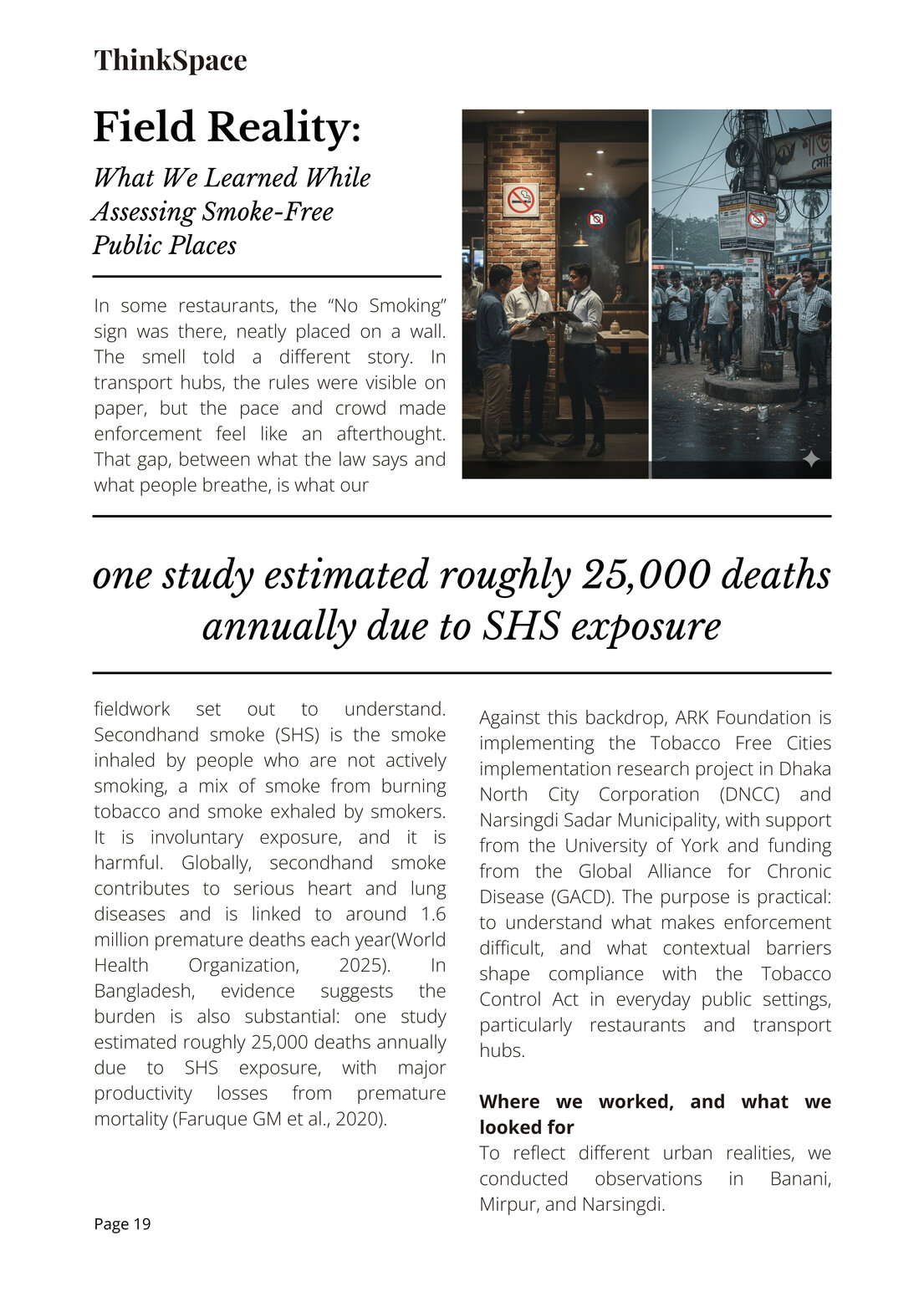
In some restaurants, the “No Smoking” sign was there, neatly placed on a wall. The smell told a different story. In transport hubs, the rules were visible on paper, but the pace and crowd made enforcement feel like an afterthought. That gap, between what the law says and what people breathe, is what our fieldwork set out to understand.

Secondhand smoke (SHS) is the smoke inhaled by people who are not actively smoking, a mix of smoke from burning tobacco and smoke exhaled by smokers. It is involuntary exposure, and it is harmful. Globally, secondhand smoke contributes to serious heart and lung diseases and is linked to around 1.6 million premature deaths each year(World Health Organization, 2025). In Bangladesh, evidence suggests the burden is also substantial: one study estimated roughly 25,000 deaths annually due to SHS exposure, with major productivity losses from premature mortality (Faruque GM et al., 2020).

Against this backdrop, ARK Foundation is implementing the Tobacco Free Cities implementation research project in Dhaka North City Corporation (DNCC) and Narsingdi Sadar Municipality, with support from the University of York and funding from the Global Alliance for Chronic Disease (GACD). The purpose is practical: to understand what makes enforcement difficult, and what contextual barriers shape compliance with the Tobacco Control Act in everyday public settings, particularly restaurants and transport hubs.

Where we worked, and what we looked for

To reflect different urban realities, we conducted observations in Banani, Mirpur, and Narsingdi. Banani represented an upscale, highly commercial area with a dense restaurant environment. Mirpur represented a mixed-income setting within a growing entertainment and commercial zone. Narsingdi provided a semi-urban comparison.

In each area, we observed restaurants (at least one hour) and transport hubs (at least three hours). We focused on a few clear indicators that any visitor would notice: whether “No Smoking” signs were present and visible, whether active smoking was observed, and whether there were clear signs of smoke exposure such as ashtrays, cigarette butts, or a persistent smell.

What the field made clear

The biggest lesson was that collecting reliable evidence in real public spaces is rarely straightforward. In restaurants, long observation periods were sometimes disrupted by peak-hour crowds and staff expectations that observers should place orders or explain their presence repeatedly. In more sensitive settings, such as shisha venues and bars, access and documentation were complicated by security and operating restrictions.

Across both restaurants and transport hubs, ethical and privacy considerations also limited photography. Even when active smoking was visible, capturing images inside premises was often not appropriate. This meant our documentation relied heavily on careful observation, structured note-taking, and consistency across data collectors.

Talking to people: the survey reality

After observations, we conducted brief interviews with restaurant owners, managers, staff, and customers to understand what they knew about the law, how they viewed it, and what they practiced in daily operations. Since each interview took 15–20 minutes, participation was not always easy. Owners and staff were often unavailable during busy hours, while customers cited time constraints, leading to refusals or incomplete interviews. Some restaurants had irregular operating hours, requiring repeated schedule adjustments.

One moment captured the “field reality” perfectly. During a visit to a restaurant near a college at around 5:00 PM, an interview with the manager was interrupted by a sudden rush of students after classes ended. The manager was the only staff member and had to switch immediately to serving customers. We could not shift to interviewing customers either, because most were uniformed students under 18 and ineligible under our ethics protocol. We returned after 9:30 PM, once the rush had passed, to complete the interview.

Why this matters

These observations are not just background details. They show how compliance is shaped by crowd dynamics, business pressures, venue type, and what is realistically enforceable in public spaces. In the field, smoke-free policy is not a checkbox. It is a series of small decisions, made in busy places, that determine whether people are protected or exposed.

Originally published in ThinkSpace Vol:1 (February, 2026)

References:

Faruque GM, Ahmed M, Huq I, Parven R, Wadood SN, Chowdhury SR, Hussain AKM G, Haifley G, Drope J, & Nargis N. (2020). The Economic Cost of Tobacco Use in Bangladesh: A Health Cost Approach.

World Health Organization. (2025). Tobacco. https://www.who.int/health-topics/tobacco#tab=tab_1

What you can read next

Tackling Antimicrobial Resistance in Urban Bangladesh |Journey Of Arts4amr|
দেশের ৪২.৭ শতাংশ জনগোষ্ঠী পরোক্ষ ধুমাপানের শিকার
A training of Field Investigators by Dr. Md. Abul Bashar Sarker

Recent Posts

  • Experts urge action as misinformation threatens vaccination efforts

    Read the report here As measles cases resurface...
  • Webinar on 𝐒𝐭𝐚𝐧𝐝𝐢𝐧𝐠 𝐰𝐢𝐭𝐡 𝐒𝐜𝐢𝐞𝐧𝐜𝐞 𝐢𝐧 𝐭𝐡𝐞 𝐀𝐠𝐞 𝐨𝐟 𝐌𝐢𝐬𝐢𝐧𝐟𝐨𝐫𝐦𝐚𝐭𝐢𝐨𝐧: 𝐏𝐫𝐨𝐭𝐞𝐜𝐭𝐢𝐧𝐠 𝐏𝐮𝐛𝐥𝐢𝐜 𝐇𝐞𝐚𝐥𝐭𝐡

     Join us for an insightful discussion: “𝐒𝐭𝐚𝐧𝐝𝐢𝐧...
  • Air Pollution is Changing: The Hidden Climate Risks We are Not Talking About

    Read the blog here or download the PDF version ...
  • mHealth intervention (mTB-Tobacco) for smoking cessation in people with drug-sensitive pulmonary tuberculosis in Bangladesh and Pakistan: protocol for an adaptive design, cluster randomised controlled trial (Quit4TB)

    Read the article here or download the PDF versi...
  • Gender differences in mental health help-seeking behaviour in Bangladesh: findings from a cross-sectional online survey

    Read the article here or download PDF version A...
  • Designing a strategic purchasing framework for urban primary healthcare services in Bangladesh: a protocol for a mixed-method study with a discrete choice experiment

    Find the article here or download PDF version A...
  • Expansion of low-price cigarette market and its implications for cigarette tax revenue: Evidence from Bangladesh

    Read the article here or download the PDF versi...
  • Engaging rural communities in Bangladesh to address antimicrobial resistance via the community dialogue approach: a protocol for a cluster-randomized controlled trial

    Read the article here or download the PDF versi...
  • Associations between sociodemographic characteristics and knowledge about antibiotics and antibiotic resistance and usage of antibiotics from a One Health perspective in rural Bangladesh: a descriptive cross-sectional study

    Find the article here or download the PDF versi...
  • Perceived barriers and the price inflating effects of informal payments in fresh food retailing in urban Bangladesh

    Find it here or download the PDF version  ...
  • Facilitators and challenges to access fresh fruits and vegetables in a low to middle income group in Bangladesh: Consumers’ perception

    Find it here or download the PDF version Abstra...
  • How prepared are urban primary care facilities to manage hypertension and type 2 diabetes in Dhaka, Bangladesh? A cross-sectional descriptive study of government urban dispensaries and NGO clinics

    Find the article here or download the PDF versi...
  • Tobacco cessation intervention for individuals with severe mental illness in Bangladesh, India, and Pakistan: protocol for a multi-country feasibility randomised controlled trial (SCIMITAR-SA)

    Read the article here or download the PDF versi...
  • When Cities Grow, Movement Shrinks: Urbanisation and Physical Activity in Bangladesh

    Find the PDF here Written by Riona Khan and S M...
  • Patient and provider perspectives of pluralistic primary care services in urban Bangladesh: a qualitative study

    Read it here or find PDF here Abstract Backgrou...
  • The Karlson-Holm-Breen (KHB) Method: Why Logistic Mediation Results Might Be Misleading?

    Read pdf here Written by Ibrahim Hasan and S M ...
  • South Asian Coalition of Policy and Evidence for Equitable food systems (SCOPE)

    The South Asian Coalition of Policy and Evidenc...
  • Fragmentation in urban health service provision? A plurality of providers is the answer

    Read it here or download PDF  Abdullah Rafi, fr...
  • International Women’s Day 2026

      When women give knowledge, care, and lea...
  • In-country public-private partnerships hold the key to promoting inclusiveness in Dutch trade and international cooperation agenda

    Read the PDF here...

Empower Your Career with ARK Foundation

Discover opportunities to make a difference in health, education, gender equality, and environmental sustainability.

JOIN US

ARK Foundation is a non-government, non-political and not-for-profit organization dedicated to the socio-economic development of Bangladesh. Through evidence-based research, training and communications it provides sustainable solutions for health, education and social development.

ADDRESS

Suite A-1, C-3 & C-4, House # 06, Road # 109,
Gulshan-2, Dhaka, Bangladesh, 1212

Phone: +88 02 55069866

Email: info@arkfoundationbd.org

LOCATION

  • GET SOCIAL

© 2025. All rights reserved. ARK Foundation.

TOP