
• Privacy Policy
  • Terms & Condition
  • Archive

ARK Foundation

  • Home
  • About
    • About Organization
    • Our Partners
    • Global Networks & Leadership
  • Our Team
    • Advisor
    • Executive Director
    • Research and Development
    • Research Uptake & Communications
    • Programme and Training
    • Finance and Administration
    • Data and Field Management
  • Our Work
    • Communicable Disease
    • Non-communicable Disease
    • Multimorbidity
    • Antimicrobial Resistance
    • Maternal, Newborn, Child and Reproductive Health
    • Nutrition
    • Health Systems
    • Climate Change and Environment
    • Gender, Equity and Social Inclusion
  • News & Media
    • Event
    • News
    • Blog
    • Video
    • Newsletter
  • Resources
    • Journal Article
    • Report
    • Working Paper
    • Project Brief
    • Policy Brief
    • Conference Proceedings
    • Infographics
    • Posters
  • Career
  • TRAINING
  • Contact
/ Published in Project Brief, Resources

Small Changes, Safer Prescribing: Lessons from a Bangladesh Public Hospital Antimicrobial Stewardship (AMS) Pilot

Project note: This article is a public summary of implementation learning from an antimicrobial stewardship pilot conducted in selected public hospitals in Bangladesh. The full academic analysis is under development for peer-reviewed publication.

Antibiotics save lives. But when they are used too often, too broadly, or without enough diagnostic support, they can make future infections harder to treat. This is the challenge of antimicrobial resistance, or AMR. In Bangladesh, where many hospitals manage high patient loads with limited laboratory capacity and medicine supply constraints, improving antibiotic use is both urgent and practical.

To help address this challenge, the Communicable Disease Control (CDC) unit of the Directorate General of Health Services (DGHS), with support from World Health Organization (WHO) Bangladesh, ARK Foundation piloted an Antimicrobial Stewardship initiative in six public hospitals across Cumilla and Dinajpur. The pilot covered three levels of care: Upazila Health Complexes, District/General Hospitals, and Medical College Hospitals.

The purpose was to test whether practical, facility-owned stewardship actions could be introduced into routine public hospital services to support safer and more rational antibiotic use.

A practical package for busy hospitals

Antimicrobial stewardship, often called AMS, means supporting health workers to use antibiotics responsibly. It is not about withholding treatment from patients who need it. It is about helping clinicians choose the right antibiotic, at the right dose, for the right duration, with review when more information becomes available.

The pilot introduced a simple, facility-based AMS package designed for real hospital settings. AMS committees were established in all participating hospitals, bringing together hospital leaders, clinicians, pharmacists, nurses, laboratory staff, and other relevant teams to review antibiotic use and discuss practical actions.

Health workers received hands-on training on antimicrobial stewardship, standard treatment guidelines, infection prevention and control, and rational antibiotic use. National standard treatment guidelines were promoted to support more consistent clinical decision-making.

One of the main activities was prescription survey and feedback. Project teams and facility staff reviewed antibiotic prescriptions and discussed findings with clinical teams in a supportive, non-punitive way. This helped create space for honest discussion and practical improvement.

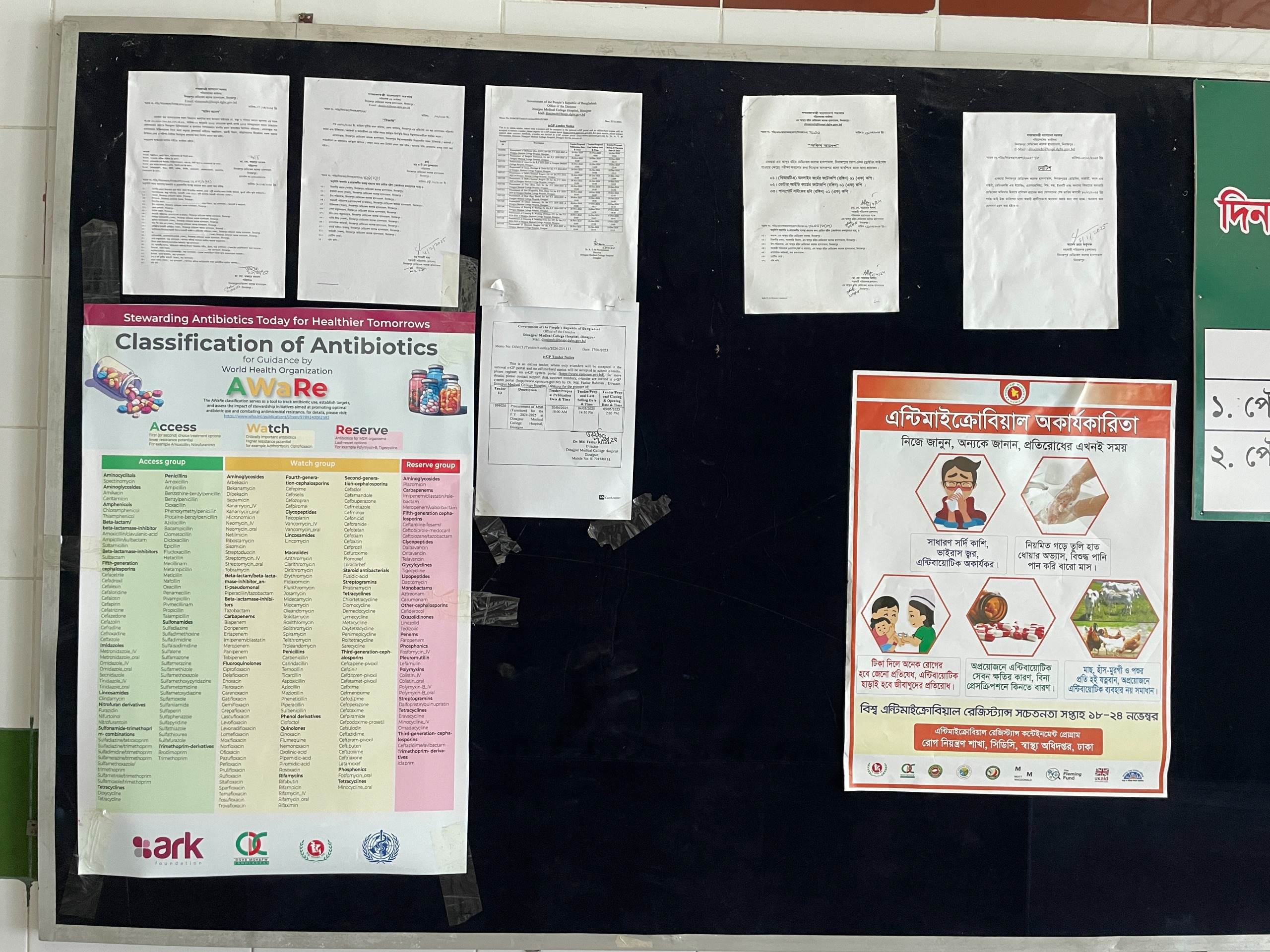
The pilot also introduced facility-level controls for selected antibiotics, including restriction and preauthorization steps for higher-risk medicines. Information, education, and communication materials were displayed in wards and staff areas as reminders of stewardship principles. Project Research Physicians supported regular follow-up, helped facilities track prescribing patterns, and provided on-the-job mentoring.

What the pilot showed

The pilot demonstrated that antimicrobial stewardship can be introduced in public hospitals using simple tools, local ownership, and regular feedback.

Across the participating hospitals, the proportion of inpatients receiving antibiotics fell from nearly three-quarters at baseline to about three-fifths by the end of the pilot. The strongest improvements were seen in secondary-level hospitals, while tertiary hospitals showed more modest change, reflecting heavier patient loads, more complex cases, and greater pressure on hospital systems.

The findings also showed that reducing total antibiotic use is only part of the story. The share of broad-spectrum Watch-category antibiotics increased during the pilot period, pointing to a major system issue: hospitals need reliable availability of recommended Access-category antibiotics if clinicians are expected to follow standard treatment guidance.

Diagnostic capacity was another major constraint. Culture and sensitivity testing remained limited, making it difficult for clinicians to shift from empirical treatment to more targeted therapy. This shows that antimicrobial stewardship cannot succeed through prescription review alone. It must be supported by better laboratory services, stronger infection prevention and control, reliable medicine supply, and routine use of prescribing data.

The way forward

Bangladesh already has national policy direction on AMR and antimicrobial stewardship. The challenge is turning policy into daily practice inside hospitals. This pilot helped show what that can look like.

Future scale-up should focus on keeping AMS committees active, continuing prescription survey and feedback, strengthening standard treatment guideline use, and ensuring that recommended Access-category antibiotics are available in hospital stores. Laboratory capacity, especially culture and sensitivity testing, also needs to be strengthened so clinicians can make more targeted treatment decisions.

Antimicrobial stewardship is not a one-time training, a committee formed on paper, or a poster on a wall. It is a hospital habit. This pilot showed that the habit can begin, even in busy public hospitals, when teams have practical tools, supportive feedback, and institutional commitment.

What you can read next

Research-Policy Forum Report : Bangladesh The Impact of the Covid-19 Pandemic on People with Severe Mental Illness and on Mental Health Service Provision in South Asia (IMPASS)
Effectiveness of involving the private medical sector in the National TB Control Programme in Bangladesh, evidence from mixed methods
Addressing antimicrobial resistance through community engagement: a framework for developing contextually relevant and impactful behaviour change interventions

Recent Posts

  • OP-ED: Bangladesh’s next health breakthrough

    A mother in a rural village should not have to ...
  • The Budget That Shrinks: How Bangladesh’s Health Allocations Disappear Over Time

    Download PDF here or read the HTML version Writ...
  • A Costly Assumption: What Every BDHS Researcher Should Know Before Combining Survey Waves

    [PDF Version]  Written by Salina Siddiqua, Dr. ...
  • 𝐘𝐎𝐔𝐑 𝐕𝐎𝐈𝐂𝐄. 𝐘𝐎𝐔𝐑 𝐂𝐈𝐓𝐘. 𝐘𝐎𝐔𝐑 𝐅𝐔𝐓𝐔𝐑𝐄.

    To carry forward the impact of 𝐖𝐨𝐫𝐥𝐝 𝐍𝐨 𝐓𝐨𝐛𝐚𝐜𝐜𝐨...
  • বাণিজ্যিক স্বার্থে নীতিগত আপস?

    বাংলাদেশ যখন তামাকমুক্ত ভবিষ্যতের দিকে এগোতে চা...
  • শ্রমিকের স্বাস্থ্য রাষ্ট্রের সম্পদ

    গত বছর প্রকাশিত বিশ্বব্যাংকের প্রতিবেদন বলছে, শ...
  • OP-ED: Quiet crisis of labour

    EVERY year, as the first of May arrives with th...
  • Adding data to Bangladesh’s DHIS2 using the Simple App

    Download the case study here or find it here De...
  • Bridging the Gap in Urban Health Journalism in Bangladesh

    Find the Policy Brief Here...
  • 𝐂𝐨𝐦𝐦𝐮𝐧𝐢𝐭𝐲-𝐥𝐞𝐝 𝐑𝐞𝐬𝐩𝐨𝐧𝐬𝐢𝐯𝐞 𝐚𝐧𝐝 𝐄𝐟𝐟𝐞𝐜𝐭𝐢𝐯𝐞 𝐔𝐫𝐛𝐚𝐧 𝐇𝐞𝐚𝐥𝐭𝐡 𝐒𝐲𝐬𝐭𝐞𝐦𝐬 (𝐂𝐇𝐎𝐑𝐔𝐒) — 𝐖𝐡𝐚𝐭’𝐬 𝐍𝐞𝐱𝐭?

    One of ARK Foundation’s major urban health init...
  • Experts urge action as misinformation threatens vaccination efforts

    Read the report here As measles cases resurface...
  • Webinar on 𝐒𝐭𝐚𝐧𝐝𝐢𝐧𝐠 𝐰𝐢𝐭𝐡 𝐒𝐜𝐢𝐞𝐧𝐜𝐞 𝐢𝐧 𝐭𝐡𝐞 𝐀𝐠𝐞 𝐨𝐟 𝐌𝐢𝐬𝐢𝐧𝐟𝐨𝐫𝐦𝐚𝐭𝐢𝐨𝐧: 𝐏𝐫𝐨𝐭𝐞𝐜𝐭𝐢𝐧𝐠 𝐏𝐮𝐛𝐥𝐢𝐜 𝐇𝐞𝐚𝐥𝐭𝐡

     Join us for an insightful discussion: “𝐒𝐭𝐚𝐧𝐝𝐢𝐧...
  • Air Pollution is Changing: The Hidden Climate Risks We are Not Talking About

    Read the blog here or download the PDF version ...
  • mHealth intervention (mTB-Tobacco) for smoking cessation in people with drug-sensitive pulmonary tuberculosis in Bangladesh and Pakistan: protocol for an adaptive design, cluster randomised controlled trial (Quit4TB)

    Read the article here or download the PDF versi...
  • Gender differences in mental health help-seeking behaviour in Bangladesh: findings from a cross-sectional online survey

    Read the article here or download PDF version A...
  • Designing a strategic purchasing framework for urban primary healthcare services in Bangladesh: a protocol for a mixed-method study with a discrete choice experiment

    Find the article here or download PDF version A...
  • Expansion of low-price cigarette market and its implications for cigarette tax revenue: Evidence from Bangladesh

    Read the article here or download the PDF versi...
  • Engaging rural communities in Bangladesh to address antimicrobial resistance via the community dialogue approach: a protocol for a cluster-randomized controlled trial

    Read the article here or download the PDF versi...
  • Associations between sociodemographic characteristics and knowledge about antibiotics and antibiotic resistance and usage of antibiotics from a One Health perspective in rural Bangladesh: a descriptive cross-sectional study

    Find the article here or download the PDF versi...
  • Perceived barriers and the price inflating effects of informal payments in fresh food retailing in urban Bangladesh

    Find it here or download the PDF version  ...

Empower Your Career with ARK Foundation

Discover opportunities to make a difference in health, education, gender equality, and environmental sustainability.

JOIN US

ARK Foundation is a non-government, non-political and not-for-profit organization dedicated to the socio-economic development of Bangladesh. Through evidence-based research, training and communications it provides sustainable solutions for health, education and social development.

ADDRESS

Suite A-1, C-3 & C-4, House # 06, Road # 109,
Gulshan-2, Dhaka, Bangladesh, 1212

Phone: +88 02 55069866

Email: info@arkfoundationbd.org

LOCATION

  • GET SOCIAL

© 2025. All rights reserved. ARK Foundation.

TOP