• Privacy Policy
  • Terms & Condition
  • Archive

ARK Foundation

  • Home
  • About
    • About Organization
    • Our Partners
    • Global Networks & Leadership
  • Our Team
    • Advisor
    • Executive Director
    • Research and Development
    • Research Uptake & Communications
    • Programme and Training
    • Finance and Administration
    • Data and Field Management
  • Our Work
    • Communicable Disease
    • Non-communicable Disease
    • Multimorbidity
    • Antimicrobial Resistance
    • Maternal, Newborn, Child and Reproductive Health
    • Nutrition
    • Health Systems
    • Climate Change and Environment
    • Gender, Equity and Social Inclusion
  • News & Media
    • Event
    • News
    • Blog
    • Video
    • Newsletter
  • Resources
    • Journal Article
    • Report
    • Working Paper
    • Project Brief
    • Policy Brief
    • Conference Proceedings
    • Infographics
    • Posters
  • Career
  • Contact
/ Published in News, News and Media

Illicit tobacco trade : Underreporting in Bangladesh perspective

Effectiveness of tobacco control initiatives is subject to the status of trade regulations of a region. As a direct effect of trade liberalisation by many countries, the world has experienced stimulation in trade volume of tobacco and tobacco products in recent years. Reduction in trade barriers might increase possibility of tobacco marketing and reduce their price causing higher consumption of tobacco. This effect of liberalisation on consumption is more prominent in low and middle income countries (LMIC) than their high-income counterparts according to researcher Taylor and Bettcher.

Similar to licit trade of tobacco validated by trade openness among countries, presence of illicit trade in the sector also enhances easy accessibility of tobacco products by undercutting tobacco prices. The extent of illicit trade, therefore, possesses a complex and pressing challenge for effective control of tobacco in any country.

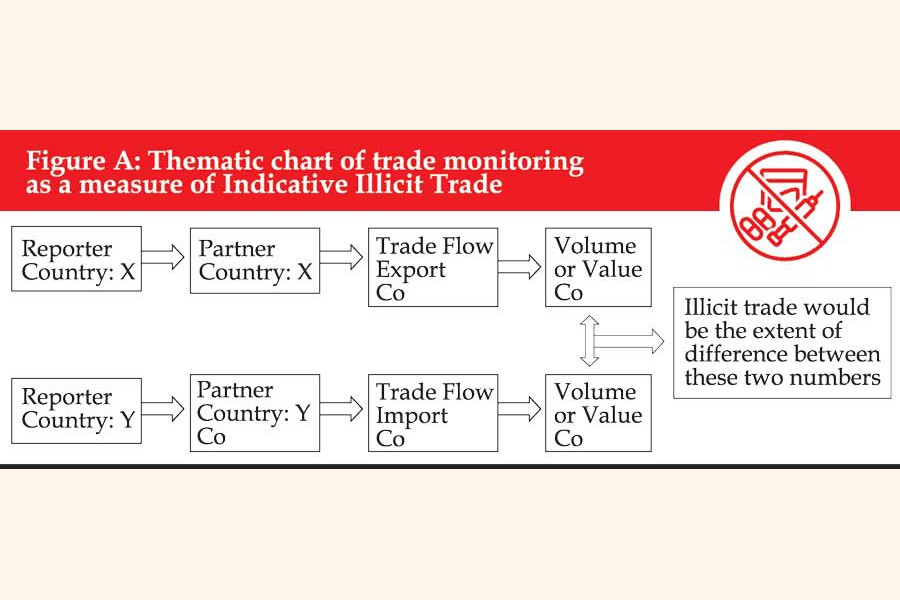
Empirical estimation of the extent of illicit trade in tobacco market often remains as an intricate task because of its stealthy nature. Tobacco researchers around the world quite often triangulate several methods to improve preciseness of measurement of magnitude of illicit trade.

In 24 November 2019, reputed researcher Dr. Rumana Huque, SM Abdullah (Faculty members at Department of Economics, the University of Dhaka) and Nahian Azad Shashi (Research associate at Bangladesh Institute of Development Studies) have written an editorial about illicit trade at business daily The Financial Express (Bangladeshi national English newspaper). Where they underlined to monitor in tobacco trade to reduce Illicit tobacco trade. And they also emphasize on tracking and tracing system for proper implementation of the FCTC protocol on illicit trade. Because it would be the key to addressing the concern over illicit supply of tobacco products. They think addressing underreporting of tobacco trade might help increasing fiscal revenue and making tobacco combat successful in Bangladesh.

To read this article in brief please click the bottom link …
Underreporting in Bangladesh perspective

What you can read next

Tackling the Overlooked Pandemic of Antimicrobial Resistance: Community Solutions To Antimicrobial Resistance (COSTAR)
Addressing the Knowledge Deficit: Health Education and Public Awareness in Bangladesh
Using Community Dialogue to tackle antibiotic resistance in Bangladesh

Recent Posts

  • Why does it matter? Childhood obesity among school going children in Urban Bangladesh: Potential Way Forward

    Read the PDF here Written by Badruddin Saify Fo...
  • How SCIMITAR-SA turns barriers into better support to quit tobacco

    Find the HTML version  SCIMITAR-SA is built aro...
  • Strengthening Tobacco Cessation Through Local Adaptation

    Find the HTML version here  WP1 focuses on adap...
  • 𝐒𝐂𝐈𝐌𝐈𝐓𝐀𝐑-𝐒𝐀 | 𝐒𝐞𝐯𝐞𝐧 𝐒𝐞𝐬𝐬𝐢𝐨𝐧𝐬 𝐭𝐨 𝐐𝐮𝐢𝐭 𝐓𝐨𝐛𝐚𝐜𝐜𝐨

    Find it here A tobacco cessation intervention d...
  • Factors associated with knowledge, attitude, practice and training interest of drug sellers in shaping antimicrobial resistance: A cross-sectional study in urban Bangladesh

    Find the PDF here  or HTML version here  ...
  • Country Case Studies on Implementation of Drowning Prevention Activities

    This study will consist of ten in-depth country...
  • Where antibiotics enter the city: what we are learning with drug sellers in Mirpur

    Written by: Asiful Haidar Chowdhury (Senior Res...
  • Closing the Gap: How Urban Primary Health Care Can Achieve Health Equity

    Written by: Marhouba Khan Asfi (Research Assist...
  • Field Reflections from CHORUS Project 1 and 2: Listening Between Appointments, Streets, and Silence

    Written by: Nabila Binth Jahan (Junior Research...
  • When Public Spaces Aren’t Truly Public: Making Physical Activity Safer for Women and Girls in Urban Bangladesh

    Written by: Umme Salma Anee (Senior Research As...
  • Addressing the Knowledge Deficit: Health Education and Public Awareness in Bangladesh

    Written by: Kazi Fatin Sami (Research Assistant...
  • Behind the Numbers: Verifying Immunization Coverage in the Rohingya Camps

    Written by: Ibrahim Hasan (Research Assistant) ...
  • Field Reality: What We Learned While Assessing Smoke-Free Public Places

    Written by: Lenik Chakma (Research Assistant) I...
  • The Hidden Tax on Health: Why Diabetes is Bankrupting Bangladesh’s Families

    Written by: Sirat-E-Rowshan Islam (Research Upt...
  • Social determinants of health (SDOH) and its relationship with clinical and economic outcomes in people with type 2 diabetes in Bangladesh

    Social determinants of health and its relations...
  • Universal Health Coverage needs more than a bigger budget. It needs institutions and skills

    As the nation is heading towards its 13th natio...
  • Developing and evaluating an adapted behavioral activation intervention for people with depression and diabetes (DiaDeM)

    DiaDeM stands for “Developing and evaluating an...
  • ThinkSpace: Quarterly Research Digest

    ARK Foundation is pleased to launch ThinkSpace,...
  • CHORUS Annual Partners’ Meeting

    The CHORUS Partners’ Meeting officially commenc...
  • আসন্ন নির্বাচনে রাজনৈতিক দলগুলোর কাছে স্বাস্থ্যখাতে প্রত্যাশা

    আগামী ত্রয়োদশ জাতীয় সংসদ নির্বাচনকে সামনে রেখে ...

Empower Your Career with ARK Foundation

Discover opportunities to make a difference in health, education, gender equality, and environmental sustainability.

JOIN US

ARK Foundation is a non-government, non-political and not-for-profit organization dedicated to the socio-economic development of Bangladesh. Through evidence-based research, training and communications it provides sustainable solutions for health, education and social development.

ADDRESS

Suite A-1, C-3 & C-4, House # 06, Road # 109,
Gulshan-2, Dhaka, Bangladesh, 1212

Phone: +88 02 55069866

Email: info@arkfoundationbd.org

LOCATION

  • GET SOCIAL

© 2025. All rights reserved. ARK Foundation.

TOP