
• Privacy Policy
  • Terms & Condition
  • Archive

ARK Foundation

  • Home
  • About
    • About Organization
    • Our Partners
    • Global Networks & Leadership
  • Our Team
    • Advisor
    • Executive Director
    • Research and Development
    • Research Uptake & Communications
    • Programme and Training
    • Finance and Administration
    • Data and Field Management
  • Our Work
    • Communicable Disease
    • Non-communicable Disease
    • Multimorbidity
    • Antimicrobial Resistance
    • Maternal, Newborn, Child and Reproductive Health
    • Nutrition
    • Health Systems
    • Climate Change and Environment
    • Gender, Equity and Social Inclusion
  • News & Media
    • Event
    • News
    • Blog
    • Video
    • Newsletter
  • Resources
    • Journal Article
    • Report
    • Working Paper
    • Project Brief
    • Policy Brief
    • Conference Proceedings
    • Infographics
    • Posters
  • Career
  • Contact
/ Published in Policy Brief, Resources

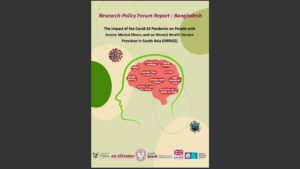
Research-Policy Forum Report : Bangladesh The Impact of the Covid-19 Pandemic on People with Severe Mental Illness and on Mental Health Service Provision in South Asia (IMPASS)

The Impact of the Covid-19 Pandemic on People with Severe Mental Illness and on Mental Health Service Provision in South Asia (IMPASS) Research-Policy Forum Workshop in Bangladesh was held on 20th June, 2022, organized by IMPASS research team at ARK Foundation in partnership with National Institute of Mental Health (NIMH). Prof. Rumana Huque, Executive Director, ARK Foundation hosted the workshop along with Dr. Helal Uddin Ahmed, Associate Professor, National Institute of Mental Health (NIMH).

Diverse group of stakeholders (22 participants) including policy makers, clinicians, researchers and academicians attended the workshop from Public, Non-Government, Development Partner’s organizations.

IMPASS Project

Severe mental illnesses (SMI) are chronic disorders (e.g. schizophrenia, bipolar disorder), which may cause considerable impairment in ability to engage in functional and occupational activities, affecting around 1% of the population, globally. Eighty percent of the SMI people die due to physical illnesses while SMI lowers life expectancy by ~10-20 years.

The IMPASS project aimed to investigate and help mitigate the impact of the Covid-19 pandemic and its response (e.g. lockdown and social distancing) on people with SMI and on mental health service provision in Bangladesh. Using our existing research collaborations and infrastructure, including a current SMI research cohort, we conducted:

  1. Surveys of people with SMI
  2. Semi-structured telephone interviews with patients, families and mental healthcare workers (in each country)
  3. Mental health facility surveys
  4. Joint stakeholder workshops, to present emerging findings, receive feedback and iteratively codesign survey/interview questions, ensuring they are responsive to the evolving pandemic and policy context
  5. Reviews of the literature on vaccination in people with SMI

Prof. Dr. Rumana Huque, Executive Director ARK Foundation did the presentation on IMPASS study.
Read the full report here

What you can read next

Perspectives on reforming the tobacco tax administration system in Bangladesh to enhance public health
In-country public-private partnerships hold the key to promoting inclusiveness in Dutch trade and international cooperation agenda
Embedded health service development and research: why and how to do it (a ten-stage guide)

Recent Posts

  • mHealth intervention (mTB-Tobacco) for smoking cessation in people with drug-sensitive pulmonary tuberculosis in Bangladesh and Pakistan: protocol for an adaptive design, cluster randomised controlled trial (Quit4TB)

    Read the article here or download the PDF versi...
  • Gender differences in mental health help-seeking behaviour in Bangladesh: findings from a cross-sectional online survey

    Read the article here or download PDF version A...
  • Designing a strategic purchasing framework for urban primary healthcare services in Bangladesh: a protocol for a mixed-method study with a discrete choice experiment

    Find the article here or download PDF version A...
  • Expansion of low-price cigarette market and its implications for cigarette tax revenue: Evidence from Bangladesh

    Read the article here or download the PDF versi...
  • Engaging rural communities in Bangladesh to address antimicrobial resistance via the community dialogue approach: a protocol for a cluster-randomized controlled trial

    Read the article here or download the PDF versi...
  • Associations between sociodemographic characteristics and knowledge about antibiotics and antibiotic resistance and usage of antibiotics from a One Health perspective in rural Bangladesh: a descriptive cross-sectional study

    Find the article here or download the PDF versi...
  • Perceived barriers and the price inflating effects of informal payments in fresh food retailing in urban Bangladesh

    Find it here or download the PDF version  ...
  • Facilitators and challenges to access fresh fruits and vegetables in a low to middle income group in Bangladesh: Consumers’ perception

    Find it here or download the PDF version Abstra...
  • How prepared are urban primary care facilities to manage hypertension and type 2 diabetes in Dhaka, Bangladesh? A cross-sectional descriptive study of government urban dispensaries and NGO clinics

    Find the article here or download the PDF versi...
  • Tobacco cessation intervention for individuals with severe mental illness in Bangladesh, India, and Pakistan: protocol for a multi-country feasibility randomised controlled trial (SCIMITAR-SA)

    Read the article here or download the PDF versi...
  • When Cities Grow, Movement Shrinks: Urbanisation and Physical Activity in Bangladesh

    Find the PDF here Written by Riona Khan and S M...
  • Patient and provider perspectives of pluralistic primary care services in urban Bangladesh: a qualitative study

    Read it here or find PDF here Abstract Backgrou...
  • The Karlson-Holm-Breen (KHB) Method: Why Logistic Mediation Results Might Be Misleading?

    Read pdf here Written by Ibrahim Hasan and S M ...
  • South Asian Coalition of Policy and Evidence for Equitable food systems (SCOPE)

    The South Asian Coalition of Policy and Evidenc...
  • Fragmentation in urban health service provision? A plurality of providers is the answer

    Read it here or download PDF  Abdullah Rafi, fr...
  • International Women’s Day 2026

      When women give knowledge, care, and lea...
  • In-country public-private partnerships hold the key to promoting inclusiveness in Dutch trade and international cooperation agenda

    Read the PDF here...
  • COVID-19 and Tobacco

    Read the PDF here  ...
  • Taxation on Sugar-Sweetened Beverages (SSBs) in Bangladesh: What should we do?

    Read the PDF here...
  • Public Private Partnership in Improving Access and Utilization of Health Care Services: Scopes, Opportunities and Challenges

    Find the PDF here  ...

Empower Your Career with ARK Foundation

Discover opportunities to make a difference in health, education, gender equality, and environmental sustainability.

JOIN US

ARK Foundation is a non-government, non-political and not-for-profit organization dedicated to the socio-economic development of Bangladesh. Through evidence-based research, training and communications it provides sustainable solutions for health, education and social development.

ADDRESS

Suite A-1, C-3 & C-4, House # 06, Road # 109,
Gulshan-2, Dhaka, Bangladesh, 1212

Phone: +88 02 55069866

Email: info@arkfoundationbd.org

LOCATION

  • GET SOCIAL

© 2025. All rights reserved. ARK Foundation.

TOP