Safeguarding policies and practices in the global health research sector are inspired and influenced by different sources and entities. In most countries, organizations form their safeguarding policies as per the law of the respective country and relevant laws of the host/donor countries they work with. While safeguarding policies are not the same in all research organizations within Bangladesh, the risks and possible dangers that await researchers and data collectors have a pattern that we need to notice, and guide all researchers accordingly to prevent harm. Whether a safeguarding issue arises within or outside the boundaries of the organization, researchers must know when and how to seek help, and who to call at the moment of need.
Research on urban health in Bangladesh has predominantly been focused on a) increasing awareness and b) accessibility of the healthcare system. As CHORUS researchers, our focus is on improving healthcare provision for marginalized groups and we design our research and tools around the health related needs and health seeking behaviors, so we spend significant time in slums, informal settlements and the healthcare centers serving these residents. However, residents of these areas have lived with insecurities and unrest for years – the slums are often not safe places for neither residents or for visitors who enter the areas, particularly if they are unknown to the locals and the intentions are not clear.
Challenges of slum areas
There are so many difficulties for residents and visitors of informal settlements and deprived urban areas which significantly increase the risk of harm; multiple studies and reports of the city administrators highlight the higher rate of crime in the slum areas in Dhaka, including violence against women and children, drug dealing, illegal consumption and supply of alcohol, smuggling, and attacks, compared to the non-slum areas of the city. Researchers maintain clear protocols and codes of ethics, but no matter how skilled a researcher and how well connected they are with communities and leaders, the possibility of harmful incidents cannot be overlooked. Mid-way through an interview, chaos can swiftly occur in the surroundings!
Slums are places with a very low standard of living due to the lack of proper sanitation, sewerage, water supply, concrete roads, pest control and other infrastructure and services. We need to ensure all these risks to researchers are considered and mitigated as far as possible, as well as any potential risk to the participants through contributing to the study.
Challenges of health care centers
When collecting data from the healthcare centers and health workers, without proper channels for raising concerns and strong back-up from city authorities, there remains chance of harsh behavior, intimidation, improper power practice and/or harassment towards staff participating in the research. This is particularly the case for female researchers when entering crowded clinics and offices. During the needs assessment phase of CHORUS Bangladesh Project-I, COVID cases were very high, there were very few (if any) visitors to the crowded healthcare centers wearing masks, presenting additional challenges to our researchers.
Initiatives to mitigate the challenges
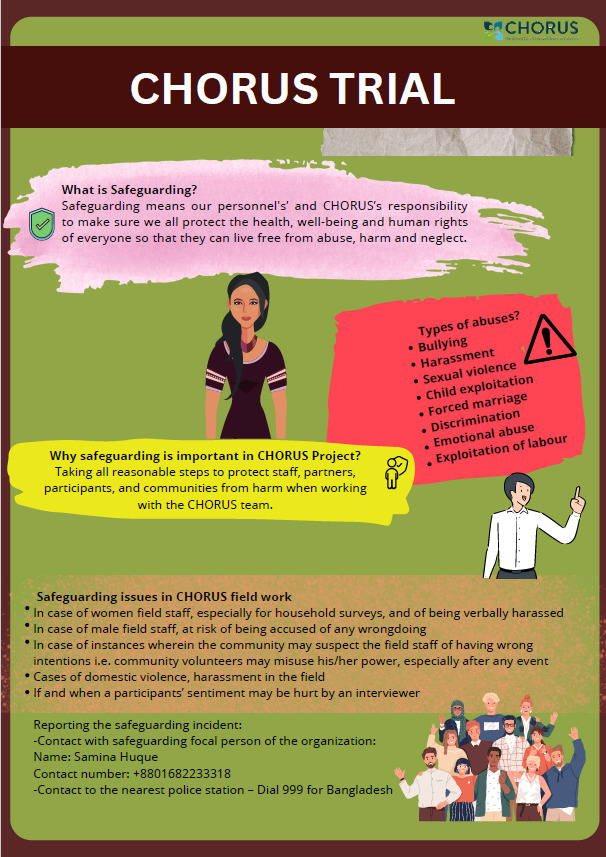
Prior to CHORUS field activities, all researchers have training on the safeguarding policies, procedures and responsibilities to make sure we impose no harm in any form on the stakeholders of the project and our study participants. We believe it is the same for all organizations in Bangladesh who send researchers to work closely with communities. Researchers also need to be fully aware of what to do if a risk or threat is imposed on them by any person or entity within or outside their place of work.
The law of Bangladesh has clear definitions in the penal codes of 1860 and penal codes for violence against women. For any attack or threat of harm, be it physically, financially or mentally, there are well defined penal codes as well, and each citizen has equal access to the police via police stations and different emergency helplines. If a researcher concerned, threatened, attacked or abused during research activities in Bangladesh, the following routes are available:
- Contact the safeguarding focal point of the organization, such as ARK Foundation, who will instigate the reporting process and escalate wherever needed.
- Contact directly the higher authority of your own or a partner organization.
- In case of emergencies, call the national helpline: 999; The national helpline for violence against women is 10921
- If researchers witness an incident or crime while working with the community, or become aware of harm on a participating community member, go to the organization safeguarding focal point, and the reporting process will be instigated. Remember, it is only your responsibility to report, you do not need to investigate. The focal points can follow the appropriate procedure. If an emergency, call 999.
- Discuss personal protective equipment requirements with your organization focal point. Risk assessments should be done prior to all fieldwork and necessary protection provided to prevent transmission of infection and other health risks.
- Know your safeguarding policies, procedures and reporting routes!
Initiatives for organizations
- Keep close communication with the safeguarding focal person and ensure they are aware of all safeguarding issues arising in the field, this will help organizations protect their employees.
- Maintain good relationships with local authorities, community leaders and resident groups, this helps prevent harm to researchers and participants. Good connections also provide reporting routes within communities.
- Build trust and confidence within organizations to assure staff that any report of a safeguarding issue or concern will be handled swiftly, responsibly, and in confidence. All staff are responsible for protecting the dignity and comfort of their workplace.
- All staff should be aware of her/his rights of safety, the organization’s safeguarding policy, and the responsibilities of themselves and others to create a positive safeguarding culture. A code of conduct and clear guideline is helpful for transparency on behaviors within organizations. Clear reporting processes are vital so all staff know how to report and what happens after making a report, for both internal and external safeguarding concerns
- Training programs should be provided, including refresher training and for new employees. In ARK Foundation safeguarding training is conducted every quarter and a summary is provided in every monthly meeting. The focal person is always available to receive concerns and provide guidance on implementing policy.Originally published in: https://chorusurbanhealth.org/blog-safeguarding-and-urban-health-researchers-in-bangladesh/