ARK Foundation has developed a new policy report highlighting critical gaps in Bangladesh’s multisectoral nutrition response and outlining practical recommendations to strengthen coordination, service delivery and nutrition-sensitive policies across government ministries.
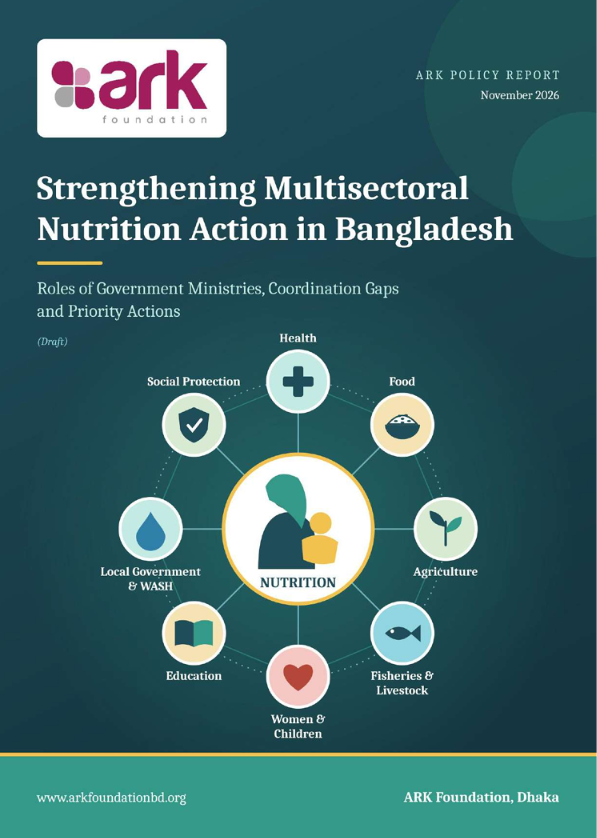
Titled “Strengthening Multisectoral Nutrition Action in Bangladesh: Roles of Government Ministries, Coordination Gaps and Priority Actions,” the report examines the nutrition-related responsibilities and activities of 22 government ministries, alongside the Prime Minister’s Office and Cabinet Division. It identifies opportunities to strengthen Bangladesh’s nutrition governance, improve public spending and integrate nutrition priorities across health, agriculture, education, food systems and social protection programmes.
Bangladesh’s Nutrition Challenges: Progress and Persistent Gaps
Bangladesh has made considerable progress in reducing child undernutrition. According to the Bangladesh Demographic and Health Survey 2022, stunting among children under five declined to 22.5%, meeting the target established under the Second National Plan of Action for Nutrition (NPAN2).
However, significant challenges remain. Child wasting persists at nearly 10%, approximately 29% of women of reproductive age experience anaemia, and 36.5% of women are overweight.
The report highlights that addressing these interconnected challenges requires action beyond the health sector. Food affordability, agricultural production, social protection, education, water and sanitation, and food safety regulations all influence nutrition outcomes.
Key Findings: Coordination and Delivery Gaps
The report identifies several institutional and policy challenges affecting Bangladesh’s nutrition response.
While the Ministry of Health and Family Welfare, Ministry of Food, and Ministry of Women and Children Affairs lead major nutrition-related interventions, several other ministries primarily undertake activities that indirectly influence nutrition outcomes.
The report also highlights gaps in coordination and accountability. The Second National Plan of Action for Nutrition (2016–2025) has concluded, while its proposed successor, NPAN3 (2026–2035), had not yet been adopted at the time of the review. Meanwhile, the Bangladesh National Nutrition Council (BNNC) faces institutional capacity constraints, and nutrition coordination committees at district and upazila levels remain insufficiently active.
Further challenges include disruptions to essential nutrition services, limited integration of nutrition objectives into major food and cash transfer programmes, inadequate tracking of nutrition-related government expenditure, and gaps in enforcing food safety regulations.
Policy Recommendations for Strengthening Nutrition Governance
To address these challenges, the report proposes a coordinated set of policy and programme priorities:
- Strengthen national nutrition governance: Adopt a costed NPAN3 with clearly defined ministerial responsibilities, measurable indicators and dedicated budget allocations.
- Improve multisectoral coordination: Strengthen the BNNC and revitalise district and upazila nutrition coordination mechanisms to improve implementation and accountability.
- Protect essential nutrition services: Ensure uninterrupted delivery of vitamin A supplementation, micronutrients, maternal and child nutrition services, and community-level nutrition interventions.
- Make social protection more nutrition-sensitive: Integrate nutrition counselling, growth monitoring and fortified foods into existing food distribution and cash transfer programmes.
- Improve nutrition financing and monitoring: Introduce nutrition budget tagging, publish an annual multisectoral nutrition budget statement and establish a shared nutrition information system.
- Promote healthier food environments: Strengthen enforcement of trans-fat regulations, introduce front-of-pack nutrition warning labels and consider stronger health taxes on sugary drinks.
The report also outlines opportunities to improve school feeding, adolescent nutrition, agricultural diversification and workplace nutrition, drawing on relevant international experiences.
Advancing Evidence-Informed Nutrition Policies in Bangladesh
Strengthening nutrition outcomes requires coordinated action across government institutions, supported by adequate financing, measurable commitments and effective implementation mechanisms.
By mapping existing responsibilities and identifying practical opportunities for improvement, this report aims to inform policy dialogue and support more integrated, accountable and evidence-informed nutrition programming in Bangladesh.
The report was prepared by Prof. Rumana Huque, Executive Director of ARK Foundation, and Md. Badruddin Saify, Research Associate at ARK Foundation.
Read the full report: Strengthening Multisectoral Nutrition Action in Bangladesh: Roles of Government Ministries, Coordination Gaps and Priority Actions.
Publication note: This November 2026 report is a draft shared for early access. Its findings and recommendations may be revised following consultation, validation or final publication.