Find it here or download the PDF version Abstract Objective To explore challenges and barriers faced by vulnerable women and men in accessing fresh foods, and how they overcome existing barriers to healthier dietary improvements in households and communities. Study design This study employed an explorative qualitative research design. Methods Using purposive sampling through a
- Published in Journal Article, Resources
No Comments
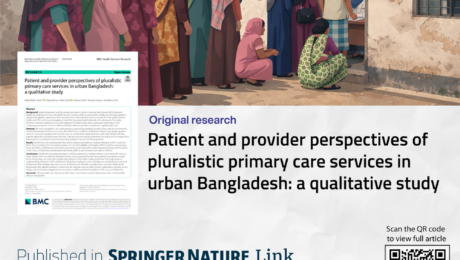
Find the article here or download the PDF version Abstract Background In urban Bangladesh, rapid urbanisation is increasing the prevalence of hypertension (HTN) and type 2 diabetes (T2D). The plurality of providers, often with minimal public provision, adds complexity. We aimed to evaluate how well two categories of primary health care (PHC) facilities for poor
- Published in Journal Article, Resources
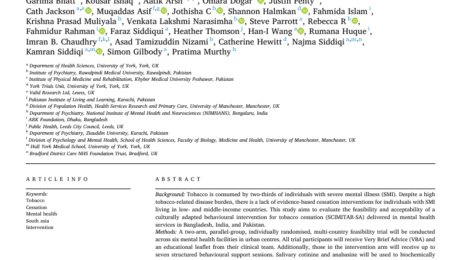
Read the article here or download the PDF version Abstract Background Tobacco is consumed by two-thirds of individuals with severe mental illness (SMI). Despite a high tobacco-related disease burden, there is a lack of evidence-based cessation interventions for individuals with SMI living in low- and middle-income countries. This study aims to evaluate the feasibility and acceptability
- Published in Journal Article, Resources
Read it here or find PDF here Abstract Background Rapid urbanisation and the growing prevalence of non-communicable diseases (NCDs) present significant challenges for low- and middle-income countries (LMICs). Among these, Dhaka, the densely populated capital of Bangladesh, experiences these pressures more intensely than most. As a result, the city’s public primary health care (PHC) services are
- Published in Journal Article, Resources
- Published in Policy Brief, Resources
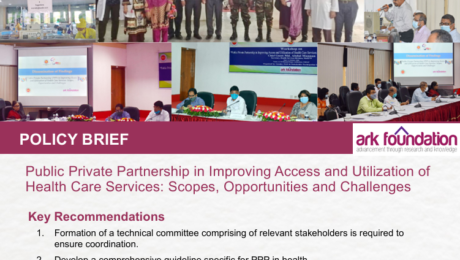
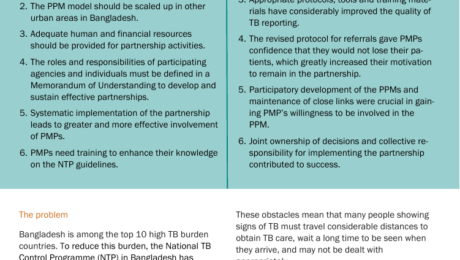
Read the PDF here Policy messages: TB case notification can be increased by involving a small number of Private Medical Practitioners (PMPs) in selected areas. This makes scale-up feasible, as training in using the Public-Private Mix (PPM) model does not have to in-clude all PMPs in the area. The PPM model should be scaled up
- Published in Policy Brief, Resources
Read the PDF here Using a public-private partnership model is appropriate for both family planning healthcare providers and clients. This model is effective in increasing the use of long acting contraceptive methods. Implications and recommendations Orientation and hands on training of the private medical practitioners (PMPs) to family planning services and methods can result in
- Published in Policy Brief, Resources