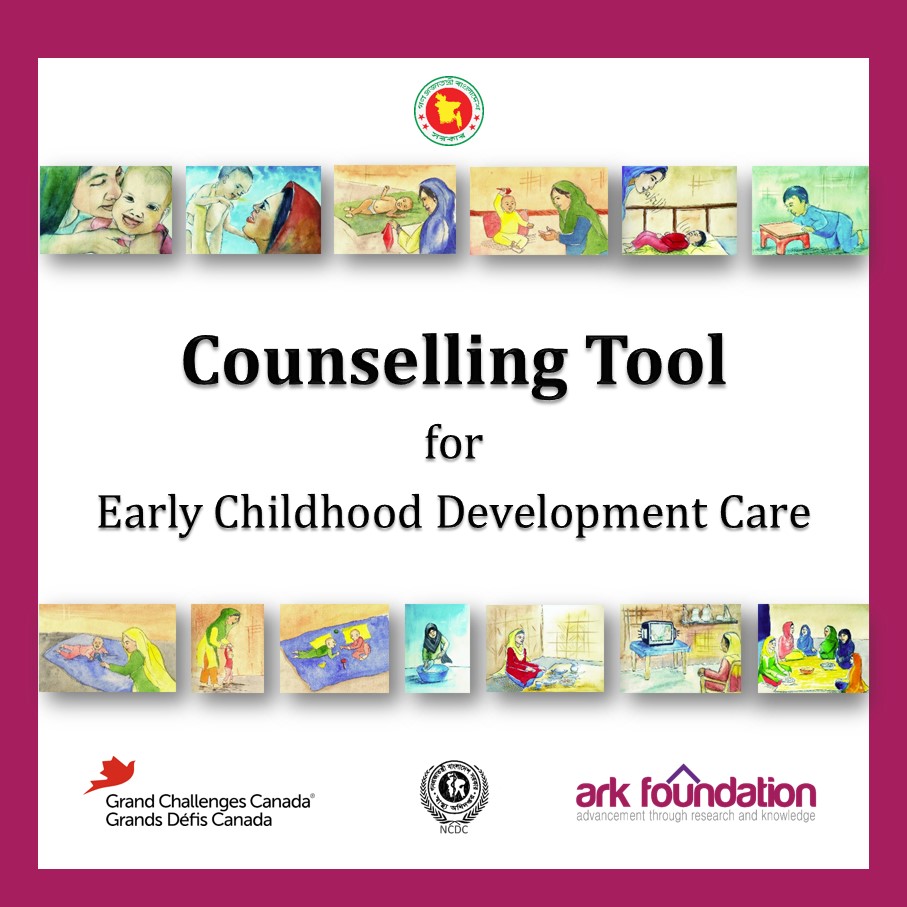
 Background of the study:
The early childhood period is the basis for later success in life. It is the time when a child’s brain develops at a rapid rate creating plenty of opportunities for children’s learning and development. A child can have a good start in life when he/she grows up in a nurturing and stimulating environment that meets his/her essential needs such as nutrition, health, and safety, as well as the psychological, social, spiritual, and intellectual needs. This also means that the child has a greater chance of reaching his/her full potential later in life. Therefore, it is important to address children’s needs holistically because the absence of one or more essential needs can lead to negative developmental outcomes for children. Each and every child has a right to early
childhood development (ECD). The United Nations Convention on the Rights of the Child Article 6 (Article 6, UNICEF) highlights that the child has “a right to live…and develop healthy” and that every child has “the right to a standard of living that is good enough to meet their physical and mental needs” (Article 27, UNICEF).
Many of Bangladesh’s 61 million children suffer from malnutrition and lack appropriate
stimulation and early learning opportunities. About two fifths of the country’s children younger than five years old have stunted growth and about a fifth of newborns have low birth weights. In addition, about half the two-year-olds in Bangladesh are well below international height standards and about a third are severely underweight.
As of February 2018, the United Nations estimates that almost 1 million Rohingya refugees have fled Burma’s violent campaign of ethnic cleansing (4). Almost universally, they’ve moved into refugee settlements in Cox’s Bazar, Bangladesh.
This has caused a strain to Bangladesh, which has sheltered a remarkable number of people in just six months, leading to desperately cramped conditions in the camps. Air pollution in Ukhia and Teknaf has increased because of smoke from firewood burned by refugees and exhaust from thousands of trucks, jeeps, and cars bringing people and goods into the camps.
The refugees have changed the demographics of Bangladesh’s Ukhia and Teknaf areas, where Rohingya now outnumber locals 2 to 1.Of the approximately 900,000 Rohingya, 73 percent are living in new spontaneous settlements, 13 percent in makeshift settlements, 9 percent among host communities, and 5 percent in formal refugee camps.
More than 48,000 Rohingya infants are expected to be born in Bangladesh this year and would be exposed to different diseases and malnutrition since birth that might cause untimely death by five, warns Save the Children. According to the Needs and Population Monitoring Report, approximately 4.9 percent or 42,516 women of the total Rohingya population in Bangladesh (867,673) are pregnant. It is estimated that 15 percent of them will suffer miscarriage, meaning there will be an estimated 4,015 live births per month or 48,184 live births in 2018, Save the Children says. Children make up approximately 58 percent of the 655,000 Rohingyas, who fled violence in Rakhine of Myanmar to Bangladesh since late August last year. “We’re expecting about
130 live births per day in 2018. Most babies will likely be born at home in basic tents, in part because of the shortage of quality, 24-hour health facilities able to handle and manage basic emergency obstetrics, as well as challenges accessing healthcare,” said Rachael Cummings, the aid group’s health advisor in Cox’s Bazar.
Comprehensive early childhood care provides a strong foundation for good health, growth, and success in education, according to global evidence. Education is important for early learning and to prepare children for a better interactive youth years. It motivates and prepares children to attend primary school, provides parents with information about new approaches to education and prepares them to support their children’s growing experience.
Purpose:
The aim of the study is to develop an contextualize and evaluate an intervention for communitybased child development and maternal depression care in refugee camps.
Materials and Methods:
The intervention materials (i.e. provider training and mother counseling) will be contextualized and evaluated for delivering similar care in Bangladesh refugee setting. A cluster randomized trial, process evaluation and costing study will help knowing its effectiveness and feasibility in refugee setting. This adaptation, through a locally constituted technical working group, will take into account the technical, social, economic, and management support considerations for delivering child development and mental health care in a refugee camp setting.
We propose to evaluate the effectiveness (rather than efficacy) of a contextualized intervention, under potentially replicable circumstances in the refugee setting. A cluster randomized trial will have a total of 696 mother-child pairs in 22 clusters, randomly divided into equal number of intervention and control clusters. The mother-child pairs will get registered in the trial when the newborn child is less than 6 weeks old; and will be followed up, on quarterly basis, till the child gets one year old i.e. when the outcome measurements for child development and maternal mental health will be done.
We will also evaluate the feasibility of delivering child development and maternal mental health care, through community based care providers, in the refugee setting. The feasibility assessment will have a process-evaluation component to learn about the provider and consumer experiences of the intervention; and a costing study to assess the financial implications of replicating the intervention.
The clinic-based counseling intervention covering child stimulation, nutrition, and maternal mental health was delivered mainly by clinic assistant to mothers at ≤6 weeks, 3, 6, and 9 months of the child’s age. At 12 months of child age; each mother-child pair will be assessed for: the primary outcome, delays in the five development domains (ASQ-3 scores), and secondary outcomes, prevalence of stunting and maternal depression (PHQ-9 score). The outcome assessors will be blinded to the cluster-arm allocation. Outcome analyses will be calculated on cluster-level.
Procedure:
All children less than 6 weeks of age will be screened for eligibility, based on agreed
inclusion/exclusion criteria. The mother of each eligible child will be informed about the ECD care trial; and asked for consent to participate. Those who consent will get recruited in the trial, while those who refuse will receive the same care but their data will not be included in the trial. The ECD care will be delivered, at respective homes, by trained refugee women from the same camp. The care package will include mainly: a) child brain development and nutrition counseling; and b) mother depression assessment and care. At the end, home-based measurement of the outcomes will be arranged/ conducted for all registered children and their mothers. The outcome
measurement (when child gets 12 month old) will include: a) child brain development with ASQ-3; b) child physical growth i.e. weight and length; and c) mother depression with PHQ-9. These measurements will require 30-45 minutes for each mother-child pair. The quantitative data (ASQ-3 and PHQ-9) will be supplemented by semi-structured interviews with mothers, community care providers, and project staff. The quantitative and qualitative data collected on participating mothers and children will be kept confidential. This will include measures such as safe storage and restricted access to data; and using codes to identify mothers and children; and report statistics and
responses without identifying any individual. The intervention is expected to have beneficial health effect on children and mothers, without adding any potential risk to their health and wellbeing.
Potential benefit of the study:
This study will contextualize and potentially scale up implementation products available to deliver community-based child development and maternal mental health care in refugee camps. This will provide evidence of intervention effectiveness and feasibility for its possible scaling in refugee camps. This possibly may get considered for an integrated delivery of child development and mental health care at public primary health care facilities.